Oliver Bearman will make it to Miami. The bigger question after Suzuka is what Formula 1 does next.
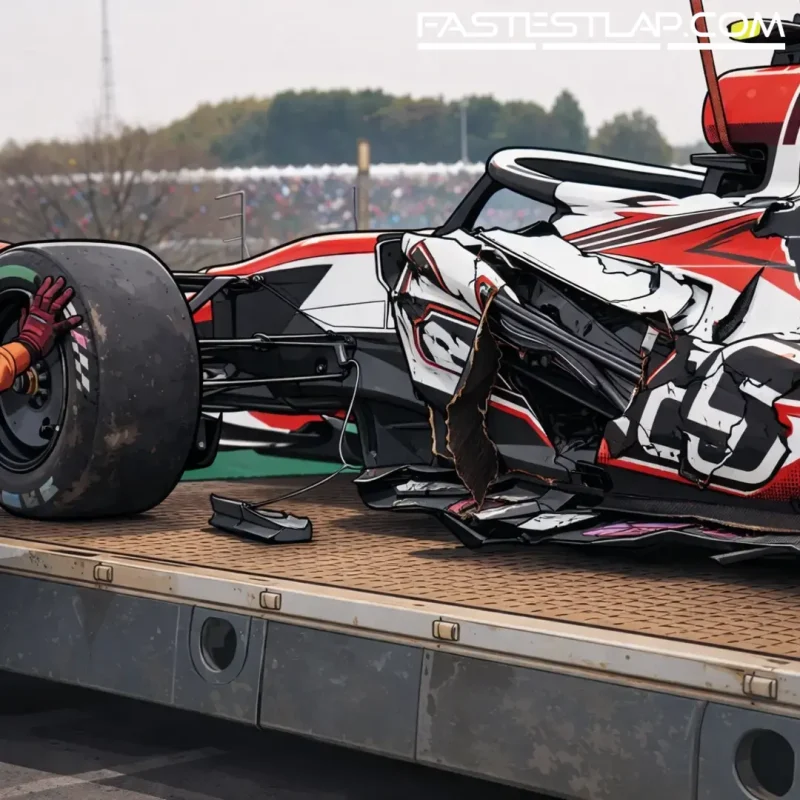
Haas expects the rookie to be “fully ready” for the next round after he walked away from a brutal 50G impact at Spoon Curve in the Japanese Grand Prix — an accident that, in an instant, turned an ordinary scrap into the clearest warning yet about the new generation of 2026 cars and the speed deltas they can create.
Bearman’s crash came while fighting Franco Colapinto for position. Approaching Spoon, Bearman arrived on the Alpine far quicker than expected — the closing speed was around 50km/h, with data clocking Bearman at 308km/h. Colapinto, meanwhile, was essentially repeating his previous-lap speed through the same section. The mismatch left Bearman reacting late; he jinked left to avoid contact, put the VF-26 onto the grass, then lost control and fired across the circuit in front of Colapinto before hitting the barrier sideways.
It was the kind of impact that hushes a paddock even in an era that’s grown used to drivers climbing out of wrecks. Bearman did get out, but he couldn’t immediately put weight through his left leg and leaned on two marshals as he made his way clear. X-rays at the medical centre confirmed a bruised knee — painful, but, mercifully, not structural.
Team boss Ayao Komatsu sounded more relieved than anything when he gave his update, and you could hardly blame him.
“He is fine,” Komatsu said. “Thankfully, he’s just got a bruised knee, nothing’s broken. I’m really grateful that he came away with nothing too serious. He should be back fully ready for Miami.”
The month-long gap before Miami — extended further by the cancellations of Bahrain and Saudi Arabia — gives Bearman time to heal. But it also gives the sport time to argue, privately and publicly, about what Suzuka actually exposed.
Because this wasn’t just a driver misjudgement. It was that, plus a regulatory ecosystem that can turn small differences in deployment state into enormous differences in speed. The FIA acknowledged after the crash that increased closing speeds were a contributing factor, and drivers had already warned about exactly this scenario during the Friday evening briefing in Japan.
That’s the crux: 2026 hasn’t just changed how the cars make lap time, it’s changed how they arrive at corners relative to one another. With battery harvesting, “super clipping” near the end of straights, and varying power modes, two cars can look stable and predictable in isolation but become a nasty equation when they converge at 300km/h. One driver effectively becomes the moving chicane without doing anything “wrong”, while the other suddenly has to make a split-second decision based on assumptions that no longer hold.
The sport has been here before in different forms — DRS trains, tyre delta chaos, even the early hybrid-era deployment games — but the immediacy of Bearman’s crash will sharpen the conversation. When the FIA itself points to the closing-speed issue, the debate stops being theoretical and turns into a question of what can realistically be fixed without unpicking the entire philosophy of the new rules.
There are already calls in the paddock for changes, and it’s easy to see why. Spoon is not a place where you want uncertainty about what the car ahead is doing, or how quickly you’ll arrive on it. It’s also not a corner where a last-ditch swerve onto the grass is ever going to end well.
Komatsu, though, is pushing back on the temptation to swing the regulatory hammer immediately — and his caution is worth listening to, even as the sport searches for answers.
“We’re looking at it from all dimensions because, when we make changes, we’ve got to make the correct ones,” he said. “We cannot be making knee-jerk reaction changes and then a few races later be saying: ‘That was the wrong option.’”
What’s striking is the tone: less tribal, more collective. Komatsu pointed to an unusually open working relationship between teams, F1 and the FIA as they dig into the problem. That might be the most encouraging part of the whole episode, because the solution — whatever it becomes — will almost certainly require compromise. And in Formula 1, compromise rarely arrives without bruising a few egos.
For Haas, the immediate priority is simpler. Bearman’s confidence will matter as much as the swelling on his knee. A 50G hit has a way of sticking in your peripheral vision the next time you turn in at high speed, and Miami will come with its own set of pressures: a high-profile event, a street circuit, and a young driver returning after the kind of crash that instantly defines highlight reels.
Still, Bearman is going back racing, which is the part that would’ve felt impossible not that long ago. The sport can take the win on safety — but it can’t ignore the message. Suzuka didn’t just bite a rookie. It showed everyone where 2026’s sharp edges are, and how quickly they can cut.