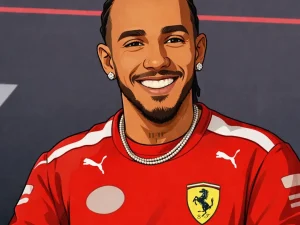
Lewis Hamilton doesn’t sound like a man arriving for a second season at Ferrari determined to simply “do better”. He sounds like someone who’s stripped the whole thing back to the studs.
After a bruising first year in red in 2025 — a campaign where the story never really got going beyond one bright sprint win in China — Hamilton has spent the winter asking, in his own words, “uncomfortable questions”. Not the performative kind drivers toss out when they need a clean quote in February, but the sort that hint at a genuine internal reset: whether he’s doing enough, whether he can be better, whether his methods still fit the moment he’s in.
And, crucially, whether the weight of Ferrari has been sitting on him rather than lifting him.
Hamilton arrived at Maranello last season with the obvious dream attached: the eighth title, the record, the fairytale ending. Instead, he found a team-mate in Charles Leclerc who looked entirely at home, and a car — the SF-25 — that wasn’t built to win titles or grands prix. Leclerc still dragged it to six podiums. Hamilton didn’t stand on one. Over the full year he ended up sixth in the standings on 156 points, 86 behind Leclerc.
Those numbers matter, because Ferrari doesn’t do patience as an abstract concept. It does patience when there’s a convincing plan.
One part of that plan is already visible. Ferrari has reshuffled Hamilton’s engineering set-up for 2026, moving Riccardo Adami into another role within the company. The identity of Hamilton’s new race engineer hasn’t been confirmed yet, but the decision itself is telling: the team has accepted that the communication and working rhythm didn’t land as intended. In modern F1, that relationship isn’t a footnote — it’s the backbone of a driver’s weekends, especially under fresh regulations where everybody is learning in public.
The other part is Hamilton’s own admission that last year, the scale of what he’d taken on might have got in the way of doing the job.
Speaking to Corriere della Sera, Hamilton described his off-season in terms that sounded more like an athlete re-centering than a champion making excuses. “It’s about analysing where you are, setting goals and a way to achieve them,” he said, before acknowledging the blunt reality: “My goal last year was to win the World Championship with Ferrari, but I didn’t succeed.”
The line that follows is the one that lands. Hamilton talks about looking inward, and outward — at colleagues, family — and forcing himself to confront the uncomfortable stuff. Am I doing enough? Can I be better? Can I be kinder? How should I change my methods?
That isn’t the language of a driver who believes a switch will magically flip because a new season has started. It’s someone trying to rebuild the conditions in which he’s at his best.
Hamilton also framed 2026 as a mental clean slate, leaning on a metaphor from the Chinese calendar: the Year of the Fire Horse, representing freedom and the need to clear the mind of pressure and refocus on fundamentals. He hinted that the sense of responsibility at Ferrari — and it is different there, more cultural than corporate — can become a trap.
“When you let responsibility weigh you down, you risk losing not only yourself but also the fun,” he said. “You have to rediscover joy.”
That “joy” thread is not insignificant. In Bahrain testing, Hamilton looked notably more relaxed than he did at the tail end of 2025, when even his best attempts to put a brave face on things weren’t fooling anyone. It was still testing — still sandbagging and fuel loads and blurred lap-time truth — but the demeanour shift was obvious.
Ferrari set the fastest time of the Bahrain test, and on the surface it’s an encouraging headline for a team starting a new rules era. Hamilton was careful not to overplay it. “Little emerged from the tests; everyone hid with their fuel loads,” he said, adding that he’d even tried the old paddock trick of ringing rivals to see what they’d learned — to no avail. “I call Toto Wolff at Mercedes and Zak Brown at McLaren to try to understand what they have learned, but I get no results.”
That’s classic February mischief, but it also underlines where Ferrari is right now: optimistic, but not naïve. Hamilton’s confidence is rooted less in a headline lap time and more in a sense that the group has been through a rough year and come out tougher. “After what we went through last year, we can handle any situation,” he said. “This team has everything it takes to win; we have to get the job done together with the fans.”
It’s also impossible to ignore the competitive dynamic in-house. If Hamilton is to mount any kind of title push with Ferrari, he has to beat — or at least consistently match — Leclerc. Yet Hamilton insists he isn’t interested in turning it into a rivalry narrative that splits Ferrari’s support.
“I don’t see it that way,” he said. “My goal is not to divide the fans.” He praised Leclerc as “phenomenal” not just for speed but for “ethics”, noting the Monegasque has been there eight years. That acknowledgement matters, because Ferrari is Leclerc’s home turf in a way it will never be Hamilton’s.
Still, Hamilton is leaning on something practical rather than political: involvement. He says he’s been working on the 2026 car for 14 months, in the simulator and with engineers — a contrast to last year, when he arrived to a concept already locked in. “This car has a bit of my DNA in it,” he said. “And that excites me.”
At 41, with almost two decades of uninterrupted F1 behind him, Hamilton is still talking like someone who feels the charge of the opportunity rather than the drag of time. “Only two people in the world drive a Ferrari in F1, and I am one of them,” he said. “I am embarking on this crazy mission… trying to free myself from what has not been effective.”
That last line is the most revealing of all. 2026 isn’t being framed as a simple “bounce-back”. It’s being framed as a rewire — of process, of mindset, of the small daily things that add up to performance when the lights go out.
Ferrari have given him a fresh start in structure. Hamilton is trying to give himself one in spirit. Now comes the part he can’t talk his way through: turning that lighter, clearer version of himself into Sunday results — and doing it with Leclerc on the other side of the garage, fully aware that Ferrari is finally entering a regulation reset with a car shaped, at least in part, by Hamilton’s own hands.