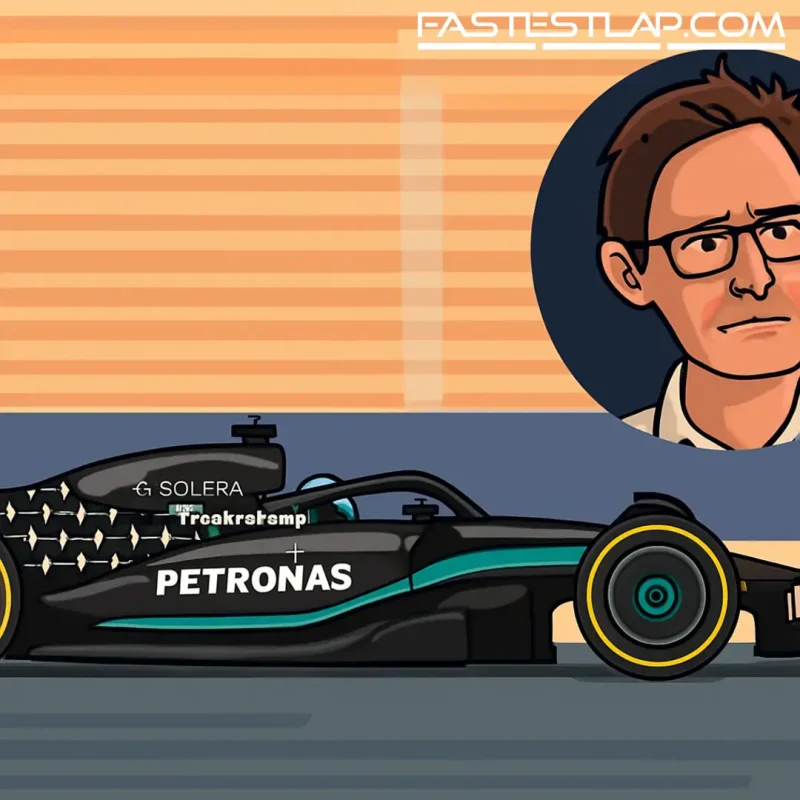
Shovlin lifts lid on the Mercedes suspension gamble that derailed their European swing
Mercedes thought they’d found a neat shortcut with a rear suspension tweak at Imola. Instead, it sent the W16 down a cul‑de‑sac that turned a promising start into a muddled middle act — and forced a mid-season U-turn before the summer break.
After opening 2025 with a competitive, all-round package in the hands of George Russell and rookie Kimi Antonelli, the team hit turbulence once F1 returned to Europe. The catalyst, as head of trackside engineering Andrew Shovlin explains, was a rear-end concept introduced at Imola that simply didn’t play nicely with the rest of the car — or with the rulebook’s mid-year shift on front wing flexibility.
“We’d been struggling to get the car to turn effectively in slow corners,” Shovlin said, reflecting on the season-ending Abu Dhabi weekend. “Some of our rear tyre temperature issues were coming from the fact the drivers were having to use the throttle to help that.”
Mercedes had previously unlocked performance by allowing the front wing to flex in a way that brought the nose into play at low speed while keeping the rear planted in quick stuff. Then came Barcelona, and a stricter FIA test that clipped those wings — literally and figuratively. “The FIA limited it, and then you’re left with a reduction in your tools,” Shovlin noted. “It took us a bit of time to readapt after those rules came in.”
With the aero crutch removed, attention swung to the mechanical platform. The paddock could see what McLaren were up to with their anti-lift philosophy, holding the rear low on entry. Mercedes’ Imola update pushed further down that path, trying to wrestle more usable rear downforce from a notoriously narrow window.
It didn’t land. “We introduced other characteristics that were quite bad,” Shovlin admitted. “We lost a bit of stiffness in the suspension that was more penalising than we’d expected. That caused us to backtrack and more or less go back to where we were at the start of the year.”
If you’re wondering why they didn’t twig immediately, look at Montreal. A 1–3 in Canada muddied the waters, masking the underlying handling gremlins as the team tried to make sense of conflicting signals. But the evidence built up across the European rounds, with drivers nursing confidence issues — too much pointy front at high speed after the wing clampdown, not enough compliance to keep the rear happy elsewhere — until the data and the seat-of-the-pants feedback finally aligned. After the Hungarian Grand Prix, Mercedes pulled the plug on the Imola spec. Russell promptly returned to the podium.
The layering of factors made the diagnosis messy. Alongside the front wing clampdown, Mercedes were probing aggressive setup territory to recover balance. “You can try to achieve [the balance] mechanically by effectively softening the rear axle as the car goes faster, or softening it in roll, which gives you an understeer balance,” Shovlin said. “But your tools are quite limited, and it also takes a bit of time. Even the drivers are adapting to that different balance… and in and around the same time, we had the updated suspension coming on and off the car. The combination of the three just led to quite a confusing European season.”
There’s a silver lining here, and Mercedes know it. The experiment came mid-season, not baked into the launch car. “If you launch with something, it’s a far harder challenge to unpick it,” Shovlin said. “Introduce it mid-season and you suddenly see the car is not handling the same way… it’s quite easy to spot that you need to revert. In a way, it was a blessing that we hadn’t introduced the Imola suspension for winter testing.”
The wider lesson is familiar to anyone following the sport’s current rules cycle. These ground-effect cars reward stiffness and punish excess movement, which means trade-offs are brutal. “You end up with a really narrow window for rear downforce, so you have to run the thing stiff,” Shovlin explained. “When you get a circuit with a range of very low and very fast corners, you’ve got to compromise it. As you slow them down, you don’t get a natural balance shift like we used to in the previous regs, because the car doesn’t move a lot.”
Mercedes have rarely had the outright fastest car since 2022, and Shovlin didn’t duck that reality either. The team began this regulation era on the back foot, and the transition from their 2020–21 strengths wasn’t seamless. “We clearly didn’t put enough effort into making sure we kept the goodness of the 2020/21 cars and brought it in on these,” he said. Now, with everyone lapping at broadly similar corner speeds, advantage comes from how well a car’s balance suits a given circuit — and how deftly a team can pivot when the rulemakers slam a window shut.
This time, the pivot took a few painful weekends, a bin for a shiny new suspension, and a reminder that shortcuts rarely are. But it also brought clarity. And for a team trying to shove its way back to the front, clarity beats confusion every time.