Twenty years on, the 2006 season still reads like the last great power shift of F1’s previous age — not because of a single rule change or one decisive Sunday, but because the sport’s centre of gravity moved in real time. One era didn’t so much end as get nudged off its perch.
It’s easy, with hindsight, to file 2006 away as “Schumacher’s Ferrari farewell” and “Alonso’s back-to-back”, neat and symmetrical. It wasn’t neat at all. It was messy, political in that very F1 way, and full of the small technical and organisational tremors that end up deciding championships.
By then Michael Schumacher was already a monument: the only seven-time world champion, the axis around which Ferrari had built a machine that flattened the field. From 1999 through 2004 Ferrari took six straight Constructors’ titles, and Schumacher collected five Drivers’ crowns in that run. It wasn’t simply dominance; it was a system.
Then Renault broke it in 2005, helped along by tyre regulations that swung the advantage toward Michelin. Schumacher and Ferrari were suddenly mortal, and 2006 became the revenge tour — until it became something else entirely.
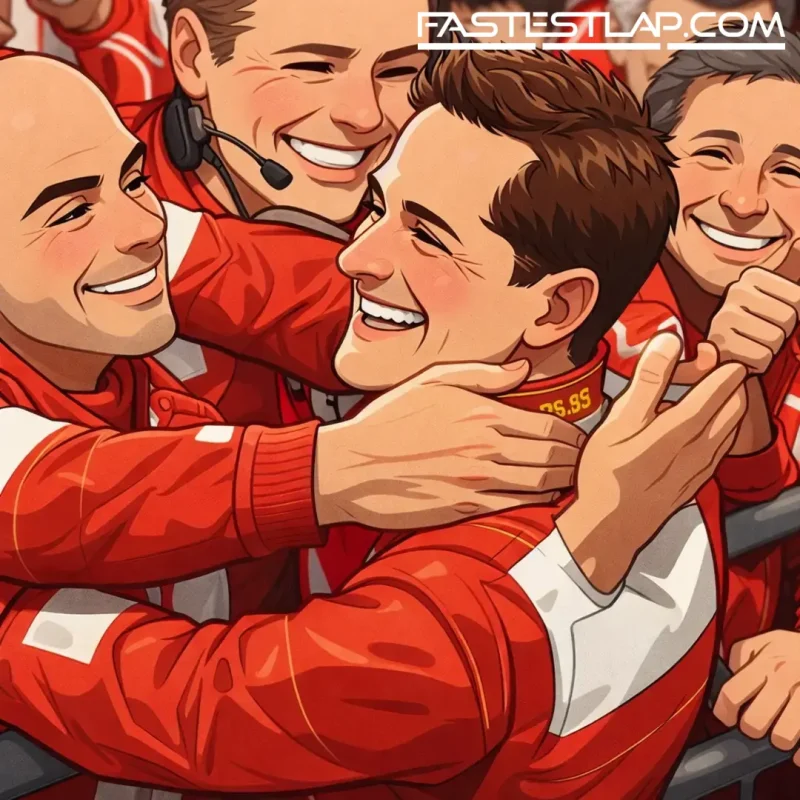
Renault’s own season was destabilised when its mass damper solution was banned mid-year by the FIA, and the knock-on effect was immediate. Ferrari, with Schumacher in full chase mode, began to look less like a fading empire and more like an empire that had been briefly inconvenienced. When Schumacher won the Chinese Grand Prix — his 91st and, as it turned out, final victory — he grabbed the lead of the Drivers’ Championship. It felt, in the moment, like the old order had one more bite.
But the twist was that the title fight was no longer the only story. Everyone in the paddock knew Schumacher wouldn’t be in the car the following season. The championship lead came with an odd sense of finality, as if Ferrari were sprinting to a finish line they hadn’t chosen.
The public punctum was Monza. Schumacher won on Ferrari’s holy ground, then used the post-race press conference to announce he’d retire at the end of the season. Luca di Montezemolo, Ferrari’s president and CEO at the time, framed it as Schumacher’s choice and admitted sadness at the decision.
Yet the longer 2006 receded, the less clean that narrative looked. Reports since have pointed the finger back at di Montezemolo as the force that ultimately pushed Schumacher out — a reminder that even in an organisation built around one driver, succession planning eventually stops being a rumour and becomes an action. Ferrari have always been ruthless about the future; they just prefer to wrap it in romance.
Schumacher stepping away created a vacancy that mattered far beyond the driver market gossip. It opened the door for Kimi Räikkönen, and with that came a change in Ferrari’s temperament. Räikkönen went on to win the 2007 Drivers’ Championship — still the most recent time Ferrari have had a world champion in their car — but the Schumacher era’s core truth remained: Ferrari weren’t just losing a driver, they were losing the keystone that held the whole architecture in place.
On the other side of the garage door, Fernando Alonso’s 2006 now looks almost surreal in 2026 terms. It’s twenty years since he won his second — and, so far, last — world championship, fending off Ferrari’s late surge despite a Renault that was no longer the class-leading weapon it had been. That he’s still on the grid two decades later, still spoken about as a top-line talent as he approaches 45, only sharpens the peculiar frustration of his record: two titles, when plenty in the paddock have long believed his ability warranted more.
Alonso leaving Renault for McLaren after 2006 set off the chain of career choices that people still argue about. He’s had returns to Renault and McLaren, a stint at Ferrari, a sabbatical, and now Aston Martin — a résumé that reads like a tour of modern F1’s biggest “what ifs”. If Schumacher’s 2006 is remembered as a forced ending, Alonso’s is remembered as the moment his story should have become something bigger than it did.
The rest of 2006, too, was full of turning points that only grew more significant with time. Jacques Villeneuve’s F1 career reached the end of the road; replaced mid-season by Robert Kubica, he called it time to get on with the rest of his life. Nico Rosberg debuted, a first chapter in a career that would eventually make him a world champion. And Toro Rosso was born after Red Bull’s takeover of Minardi — a move that, in retrospect, reshaped the sport’s talent pipeline. That team is now Racing Bulls, but its role as a proving ground for the likes of Sebastian Vettel and Max Verstappen is part of F1’s modern fabric.
That’s why 2006 still matters in 2026. Not because nostalgia is irresistible — though it is — but because it was the year F1 showed how quickly the ground can shift under even the most entrenched power. One regulatory decision, one boardroom push, one driver’s timing, and suddenly the sport is telling a different story.
Schumacher’s final Ferrari win in China and his Monza retirement announcement are the obvious images, the ones you can frame. The deeper legacy is what sat behind them: the moment Ferrari had to imagine itself without Schumacher, and the moment Alonso proved that even when the battlefield changes mid-campaign, a champion can still hang on.