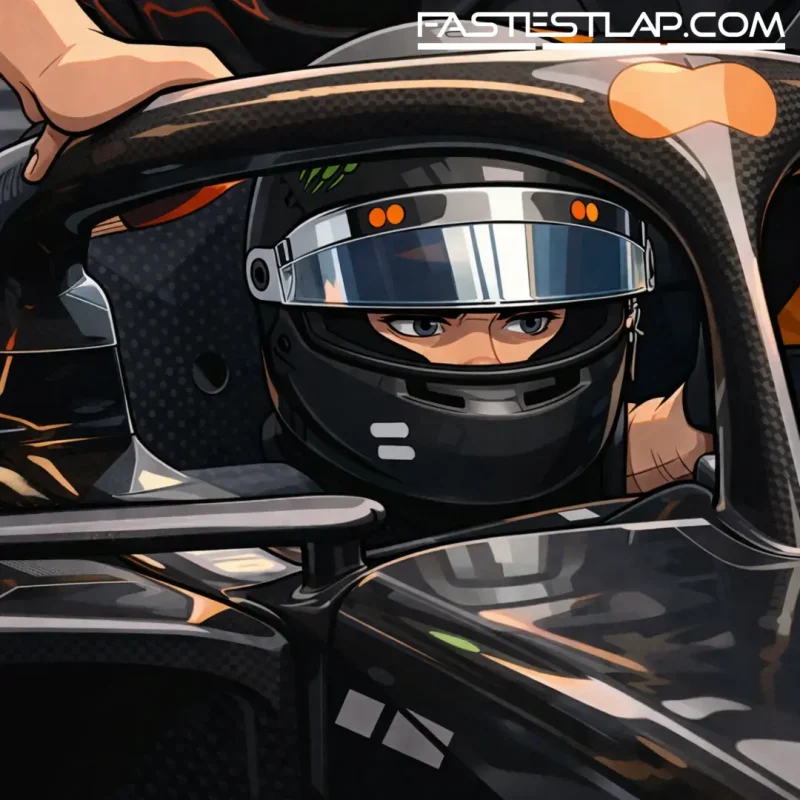
Lando Norris has seen enough winters in Formula 1 to know how quickly a paddock can talk itself into – or out of – a season before the racing’s even started. So when McLaren rolled out late at the Barcelona shakedown and left with fewer laps and a slower headline time than Mercedes and Ferrari, the reigning world champion wasn’t biting.
“It’s so easy to get caught up into comparisons,” Norris told F1TV, pushing back on the urge to read too much into the first public-ish mileage of the new era. With 2026’s reset cars still in their infancy, he’s treating the stopwatch as background noise and the data as the real prize.
McLaren’s approach to the five-day Circuit de Catalunya shakedown underlined that mindset. The team opted to run on the final three days only – the maximum permitted – having signalled beforehand it wanted “as much time as possible for development” before committing the MCL40 to the circuit. That decision inevitably made their programme look conservative on paper next to rivals who banked early laps.
Norris took Wednesday and completed 76 laps before handing the car to Oscar Piastri for Day Four. Across the three days, McLaren ended on 291 laps. Mercedes, by contrast, logged a benchmark 500, with Ferrari second on 442. In a winter where everyone is effectively discovering the limits of a new rulebook in real time, that kind of mileage matters – but mostly in what it unlocks back at the factory, not what it suggests on a timing screen.
The same applies to the lap times that inevitably grabbed attention. Ferrari and Mercedes traded the quickest runs of the week, with Lewis Hamilton’s 1:16.348 on the final afternoon edging George Russell’s best by a tenth. Norris was third overall on a 1:16.594, 0.246s off Hamilton.
It’s the sort of gap that would spark a mini-crisis in March, and a shrug in early February – particularly when fuel loads, engine modes and run plans remain closely guarded. Norris’ insistence that he’s “not interested” in comparisons wasn’t a denial of the numbers so much as a reminder of what these days are actually for.
From his telling, McLaren’s priorities were very 2026: mapping behaviours, validating systems, and making sure the car’s fundamentals are sound before chasing performance in earnest.
“We understood a lot, both in low-fuel stuff and high-fuel stuff, and the tyres,” Norris said. “It’s to understand the car, especially from a reliability point of view, make sure that all the sensors are working as they should, the PU is working as they should, gearbox, whatever it is. Everything just doing as we expect, because reliability is one of the most important things.”
That’s the less glamorous side of a title defence, but it’s the bit that wins championships in regulation-change years. The new machinery demands teams build confidence in their baselines: correlation between track and simulation, clean datasets, repeatable aero runs, and the sort of trouble-free operation that lets engineers push harder later without fearing the car will bite back.
Norris also hinted that, for all the familiar McLaren paint and the familiar names on the timing screens, the driving experience is very much not business as usual.
“Some little bits I need to change here and there,” he admitted, describing a car that still “feels like a race car” but one requiring adaptation. “It’s certainly one of the biggest changes I’ve had to get used to.”
That line landed with a bit of weight. Norris is not a driver given to melodrama about handling traits, and he’s coming into this season with a champion’s authority in the team. If he’s saying he needs to tweak “little bits” to feel comfortable, it speaks to how different the MCL40’s operating window and responses are compared to what he’s had in recent years. In early testing, comfort isn’t a luxury; it’s a performance tool, because the driver’s confidence dictates how aggressively the team can explore set-up direction without getting lost.
Still, there was no sense of alarm. Norris sounded more like someone content that the first steps have been taken properly, even if they weren’t the flashiest. “We understand the outlines of it, how things are going to be working,” he said. “So I’m happy… It’s just nice to be back in the car again. That feeling of G-force.”
McLaren’s next chance to shift the narrative comes soon enough. The first official pre-season test of 2026 runs at Sakhir from 11-13 February, followed by a second three-day test on 18-20 February. If Barcelona was about making sure the car starts, talks to its sensors and doesn’t throw surprises, Bahrain will be where the paddock begins to ask harder questions about pace, tyre management and whether the early pecking order is real or just a mirage.
For now, Norris is doing what champions do in February: keeping the temperature down, letting others chase the applause, and focusing on the unglamorous work that makes the fast laps possible when it actually counts.