Liam Lawson doesn’t need anyone in the paddock to remind him how quickly the Red Bull ground can shift under your feet. He’s lived it — fast-tracked into the senior team, spat back out after two races, then asked to reset at Racing Bulls and get on with it.
Now he’s got a new variable in the other garage: Arvid Lindblad, the only rookie on the 2026 grid and, if the early noise is anything to go by, not the kind who turns up just to learn the ropes.
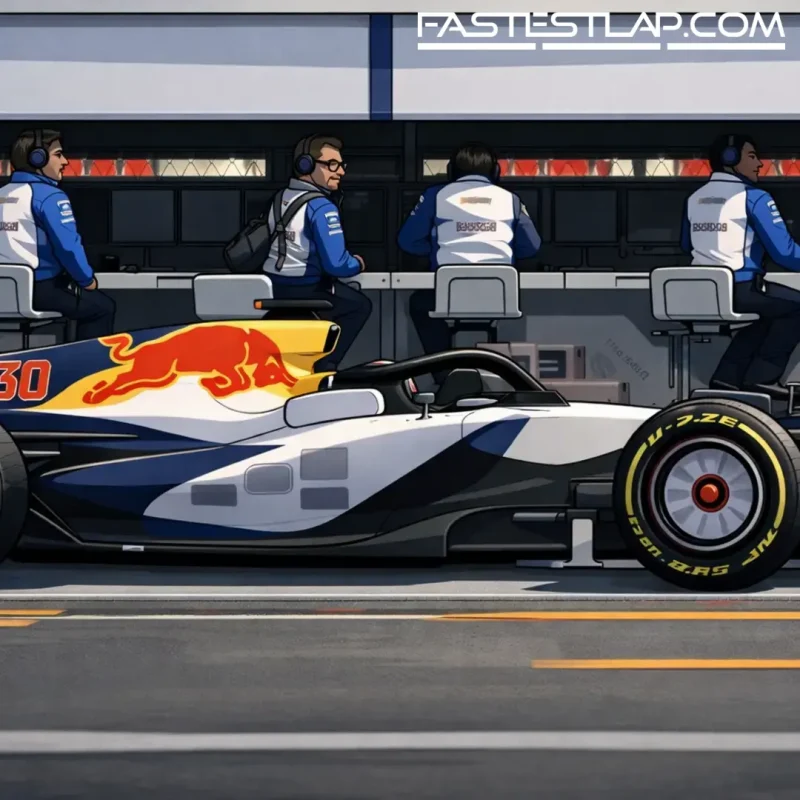
Barcelona’s shakedown offered the first public read on Red Bull’s four-car ecosystem in its new-look shape. At the senior squad, it’s Max Verstappen alongside Isack Hadjar, with Yuki Tsunoda shuffled into a reserve role. At Racing Bulls, Lawson stays on and Lindblad arrives, promoted into the seat Hadjar vacated.
The headline times don’t decide anything in January, but they do set the tone. Verstappen was the quickest of the Red Bull-backed quartet and sat seventh overall, around six tenths up on Hadjar. At Racing Bulls, Lawson held a similar margin over Lindblad. Nothing outrageous, nothing alarming — and yet the more interesting part of the week wasn’t the gap, it was what people were saying around it.
Sky’s team were already dropping the kind of hints that usually precede a narrative taking hold. Martin Brundle said he’d been “hearing impressive things about Lindblad”. Ted Kravitz backed that up, suggesting the faith in the promotion was well placed. Craig Slater added a pointed “belatedly” to the consensus, a small verbal shrug that carried a familiar implication: Red Bull thinks it’s found another one.
That assessment isn’t new inside the organisation. Christian Horner had previously spoken warmly about Lindblad, calling him “definitely a talent for the future” with the attitude and determination Red Bull looks for. And Helmut Marko — who has now left the team — had been equally bullish, describing Lindblad as “a man for the future” after a solid FP1 outing at Silverstone, where he went 14th in the RB21 and impressed with his feedback.
Lindblad himself has been clear about who he felt backed him hardest. When his Racing Bulls promotion was confirmed in December, he made a point of thanking Marko, and he didn’t dress it up for PR. He said it hadn’t been his easiest year, that he wasn’t happy with how it had gone, but that Marko believed in him “when others didn’t”. He even pushed back on Marko’s fearsome reputation, describing their relationship as the opposite of the horror stories you usually hear.
All of that matters because Racing Bulls isn’t just a midfield team with its own ambitions — it’s the audition stage for the next Red Bull seat. And in 2026, that ladder feels particularly exposed. Red Bull has locked in Verstappen and taken the punt on Hadjar at the senior team with only a season of F1 experience. That’s a statement of intent, but it also raises the stakes: if Hadjar flies, he’s the long-term partner. If he doesn’t, Red Bull will do what Red Bull always does and look for the next solution at speed.
That’s where Lawson’s problem starts to look less like a straight duel and more like a three-way squeeze.
Lawson isn’t just fighting Lindblad for day-to-day supremacy at Racing Bulls — he’s fighting to stay relevant in a system that has already shown it can move on from him mid-sentence. The team knows what he is: quick, tough, and already battle-tested in the politics of being “next in line”. But Red Bull also knows what he isn’t, at least for now: the driver it chose when the chance came to place someone next to Verstappen. That nod went to Hadjar.
So Lawson’s 2026 brief is awkwardly specific. He has to beat a rookie who arrives with hype and internal support, while also outperforming a newly promoted Hadjar in the broader Red Bull conversation — or at least apply enough pressure that the senior team feels it. It’s not a comfortable place to be, because a clean season at Racing Bulls might not be enough if Lindblad looks like the shinier long-term asset.
From Lindblad’s side, the opportunity is obvious. If you’re the only rookie on the grid and you land in the one environment where seats can change hands with ruthless efficiency, you’re not there to be patient. You’re there to be undeniable. Red Bull has never been sentimental about experience when it believes it’s staring at upside.
Barcelona, then, didn’t just kick off a new rules era on track. It quietly started a familiar Red Bull storyline off it — one where the stopwatch is only half the weapon, and perception does the rest. Brundle’s “impressive things” comment might be nothing more than paddock chatter. Or it might be the first breadcrumb in the kind of momentum that can turn a rookie into a threat before the opening race has even arrived.
Lawson will know that better than anyone. In this programme, you don’t get much time to make your case — and you get even less time to recover if the team decides someone else is the future.