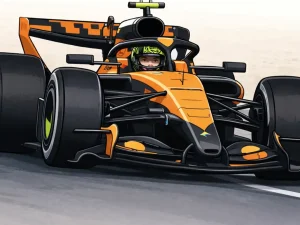
Jack Doohan’s 2026 programme is starting to look like a neat, if slightly unconventional, piece of career management — and it very nearly included a factory Ferrari drive.
The Australian, now Haas’ reserve driver, was sounded out by Ferrari over a seat in its World Endurance Championship hypercar line-up for 2026, understood to have been proposed last winter. In the end, no agreement was reached and Ferrari has rolled into this season with the same nine drivers it had in 2025 across its three 499P entries. Doohan has instead locked in a return to race mileage via the European Le Mans Series, lining up with Nielsen Racing from next weekend’s opener in Barcelona.
On paper, it’s the sort of fork-in-the-road decision that can define the next phase of a driver’s career. A Ferrari hypercar seat right now isn’t a romantic vanity project; it’s one of the sharpest rides in endurance racing. The 499P has become the reference point since Ferrari’s top-class return, and the operation led by Antonello Coletta has been hoovering up silverware. The obvious attraction for a driver in Doohan’s position is that it offers proper, high-profile wins — and the kind of manufacturer credibility that can carry you a long way if F1 doesn’t reopen its doors.
But there’s another layer here: timing and leverage.
Doohan is trying to keep his F1 prospects alive after a bruising 12 months. He made seven race appearances for Alpine across 2024 and 2025, only to be replaced by Franco Colapinto after last year’s Miami Grand Prix. He slipped back into reserve duty, then fully split with Alpine at the end of 2025. Haas picked him up in February, and while reserve roles are never glamorous, they can be politically useful places to be — particularly at a team with technical ties to Ferrari.
That partnership matters. A Ferrari WEC offer doesn’t come out of thin air when you’re also entering the orbit of a Ferrari-aligned F1 outfit. For Doohan, the choice wasn’t simply “Ferrari yes or no”; it was about what keeps him most relevant to the paddock he actually wants to return to. A season in a manufacturer hypercar could easily become a one-way door — not because it’s a downgrade, but because it’s absorbing. The calendar, the demands, the identity you build there: it all starts to pull you away from F1’s weekly churn of politics and opportunity.
Doohan’s original plan, understood in the paddock, was to combine Haas reserve work with a race seat in Japan’s Super Formula, backed through Haas’ relationship with Toyota. That route makes sense for a driver who needs sharp, high-downforce mileage and a chance to put recent F1 disappointment behind him with results. Yet that move unravelled after a messy Suzuka test with Kondo Racing, where Doohan suffered three similar accidents. The belief is that the first two incidents at Degner were car-related, while the third came from overreaching as he tried to claw back lost track time.
So ELMS becomes the pragmatic alternative: racing, rhythm, a place to rebuild without stepping into a full factory commitment that might dilute the F1 push. It also keeps his weekends freer, and his headspace closer to the Haas environment — which is the point of taking that reserve job in the first place.
Ferrari, for its part, is in an enviable position. With its driver roster unchanged from 2025 after talks with Doohan didn’t land, it continues with Robert Kubica in the No. 83 AF Corse car alongside Yifei Ye and Phil Hanson. The No. 50 remains Antonio Fuoco, Miguel Molina and Nicklas Nielsen, while the No. 51 keeps Antonio Giovinazzi, Alessandro Pier Guidi and James Calado.
The endurance calendar’s own collision with F1 is a subplot worth noting too. The 2026 WEC season begins at Imola on April 14, with Le Mans clashing with F1’s renamed Barcelona-Catalunya Grand Prix on June 13-14. For a driver straddling disciplines — or eyeing a mid-season F1 opportunity — that kind of overlap can become a genuine constraint. It’s another reason Doohan opting for ELMS rather than a full hypercar campaign reads like a decision made with one eye on 2027.
None of this guarantees an F1 return, of course. Reserve drivers can spend a year looking busy without ever getting the call. But Doohan’s choices so far suggest he’s trying to avoid the trap of being labelled as “the endurance guy” too early — even when the endurance offer happens to come with a prancing horse on the door.
Instead, he’s chosen the unglamorous currency that still buys chances in Formula 1: proximity, flexibility, and race mileage on his own terms. If an opening appears, he’ll want to be the driver already embedded in an F1 garage, not the one mid-championship in a different world — even if it’s a very successful red one.