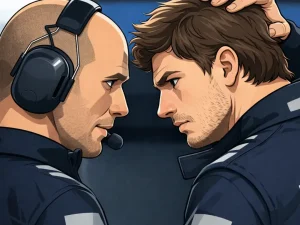
Max Verstappen’s radio has always been a blunt instrument. In 2026, with Formula 1’s new rules shaking up the competitive order and Red Bull suddenly looking mortal, that bluntness is being heard a little differently.
James Hinchcliffe’s take is basically a reminder to stop treating every clipped broadcast as an executive summary of a team in crisis. Verstappen can make a “fine-but-not-great” session sound like an existential disaster, and that’s been true through titles as much as it’s true now. The difference is that this season Red Bull isn’t papering over the noise with wins.
Verstappen arrived in Suzuka already having made himself the paddock’s loudest critic of the new regulation set. The 50/50 split between combustion and electrical power has been labelled “anti-racing” by the four-time world champion, who’s also thrown in the kind of colourful shorthand that tells you he’s not trying to win a diplomatic prize: “Mario Kart”, “Mushroom Mode”, “Formula E on steroids”. It’s not a driver quietly grumbling to his engineer; it’s Verstappen laying down a position in public.
After qualifying 11th for the Japanese Grand Prix, he sounded less angry than exhausted by it all. “I don’t get upset about it. I don’t get disappointed or frustrated by it anymore with what’s going on,” he said. Pressed on what he had to figure out, Verstappen’s answer was pointedly vague: “Life here.”
A day later, he widened the lens even further. “I’m thinking about everything inside this paddock… You just think about, is it worth it? Or do I enjoy being more at home with my family, seeing my friends more when you’re not enjoying your sport?”
On paper, you can see why those lines have caught fire. Verstappen has 12 points after three grands prix weekends. Red Bull sits sixth in the standings on 16 points, a whopping 119 behind Mercedes. These aren’t numbers that match the last half-decade of Red Bull’s reality, and they add a sharp edge to any suggestion that the sport might not be “worth it” anymore.
But Hinchcliffe’s point — made on the F1 Nation podcast — is that Verstappen being Verstappen can distort the picture if you only consume the loudest bits.
“We don’t know what’s happening back at the factory,” Hinchcliffe said, and it’s the key caveat. Public comments are one layer; the conversations behind closed doors are another. Hinchcliffe also leaned on a familiar pattern for anyone who’s followed Verstappen closely: he can sound like he’s wrestling an undriveable car even when the lap time is relatively respectable.
“I can think back to races over the last couple of years, where the balance isn’t great. Max is having an okay session or an okay race,” Hinchcliffe said. “And if you listened to his radio, you would think that he was having the worst grand prix that any driver has ever experienced in their life. That’s Max.
“And I think everybody that works at Red Bull knows that, to a certain extent, Max’s emotions can outweigh the actual feelings within the camp…”
In other words: don’t confuse theatre with surrender.
There’s also a more pragmatic angle here, and it’s one teams understand even if fans don’t always like it. Verstappen’s job isn’t to sound upbeat on the radio; it’s to extract everything from the car and give engineers a clear sense of what it’s doing. Hinchcliffe framed it as a question of alignment: is the driver matching the team’s effort? Red Bull, he argued, will believe it is.
“When he is strapped into that car, he is driving to within 100 per cent of his ability,” Hinchcliffe said. “And that’s what a team wants to know – is that the 100 per cent effort they’re putting in behind the scenes to build a better car is being matched by the driver inside the car.”
That’s a subtle but important reframing. When a top team suddenly isn’t winning, the first cracks people go looking for are psychological ones — motivation, commitment, whether the lead driver is mentally packing boxes. Yet Hinchcliffe’s read is that Red Bull’s internal reaction will be closer to: *this is who he’s always been, and at least he’s still wringing its neck*.
None of this means Verstappen’s broader complaints aren’t real, or that his comments about life “inside this paddock” are just performance. When a driver openly questions whether he enjoys the sport anymore, you take it seriously — especially one with nothing left to prove. And Verstappen has never been shy about telling F1 when he thinks it’s losing the plot.
But it does suggest that treating every angry radio burst or bleak quote as a sign he’s halfway out the door misses the texture of how he operates. The sharper he feels the problem, the sharper he communicates it. That can be abrasive; it can also be a kind of compass for a team that needs direction in a new era.
Hinchcliffe called it a moment to “galvanise the team behind him”. Red Bull hasn’t had many of those in recent years because it rarely needed them. Now it does. And in Verstappen, it has a driver who — whatever he’s thinking about the regulations, the racing, or “life here” — is still driving like someone who refuses to leave a tenth on the table.
The only question that matters, really, is whether Red Bull can give him something worthy of that refusal.