Vettel cautions Red Bull against assuming smooth sailing after Horner exit: “Let’s wait and see”
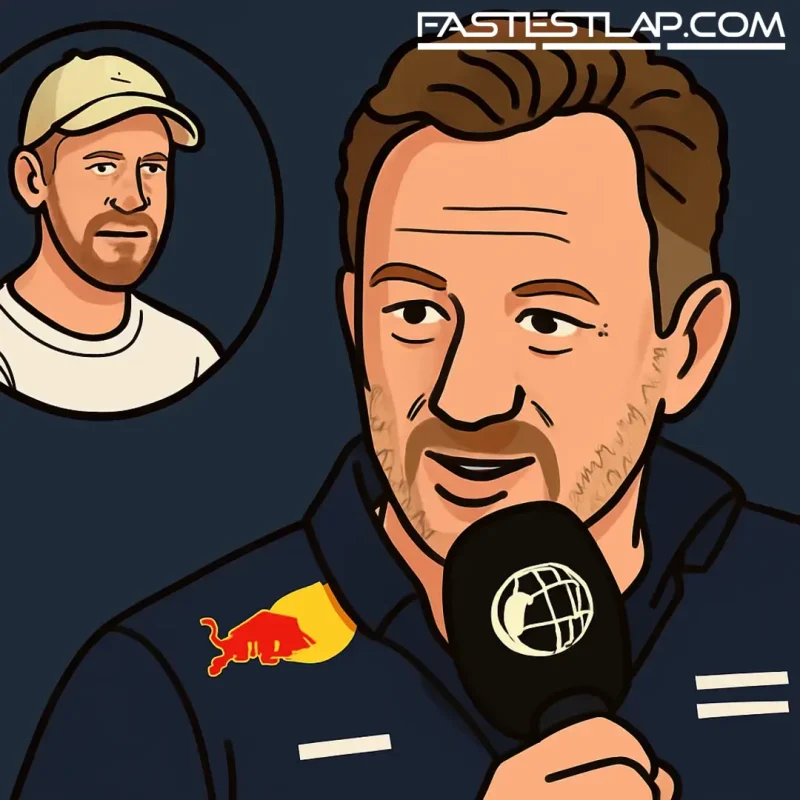
Sebastian Vettel has urged Red Bull to be wary of long-term fallout from Christian Horner’s dismissal, even as the team’s form has sharpened under Laurent Mekies.
Horner’s exit early in the season caught the paddock off guard. For nearly two decades he’d been the fixed point in Red Bull’s orbit — the constant in a team built on speed, swagger and relentless winning. Results took a dip, fingers were pointed, and the team pressed the button. In came Mekies. On paper, it’s worked: Red Bull have banked 194 points with him in charge, compared to 172 under Horner, and they’ve done it in three fewer races.
Vettel, who knows the team’s DNA as well as anyone, didn’t hide his surprise when the decision landed.
“Surprised,” he told Sky Sports. “Christian has been there for so long, since the very beginning, and knew this team inside out. I think for this year, everything was in place.”
He wasn’t casting doubt on Mekies, far from it. “I know Laurent as well, the successor, and I’ve worked with him — he’s a really great person.” But the caution light is flashing for the German. His message, beneath the polite delivery, was clear: you don’t just pull out a central pillar and expect the roof to never creak.
“Christian left some big footsteps,” Vettel added. “Not just because of all the success he’s had with the team, but also because he was such a central part of the team, knew what was going on and so on. I’m not completely aware of the organisation, the structure, and especially the plan for the future, but that’s where I think it’s valid to say, let’s wait and see how it turns out.”
It’s the right kind of sober assessment. Short-term bounces happen — fresh voices, different energy, a new way of slicing up the weekends — but stability at Red Bull was a competitive advantage as much as their aero genius. The question isn’t whether Mekies can make the car quick on Sunday. It’s whether the broader ecosystem remains as aligned as it was under Horner when decisions ran like clockwork and the culture was unmistakably sharp-edged. Continuity is currency in Formula 1; spend it carelessly and you feel it later.
Vettel’s perspective carries extra weight because he’s lived both sides of a dominant Red Bull era — the one he helped forge, and the one he’s watched from a comfortable distance since stepping away from the grid. Inevitably, that distance spawned rumors he could return to Milton Keynes in some capacity after Horner’s departure. He didn’t fan them.
“I read as well, there was a lot of talk about it,” he said with a smile. “And I did speak with Helmut [Marko] a little bit, but it never got anywhere, never gained any traction. I think for me, I’m fairly happy where I am in life right now.”
He hasn’t fallen out of love with the sport, though. Far from it. “I love Formula 1. In the beginning, I thought I’m not sure whether I want to keep watching because I need to get a distance and so on, but I watch the races and I follow and I love it because I just love the sport. I know the guys as well, so I’m still close in that way.”
Would he jump back in if the right chair appeared? He left the door ajar. “If the right opportunity, position, perspective, whatever, turns up or could turn up, maybe there’s a role that I could be happy to step up to, but time will tell.”
For now, Red Bull are winning the optics game post-shake-up. The scoreboard says the course correction is working. Vettel’s point is that the real verdict arrives later — in how the structure holds under pressure, how seamlessly the machine evolves, and whether the relationships that powered the most ruthless operation of the hybrid era remain as tight without the man who, for so long, kept his hand on the tiller.