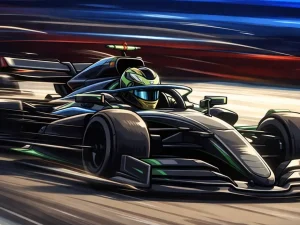
Isack Hadjar has picked an interesting moment to walk into Red Bull Racing’s lion’s den.
If you’re going to take on Max Verstappen in the same garage, you may as well do it in a year when everyone is re-learning the craft. Formula 1’s 2026 reset isn’t just a new chassis rulebook; it’s a different way of going quickly. Shorter, lighter cars, overbody aero, and moveable front and rear wings will grab the headlines. But the real muscle-memory reset is coming from the power units and how they’ll ask drivers to think their way through a lap.
The new 50/50 split between electrical and combustion power puts energy management right on the critical path. Boost and overtake modes are now part of the driving rhythm, not just a tactical button-press. Get it right and you’ll look like a genius; get it wrong and you’ll hemorrhage lap time while everyone else sails past on the straights. In that context, the old assumptions about who thrives where — and why — suddenly feel a bit less solid.
That’s the backdrop for the “Hadjar question” that Alex Brundle has been kicking around: is this actually the right time for a rookie-ish arrival to have a swing at Verstappen, and more pointedly, is Hadjar the right driver to do it?
Brundle, speaking on the Rolling Start podcast, framed it as the inevitable end point of signing up to Red Bull’s programme in the first place. You don’t climb into that system without understanding what’s waiting at the top.
“When you enter that programme, you know the destination is Max,” Brundle said. “What are you going to do? Drive for RB forever?”
It’s blunt, but it’s also the core of Red Bull’s reality. The second seat has become less a career-making opportunity than a stress test, with Verstappen’s recent run defining the team’s competitive identity. Four world titles from 2021 to 2024 tells you everything about the ceiling of that operation — and about what it’s done to the people asked to share it with him.
That’s why Hadjar’s timing matters. There’s long been chatter — sometimes informed, sometimes lazy — that Red Bull’s cars have skewed toward Verstappen’s preferences, and that the job description for the other driver is essentially “adapt or expire.” In a normal year, that storyline is hard to dislodge because the reference point is baked into the car’s DNA and Verstappen’s confidence is already fully inflated by results.
But 2026 blows the reference points up. Everyone gets a fresh set of “bits”, as Brundle put it, and an “entirely new driving style” to go with it. The intriguing implication isn’t that Verstappen suddenly becomes mortal; it’s that the advantage of familiarity is reduced. If you’re hunting for a crack in the door, this is when you’d prefer to be pushing on it.
Brundle suggested Hadjar himself appeared to understand the stakes when the prospect of the Red Bull seat first came up — perhaps even before the turn of this regulation set.
“There was that moment of slight hesitancy there,” he said, hinting that Hadjar’s instinct was to arrive on his own terms rather than simply be the next name fed into the Verstappen machine. It’s a very human reaction: ambition, yes, but also an awareness that one bad year next to a generational benchmark can leave a permanent stain.
Still, Brundle’s bigger point was that Hadjar might be better placed than the “last sequence of teammates” Verstappen has faced because the playing field is new for everyone. That’s not a guarantee of pace — it’s an opportunity for survival, which is a different thing entirely at Red Bull.
And survival matters more than ever this season for a team that can no longer rely on the simplest old plan: Verstappen wins, the other car picks up what it can, and the constructors’ arithmetic sorts itself out. If 2026 reshuffles the grid — and the sport is explicitly designed to invite that possibility — then having one car operating at peak and the other drifting in the midfield becomes a luxury Red Bull may not be able to afford.
Brundle touched on that strategic squeeze. If Red Bull doesn’t “hit the ground running,” the requirement shifts from “maximise Max” to “extract everything from both cars,” because that’s what you need when you’re fighting Mercedes, Ferrari, and reigning champions McLaren across a season rather than leaning on a single superstar to keep you in the hunt.
He also poured the sensible cold water on the pre-season noise that always swirls around big regulation changes — the sort of paddock chatter that insists someone’s engine is “going to be brilliant,” or that a shakedown time means anything more than “the car ran.”
In other words: nobody truly knows who has nailed the new formula until they’re all on track, under pressure, with the same fuel loads, the same tyres, and the same brutal exposure to reality.
What Red Bull does know is this: if the car is a frontrunner in Verstappen’s hands, the gravitational pull inside the team will always trend toward him. That’s not personal, it’s just how modern F1 works when one driver is your proven championship vector. Hadjar’s best chance, then, might be a season where Red Bull needs him — genuinely needs him — because the margins are tighter and the competition broader.
Brundle went as far as to say that if Hadjar performs, “Red Bull will back him.” That line is doing a lot of heavy lifting, because “back him” at Red Bull doesn’t mean equal status on day one; it means being allowed to become a factor. It means being given the runway to develop into a driver who can occasionally take points, wins, and strategic options out of Verstappen’s shadow — and, on the right weekends, put himself directly into the conversation.
That’s the needle Hadjar has to thread. He doesn’t need to “beat Max” in the simplistic, tabloid sense to justify the promotion. But he does need to be close enough that Red Bull can race like a two-car team when the season demands it. In 2026, there’s every chance it will.