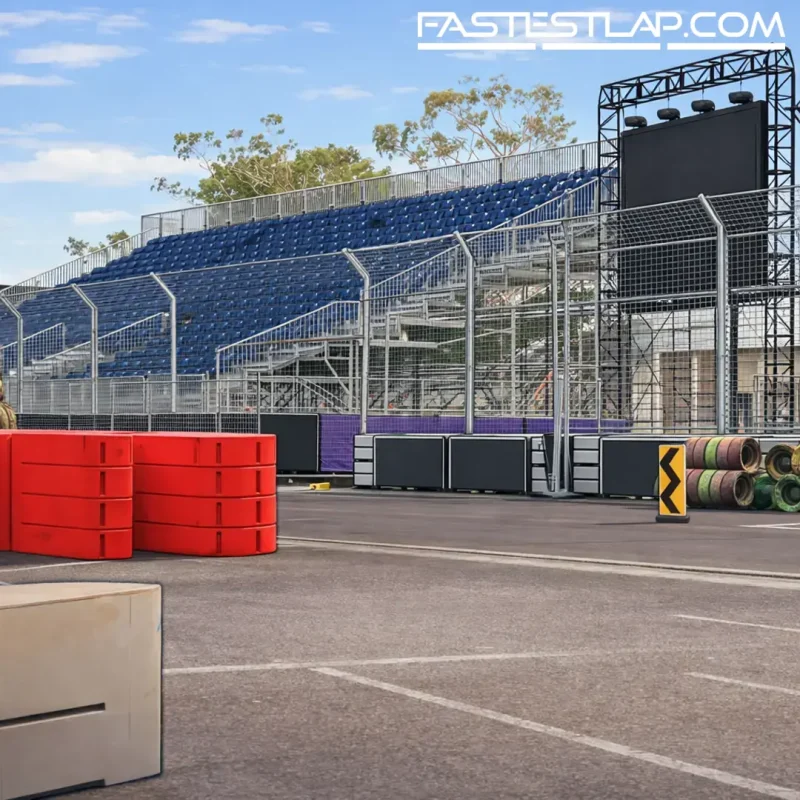
Albert Park is doing what Albert Park always does in race week: pretending nothing in the outside world can possibly interfere with the business of putting on a Grand Prix. This time, though, the outside world has pushed right up against the paddock gates.
With conflict in the Middle East escalating sharply and global travel disrupted, Melbourne’s status as the 2026 season opener has inevitably come under scrutiny. Pirelli has already pulled the plug on a tyre test in Bahrain, and the knock-on questions haven’t stopped there — not just about the Bahrain and Saudi Arabian rounds slated for April, but about the practicalities of getting thousands of F1 personnel from Europe to Australia safely and on time.
Australian Grand Prix CEO Travis Auld, speaking from Albert Park on Monday morning, insisted the event remains on track. The short version: the race is going ahead, and he expects the grid to look exactly as planned when the lights go out.
“The events of the weekend have certainly meant there’s been some reshuffling of some travel plans,” Auld said. “But the Formula 1 organisation are very good at moving people around the world. That’s what they do… and we’re not expecting any impacts on our race.”
That confidence is rooted in a simple, very modern F1 reality: these events don’t run on vibes, they run on logistics — and the sport has built a travelling machine that can reroute itself quickly when it has to. According to Auld, that machine has been busy for the last 48 hours.
“A lot of this is done by Formula 1,” he said. “So you’re talking about teams, drivers, Formula 1 personnel… I’m guessing there’d be close to 1000 people that would have already booked their flights and would be landing somewhere between sort of today, tomorrow, and Wednesday. So they had to all be changed. But they’ve been able to sort it out, is the important part.”
The freight, he stressed, is already in place. That matters, because with the calendar now stretching around the world at its usual relentless pace, the difference between a race happening and not happening often comes down to whether the equipment is there — and whether enough of the right people can get to it.
On that front, Auld painted an unusually calm picture for an unusually tense backdrop.
“All the freight is here and ready to go,” he said. “And so we’re in a space where we’re really confident there’ll be no impact.”
There’s been no attempt to sugar-coat what’s driving the concern. The situation in the region has intensified to the point of airspace closures, airports shutting down and Bahrain’s airport reportedly hit by drone activity. The conflict involves Iran, Israel and the United States, with Iran’s Supreme Leader Ayatollah Ali Khamenei reported killed, and subsequent missile and drone strikes targeting US assets and allies across the region.
In that context, it’s not dramatic to say the early part of the 2026 schedule is being tugged at from multiple directions. Bahrain is set for 12 April, with Saudi Arabia a week later — two back-to-back events that sit in a part of the world currently dealing with rapidly changing security and travel conditions.
Formula One Management, for now, is keeping its messaging narrow and forward-looking. In a statement, F1 noted the immediate run of races is in Australia, China and Japan, and said it is “closely monitor[ing] any situation like this and work[ing] closely with relevant authorities.”
That might read like boilerplate, but it also reflects how the championship tends to operate: the first job is to get the show to the next venue, and worry about the next dilemma when it actually becomes the next dilemma.
Still, Melbourne has its own travel challenge even in a quiet year. Teams and personnel have to make a long-haul jump from Europe, and with Middle East air corridors suddenly complicated, the routes — and timings — can get messy quickly. Auld said F1 has taken control of the process and, after a flurry of changes, believes it’s “locked in”.
In a later press conference, he doubled down.
“The last 48 hours have required some reshuffling of flights. That’s largely Formula 1’s responsibility,” Auld said. “They take charge of making sure the teams and drivers and personnel can get here. My understanding from talking to them as recently as this morning is that is locked in.”
He indicated some drivers are already in Melbourne, with others — and large numbers of team staff — still coming via the UK and Europe. But the expectation, based on previous years, is that the paddock will be fully populated by midweek.
“I would say based on previous years that everyone will be here by Wednesday,” Auld said. “Everyone who needs to be here will be here, there will be no impact on the race or the event in anyway. We’ll see them all arrive on time.”
If there’s a subtext to all of this, it’s that F1 has been here before — not this situation, not these stakes, but the uncomfortable moment where a race weekend is suddenly about far more than lap time. Melbourne knows it as well as any venue. The 2020 Australian Grand Prix was abandoned just hours before first practice as COVID-19 upended the world, and the sport spent the next months rewriting its own playbook. In 2022, the Saudi Arabian Grand Prix ran on despite a missile strike hitting an Aramco facility near the Jeddah circuit during opening practice.
Those memories don’t guarantee anything. They do, however, explain the tone you’re hearing from organisers: keep the system moving, stay in contact with the right authorities, and don’t add noise unless there’s something concrete to say.
For now, Melbourne’s message is simple and firm. The flights have been rerouted. The freight is on the ground. The paddock will fill up. And the 2026 season, at least at Albert Park, is still expected to start on schedule.