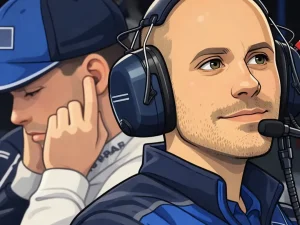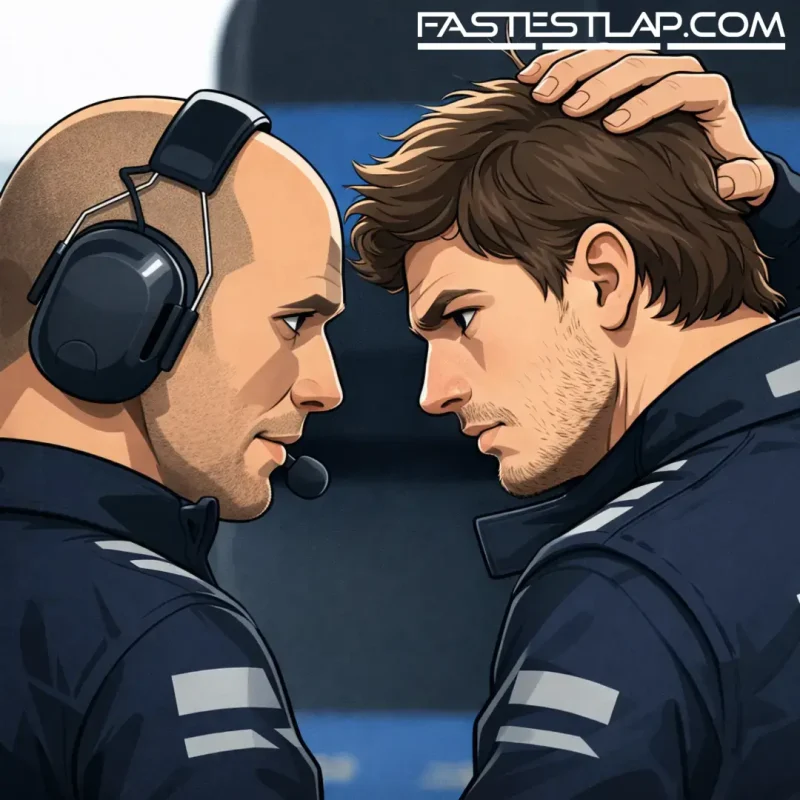
Gianpiero Lambiase has spent a decade as the calm (and occasionally exasperated) voice in Max Verstappen’s ear, the one who can translate a stream of furious micro-feedback into something Red Bull can actually put on a setup sheet. That partnership is so foundational to the Verstappen era that it’s easy to forget it isn’t a permanent feature of the sport.
It’s about to become one.
The well-connected whispers that have bubbled away for two seasons have now hardened into something far more concrete: Lambiase, Red Bull’s head of racing and Verstappen’s long-time race engineer, is expected to leave the team to join McLaren. The timing, crucially, isn’t immediate — the understanding is that the move would happen in 2028. But in modern F1, “2028” rarely means “carry on as normal until 2028”.
Contracts, confidentiality and competitive paranoia don’t allow for graceful goodbyes. If McLaren has secured Lambiase for 2028, Red Bull is unlikely to keep him embedded at the heart of its operation right up to the point he walks across to a direct rival. Gardening leave is the sport’s default setting in these cases, and depending on how hard either side plays it, you’re realistically looking at Lambiase being operationally absent well before his start date.
That’s the part that should make Red Bull uncomfortable — not because it loses a highly-rated senior figure, but because it pulls at the one human thread Verstappen has consistently valued as much as any technical upgrade.
Verstappen and Lambiase have been together since Verstappen’s first Red Bull weekend in 2016, when he replaced Daniil Kvyat and promptly won in Spain. Since then, the numbers have stacked up to the point they read like a videogame save file: 71 wins, four world titles, and those 2023 benchmarks — 19 wins in a season and a 10-race winning streak — that came with Lambiase’s clipped delivery in the background. The radio exchanges have become part of Verstappen’s public character: the impatient genius, the engineer who won’t indulge him, and a relationship that functions precisely because it can handle friction.
Verstappen has never hidden how central that dynamic is. Back in 2021 he talked about the honesty between them — the freedom to disagree, the back-and-forth that sharpens decisions rather than blurs them. In 2023, with Red Bull again in title mode, he described it more bluntly: they argue “a lot”, like a married couple, and that’s why it works. The key line in that quote wasn’t the joke; it was the bit about trust, and that when it comes to setup calls it’s effectively between the two of them.
And then there’s what Lambiase himself said in 2023 — a quote that reads very differently now.
“The day Max and I stop working together in this set-up will be the day I’m keen to take on a new challenge,” he said at the time, while also talking about hoping to continue “until at least 2028” when Verstappen’s contract is due to expire.
It was framed as loyalty, almost sentimentality, and it carried an unspoken assumption: if the Verstappen-Lambiase pairing ends, something bigger has changed.
Now, with Lambiase lined up for McLaren, that assumption hangs in the air like tyre smoke. Either he’s leaving without Verstappen — which would be a first, and not a small one — or the two timelines are more connected than anyone wants to say out loud.
Because this isn’t just about a driver losing a familiar voice. It’s about Verstappen’s tolerance for the current shape of Formula 1, and how quickly that tolerance seems to be thinning.
He’s made no secret of his frustration with what he’s repeatedly characterised as an “anti-racing” direction — the constant battery management, the super-clipping and harvesting routines that have seeped into qualifying as well as race stints. Verstappen’s point, put simply, is that even the fastest cars are too often being driven to a number rather than to the limit. That’s not nostalgia for V10s; it’s a driver in his prime telling you the job has changed into something he doesn’t particularly enjoy.
And if Verstappen isn’t enjoying it, the usual levers that keep drivers in place — legacy, money, political capital — don’t necessarily apply. He has four titles, a mountain of wins and, by his own admission, little left to prove. What keeps him showing up is the fun of it, the purity of competing flat-out. If that’s gone, the rest starts to look optional.
Put that alongside the looming reality that, by the end of next season, Verstappen could be staring at a future without the one engineer who’s been able to handle him at his most demanding and still push back without it turning personal. The Verstappen-Lambiase “marriage” has been a competitive advantage: rapid decision-making, blunt communication, no ceremony. Break that up and you’re not just changing personnel — you’re changing the temperature of the entire garage.
Red Bull will insist it can absorb the loss, and structurally it probably can. The team has lived through big departures before. But Verstappen is not a normal asset, and Lambiase is not a normal engineer. The sport is full of competent voices on the radio; it isn’t full of pairings that have effectively grown up together at the sharp end of championship pressure.
So yes, Lambiase heading to McLaren in 2028 is a story in its own right. But the more interesting question is what happens before then — whether Red Bull can keep that partnership intact long enough for it not to matter, and whether Verstappen even wants to wait around to find out.
In the paddock, the biggest moves rarely begin with a contract announcement. They begin when the people a champion trusts start making plans without him.