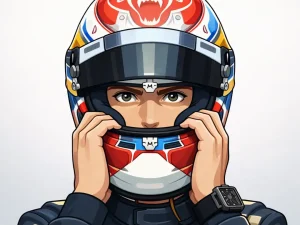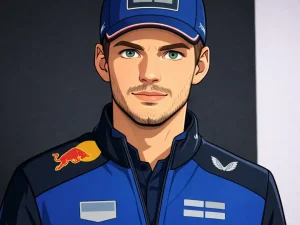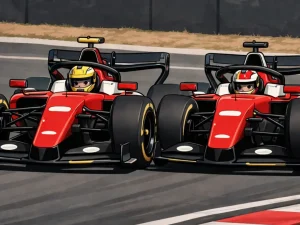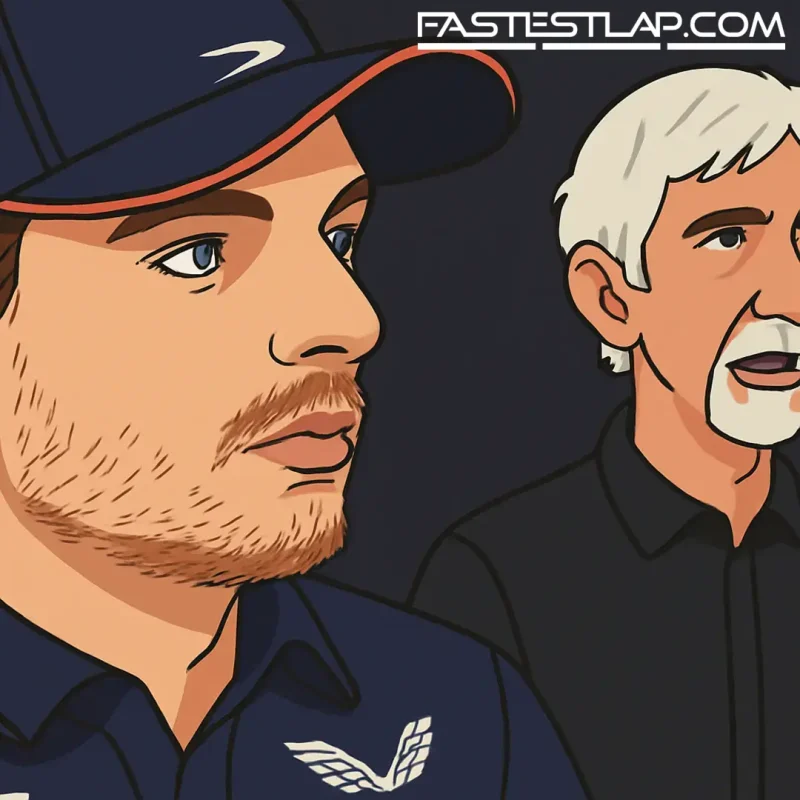
Damon Hill has never been shy about where he stands on Max Verstappen. And ahead of São Paulo, the 1996 world champion doubled down on why he bristles at the Red Bull driver’s elbows-out racecraft — and it has everything to do with the way he learned to race.
Hill cut his teeth on two wheels before switching to cars in the mid-’80s, and that background, he says, hard-wired him against contact. On the Stay on Track podcast, Hill admitted he’s struggled to reconcile Verstappen’s style — the sharp edges, the squeeze to the white line, the line-in-the-sand braking — with his own instincts. On a bike, he argued, barging someone is a good way to end up in an ambulance. In cars, it’s been normalized.
“I called him Dick Dastardly,” Hill said with a wry laugh, revisiting the line that followed Verstappen’s run-ins last year. “I likened Max’s driving to that. But he’s saying, ‘Well, the rules say this…’ I didn’t do karting. This style of driving I didn’t get because I came from bike racing. You didn’t used to barge into people, because you’d just as easily knock yourself off.”
It’s classic Hill: part moral argument, part scar tissue. He referenced how often titles have been settled by contact — right back to his own bitter end in Adelaide ’94 with Michael Schumacher. “I hadn’t learned that lesson that that is how titles are decided,” he said. “Whether or not it’s implicit, it’s just understood.”
The timing of the debate isn’t accidental. Verstappen has muscled his way back into the 2025 title fight these past few months with wins in Italy, Azerbaijan and the United States. He arrives in Brazil 36 points behind Lando Norris with four rounds left — Brazil, Las Vegas, Qatar and Abu Dhabi — and very much swinging. Norris may have been the season’s form man, but Verstappen’s never cared much for scripts.
Mexico loomed large in Hill’s discussion too. He cited Verstappen’s dive on Lewis Hamilton at Turn 1 — late, forceful, and met with shoulder-rub rather than sanction — as emblematic of F1’s modern reality. “There wasn’t a word. It was seen as a racing incident,” Hill said. “In car racing, it’s hard to get two cars around a corner together.” The implication: the rulebook might tolerate it, but that doesn’t mean he has to like it.
Johnny Herbert, who shared the mic with Hill and knows a thing or two about policing the edge as an ex-driver and FIA steward, pushed back. He called Verstappen’s Mexico move “brilliant: right on the edge, very late, but he made the move.” A little tyre rub? That’s racing, he said. The intimidation factor? Also racing — and historically very effective.
“He intimidates people,” Herbert added, lumping Verstappen into the same psychological bracket as Senna, Prost and Schumacher. “Put your helmet on and turn into a little bit of an animal. Elbows out.”
There’s a generational split here that’s hard to miss. Drivers who came up through the karting trenches — Verstappen chief among them — treat body language on corner entry as part of the game: sell a dummy, take the real estate, own the apex. For pure racers who grew up balancing throttle and peril on a motorbike, forcing a rival off-line feels like a moral red card even if it’s a legal yellow.
The stewarding trends have drifted toward that karting DNA. “Hard racing” is now the default descriptor unless something is spectacularly clumsy or malicious. Verstappen thrives in that climate, and he knows it. The Dutchman doesn’t just live at the margins; he invites others to meet him there and dares them to blink.
Interlagos, fittingly, is the backdrop. Verstappen was immense here last year, and this weekend shapes as another litmus test — not just of Red Bull’s late-season surge, but of how Norris and Hamilton engage with him when the space gets tight and the points get heavy. The title picture says Norris is in control. The mood in the paddock says nobody believes it’s done while Verstappen’s still throwing haymakers into Turn 1.
Hill’s stance isn’t going anywhere. Nor should it. He represents a line in the sand that F1 will always debate: where the rulebook ends and the racer’s code begins. Verstappen represents the other side of the same coin: a driver built for the era, fluent in the grey, and utterly unafraid of the consequences.
Brazil will ask them both to make their case again — one with words, the other with the loudest argument a driver has: a late brake marker and a car placed exactly where it needs to be.