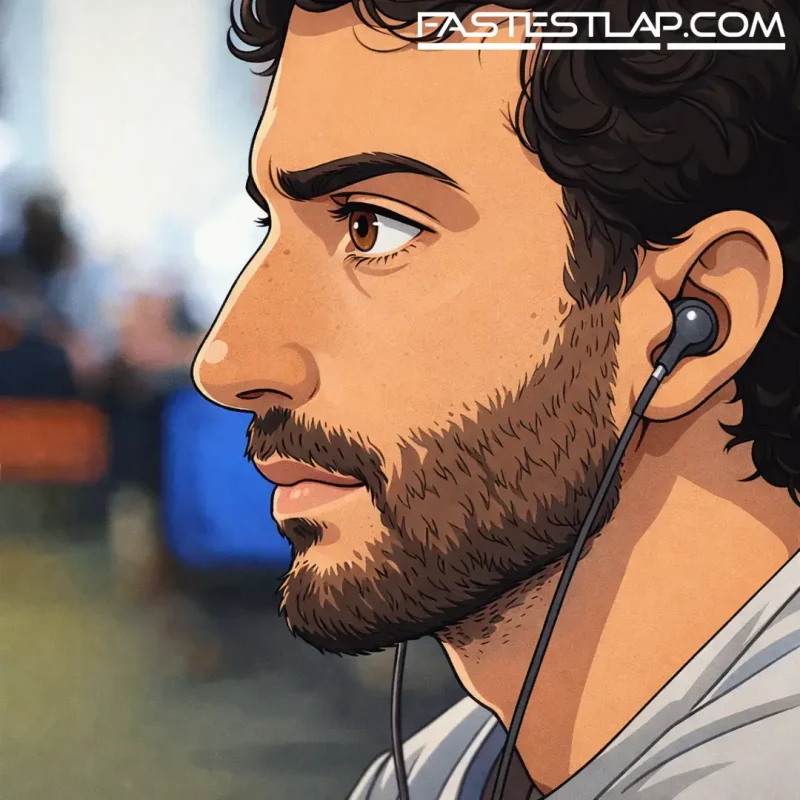
Daniel Ricciardo has finally said out loud what plenty of drivers only hint at once they’ve stepped away: it isn’t the racing that’s hardest to replace, it’s the noise.
Speaking ahead of this weekend’s Chinese Grand Prix, the 36-year-old described his 2024 Formula 1 exit as something he’s had to properly process in private — and admitted the idea of going back to that life now “terrifies” him.
For a driver whose public identity was built on an almost bulletproof front-row grin, the honesty lands with a thud. Ricciardo’s point isn’t that he misses F1 and can’t get it back; it’s that he’s discovered how much of himself got swallowed by the constant churn of people, schedules, cameras and the expectation that you’re always “on”.
“I was always pretty good at putting on a brave face and letting people know that I was good and happy and everything’s fine,” he said. “But when everything quieted down and the lights were turned off, I was like: ‘OK, I need to do some soul searching and make sure that I’m good with all this.’”
That line tells you a lot about where Ricciardo is now. Not plotting a comeback. Not fishing for a seat. Just being candid about the comedown — and why the chaos that once defined his world doesn’t feel attractive anymore.
“Jumping back into something as well and having another distraction was not going to help me figure out who I was,” he added. “It took me a while to figure it out after racing probably who I was and what maybe my purpose was beyond just being a race car driver… I sit here just more relaxed and the thought of going back into a chaotic sort of lifestyle terrifies me, to be honest.”
Ricciardo’s last F1 appearance came at the 2024 Singapore Grand Prix, with his future already the paddock’s worst-kept secret. Racing Bulls replaced him with Liam Lawson for the final six races of the season, only confirming Ricciardo’s departure four days after Singapore — a messy, drawn-out ending for a driver who’d spent more than a decade as one of the series’ most bankable personalities.
The bigger picture of his career remains complicated. Eight grand prix wins across 257 starts is a record most drivers would frame on the wall, and he’ll always have Monza 2021 — that McLaren victory that ended the team’s long wait and came with the kind of unfiltered joy Ricciardo could bottle better than anyone. But the second half of his time in F1 was also a reminder of how quickly the sport moves on when the lap time isn’t there.
After McLaren cut his stint short at the end of 2022 and promoted Oscar Piastri into the seat, Ricciardo spent the first half of 2023 as Red Bull’s reserve before resurfacing at Racing Bulls from the Hungarian Grand Prix. Alongside Yuki Tsunoda, the impact never really arrived, and by late 2024 the decision had been made.
What’s striking now is how little Ricciardo seems interested in litigating any of that. There’s no edge in his words about teams, timing or politics — just the psychological whiplash of going from a life with a single, obvious purpose to one where you have to decide what you actually want.
“When you wake up with really one purpose for so many years, even if it feels like the right time… it doesn’t really change the fact that: ‘Oh, it’s gone, and what do I do now?’” he said.
In those remarks, you can hear a driver describing the machinery around F1 as much as the driving itself. Ricciardo talked about the relentlessness of being watched — the constant performance, the carefulness, the sense that even authenticity has limits when there are always eyes on you.
“So much of my life was events and trackside and there’s always a camera around,” he said. “There’s always people and I have to put on always a smile and have to be careful what I say… it’s impossible to be 100 per cent that when there is just always eyes on you.”
If Ricciardo’s career ended abruptly, his post-F1 life hasn’t been an attempt to fill the same space with something equally loud. He kept his distance for nearly a year and confirmed his retirement from motor racing last September, later becoming an ambassador for Ford — Red Bull’s engine partner for F1’s 2026 programme.
He appeared at Ford’s season launch in Detroit in January, where he was reunited with Max Verstappen. Verstappen, now a four-time world champion, has adopted Ricciardo’s old number three for the 2026 season — a small detail, but one that underlines how quickly F1 repurposes even the personal symbols once someone leaves the frame.
Ricciardo, for his part, sounds like someone learning to enjoy the empty spaces. He said his biggest takeaway from last year was “the importance of alone time”, and that it’s only when the crowd thins out that you can ask the questions you never really make time for in F1: what you’re chasing, whether it matters, and who you are when there isn’t a job title stapled to your forehead.
“You can’t really ever ask yourself those questions if you’re constantly surrounded by groups of people and everything’s like, fun, fun, fun,” he said. “That’s not also real life, which I’ve started to realise.”
There are still hints of competitive curiosity, just redirected. Through Ford, Ricciardo has been promoting the Raptor T1+ truck used in off-road events like Dakar. He’s teased the idea of a Baja 1000 appearance down the line, though he’s careful not to dress it up as a new chapter with the same stakes as F1.
“The itch for Baja is there,” he said, “but I’ve got a lot to learn. A few more of these events and then ask me next year and we’ll see where I’m at.”
It’s a far cry from the old Ricciardo discourse — will he get another chance, will he find a seat, will the paddock fall back in love with the Honey Badger? Now, the message is simpler, and maybe more revealing: he left, it hurt, he did the work, and the idea of walking back into the circus doesn’t feel like freedom anymore.
In a sport that rarely allows its people to be anything but useful, Ricciardo’s most interesting move might be the one he’s making away from the track: choosing quiet, and not apologising for it.