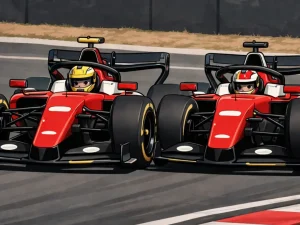
Karun Chandhok says McLaren’s “two cars or nothing” stance on upgrades might not survive the coming storm.
The team’s culture of parity became a calling card during last year’s title run. In a season that boiled into a McLaren-versus-everyone battle, the papaya operation refused to bolt on performance unless it had enough parts for both Lando Norris and Oscar Piastri. It made for clean, contained intra-team politics and a fair fight. It also helped deliver the big one: Norris edged the championship by 13 points, with Piastri dropping to third after late-season snags let Max Verstappen split the McLarens.
That philosophy rolled into 2025. Early doors, Piastri said he and Norris would have “the same car every weekend” while it was viable. And mostly, they have. When the pair did diverge late last season, it was on suspension choice rather than a performance upgrade, with Piastri preferring the earlier spec.
But 2026 sits on the horizon like a weather front, and Chandhok’s not convinced McLaren can keep playing the gentleman’s game once the new rulebook lands. The former F1 driver told Sky Sports F1 the incoming regulations will ignite a development arms race, and that’s where sentiment gives way to speed.
“I like the way McLaren has gone racing,” Chandhok said. “It’s good for the show, but next year the rate of development is going to be so high. There might be times, especially early on, where they can only get one upgrade made in time. Then what?”
That’s the crux. With ground-up cars and fresh power units arriving in 2026, teams will juggle correlation, manufacturing lead times and the sheer pace of discovery. Someone will find something. Getting that something on the car a race earlier could be the difference between track position and damage limitation. If McLaren find themselves in a knife fight again, picking fairness over lap time gets a lot harder.
There’s another thorn: engines. Mercedes, McLaren’s supplier, will provide the same hardware it races, but works teams always enjoy the advantage of early and deep integration. Packaging, cooling, software, deployment strategies — it’s not just the PU you buy, it’s how you fit and feed it.
“Personally, if Mercedes gets it right from the power unit side, the works team will be optimistic,” Chandhok added. “Integration as a factory team rather than a customer team could put them in a better position. I’m interested to see whether George Russell gets himself in a championship fight next year as well. That could add another layer.”
None of this means McLaren will abandon their principles. Andrea Stella’s group has been meticulous in planning and pragmatic when necessary. They’ve proven they can keep both cars in the window without tripping over themselves. And with Norris the reigning World Champion and Piastri a constant threat, there’s incentive to maintain harmony for as long as the scoreboard allows.
But make no mistake: 2026 will be fast and messy. Early shakedowns and pre-season running will offer the first hints of who’s nailed the concept and who’s chasing their tail. From there, the update cadence will be relentless. If a title hinges on a single front wing, a floor tweak, or a battery deployment map that can only be finished for one chassis in time for a flyaway, the hard calls arrive.
McLaren have built a reputation on doing the right thing by both of their drivers. Chandhok’s point is that “the right thing” might look very different when the field resets and the stopwatch starts writing the rules again.