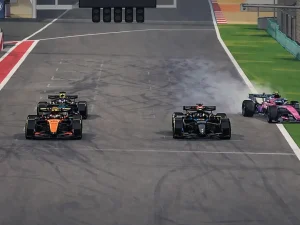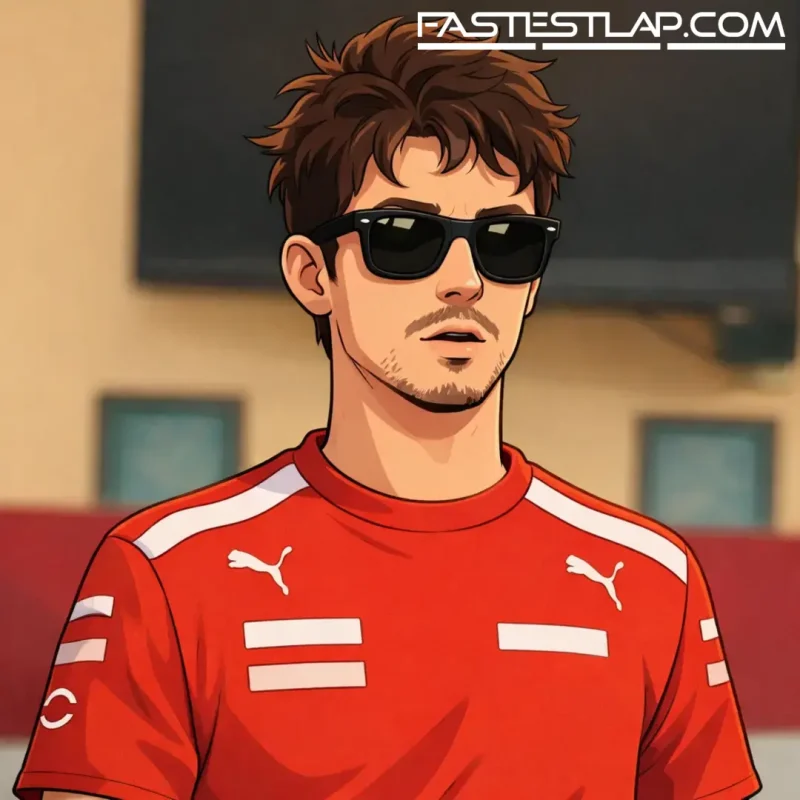
Charles Leclerc isn’t buying the idea that 2026 will magically fix Formula 1’s racing problem. After running in traffic during Bahrain testing, the Ferrari driver says overtaking is already shaping up to be a grimly expensive business — not just in lap time, but in energy.
With the new regulations pushing cars towards a 50/50 split between internal combustion power and the battery, the instinctive, flat-out “go and get him” approach drivers have lived on is being replaced by something more conditional. The question isn’t simply whether you’re quicker. It’s whether you can afford to be quicker for long enough to complete the move and then survive the next phase without paying it all back.
“We’ve checked it, and I kind of share what my colleagues have said,” Leclerc explained in Bahrain. “I find it at the moment extremely difficult to get any overtakes… it always comes with a price whenever you’ve got to overtake, and the price is a lot more costly than it was in the past.”
That word — “price” — is doing the heavy lifting. Under these cars, an overtake doesn’t end when you’re ahead; it ends when you’re far enough ahead to stop bleeding performance to the car behind. If the act of attacking burns through the battery tools you’ll later need to defend, then the pass becomes a trade rather than a gain. And if you empty the tank to get by, you may not have the means to “pull away” in the way we’ve become used to in the last couple of seasons.
Leclerc’s comments land in the same neighbourhood as the early concerns voiced by Esteban Ocon, who said his first proper experience following other cars suggested it “looks to be difficult to pass”. Ocon described losing “quite a lot of front load” when tucked up behind another car — the familiar dirty-air complaint — and while he stressed it was too early for definitive conclusions, the first impressions have hardly been reassuring.
“I’ve been following a few cars,” Ocon said. “You seem to lose quite a lot of front load, a bit more maybe than before… But so far, it looks to be difficult to pass. That’s my first thought about it.”
The uncomfortable subtext is that the sport may be inheriting the worst of both worlds: the aerodynamic hangover of the ground-effect era, plus a racing style increasingly dictated by battery management. In other words, even if a driver does get close enough to think about a move, the mechanics of executing it may be tied to energy deployment windows and recovery demands rather than pure performance advantage.
Leclerc isn’t as apocalyptic as Max Verstappen, who has been the loudest voice pushing back against the new direction and the growing dependency on battery management. But Leclerc’s critique is pointed in its own way: the cars are starting to feel like they’re taking something away from the driver’s ability to attack.
“It’s a huge change for Formula 1, it’s different,” he said. “There’s a little bit less of attack, which is what I loved with previous F1 cars.”
That’s not nostalgia talking — it’s a comment about what makes racing feel like racing from the cockpit. Drivers can adapt to systems; they always do. What frustrates them is when the optimal way to be quick actively discourages the very behaviour fans expect to see: repeated attempts, sustained pressure, and the ability to turn a pass into a decisive swing of momentum.
To be fair, even Leclerc’s caution comes with an asterisk. Testing is testing, and Bahrain running offers only a narrow glimpse. Ocon said the overtake tools and modes still need “adjusted” and “optimised”. Leclerc likewise left room for improvement as teams refine how they manage these situations — which is important, because “how we manage” is precisely where the 2026 era could be won or lost.
The bigger worry isn’t that overtaking will be impossible; it’s that it becomes transactional. If every move requires a significant energy spend, then drivers may start banking those spends for only the highest-value moments: DRS-equivalent zones, strategic phase changes, late-race sprints. That can produce bursts of action, sure — but it can also thin out the relentless lap-by-lap aggression that turns a race into a fight rather than a sequence.
Leclerc, who was already an early critic of the rules a year ago, sounded more resigned than angry this time. The sense is he’s adjusting his expectations to match reality — and focusing on the job of extracting performance from a very different animal.
“It’s getting better but the starting point was extremely different to whatever I’ve been used to in my career previously,” he said. “So many different things, so many new systems that we as drivers need to understand in order to extract the maximum out of those.”
That’s the clearest takeaway from Bahrain’s early traffic running: the learning curve isn’t just for teams on the pit wall. Drivers are being asked to recalibrate how they race, not merely how they drive. And if Leclerc’s right that overtaking now carries a steeper cost — especially the cost of the energy you’ll need later — then the 2026 season may quickly turn into an arms race of management as much as speed.
For a sport that’s spent years trying to engineer closer racing, the fact the paddock’s first shared instinct is “this is going to be hard” should ring louder than any lap time from testing.