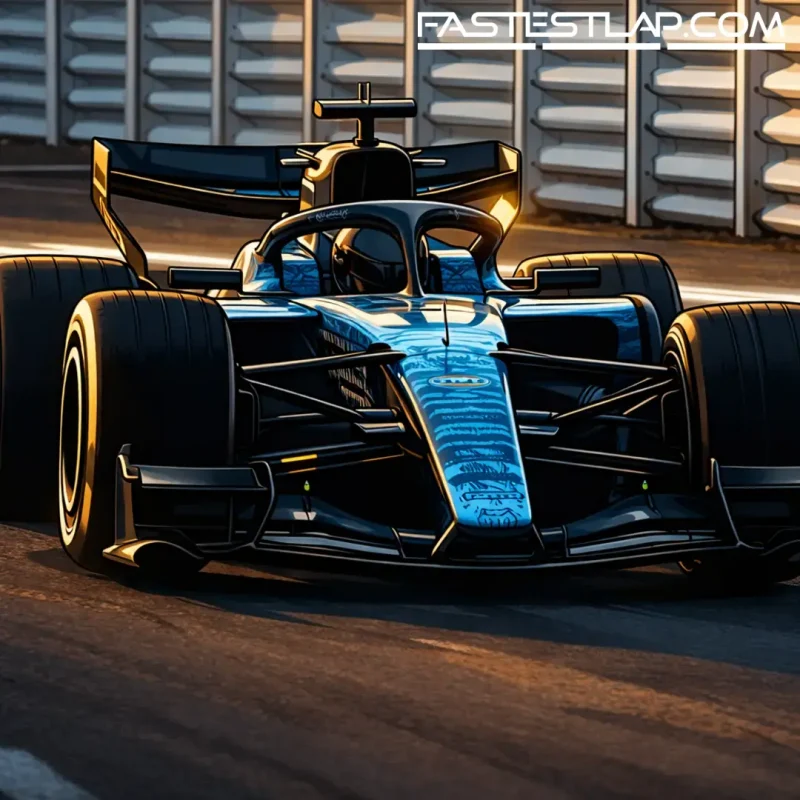
Williams has finally put its first public mileage on the FW48, completing a shakedown at Silverstone with Alex Albon at the wheel — and, inevitably, doing it in a way that underlines where the team’s head is at heading into Formula 1’s 2026 reset.
The Grove squad was the notable absentee from last week’s collective running in Barcelona, citing “delays to the FW48 programme”. In a paddock that treats any missed pre-season opportunity like the opening line of a conspiracy theory, Williams’ absence was always going to invite noise. Wednesday’s images from Silverstone won’t silence every question, but they do at least confirm the car is alive, running, and past the point of being a design-office rumour.
Williams had revealed the FW48’s livery at an event on Tuesday, before rolling the car out at Silverstone the following day. In the photo shared by the team, the car appears in a white camouflage scheme — the same look it had been expected to run in Barcelona — and Albon is pictured bringing it into the pits at the British Grand Prix venue.
“A new era comes to life,” read Williams’ caption. “Today, the FW48 completed a shakedown test at Silverstone.”
If there’s a story here beyond “car runs”, it’s the mindset behind Williams choosing to sit out Barcelona rather than take the hit and go anyway. Team principal James Vowles said last week that Williams could have made the test, but the decision came down to a very modern fear: starting the year without enough spare parts. In an era when the cost cap punishes wasted manufacture as much as it punishes wasted points, that kind of risk calculation has become a competitive weapon in itself — and the sort of call a team makes when it believes the bigger picture matters more than the optics.
Vowles described the decision to miss Barcelona as “incredibly painful”, which tracks. The first weeks of a new regulations cycle are when everyone wants to project confidence, not caveats. But Williams is also coming off its strongest season in years, having finished fifth in the constructors’ championship in 2025 with Carlos Sainz collecting two podiums. That result doesn’t guarantee anything once the sport pivots to the 2026 rules package — 50 per cent electrification, fully sustainable fuels and active aerodynamics — but it does change the internal pressure. This is no longer a team simply proving it can rebuild; it’s a team trying to prove it can strike when a reset offers genuine opportunity.
The driver line-up remains Sainz and Albon for 2026, giving Williams the rare luxury of continuity at the exact moment the technical goalposts have been moved. In practical terms, that matters as much for feedback and development discipline as it does for raw pace. A new rules era always creates a temptation to chase headlines with early lap times, but shakedowns are mainly about correlation and systems checks. The real performance story won’t begin to take shape until Bahrain testing and the races that follow.
Vowles, for his part, isn’t pretending otherwise. Asked where the FW48 sits, he was blunt about the limits of what anyone can know at this stage — even someone with an eye on what rivals have been doing in Barcelona. What he was prepared to put on the record, though, was a judgement of his own operation.
“I think, realistically, the car itself is the best I’ve seen us produce here,” Vowles said. “Those are facts I can put down. But that doesn’t indicate where it is on a timing sheet. That’s what Bahrain [testing] and beyond will tell us.”
That’s the key line. It’s not a promise of pace; it’s a statement about process. And for Williams, process has been the story since Vowles arrived in January 2023. The team is trying to turn “we’ve got a plan” into “we can execute it under pressure”, and 2026 will be an unforgiving exam. Active aero introduces a fresh layer of complexity; the new power unit split changes how teams think about deployment, efficiency and driveability; and every outfit will have to relearn how to balance performance with reliability when the hybrid side plays a bigger role.
Silverstone running won’t answer any of that. But it does at least move Williams out of the awkward limbo created by missing Barcelona — from questions about whether it could run, to questions about how well it can run.
And make no mistake: those are very different conversations.