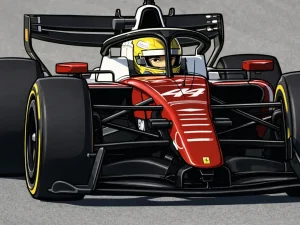
Williams’ FW48 launch was always going to be a little coy. The team’s 2026 car was unveiled with a fresh livery and just enough hard detail to feed the paddock’s appetite, but not enough to give rivals a clean look at what really matters under the skin. Even in an era where everyone claims secrecy is dead, Grove still managed to play its hand with a straight face.
The giveaway was what you *couldn’t* see. Several suspension elements were conspicuously absent from the showcar and the accompanying renders, a deliberate omission that only really makes sense if you think you’ve found something worth hiding. Williams then quietly confirmed in its technical specification document that the FW48 runs pullrod front suspension and pushrod at the rear — a split layout that, by the team’s own admission, sets it apart from the rest of the 2026 field.
It’s an oddball choice in a year where most teams have converged on pushrod at both ends, chasing packaging cleanliness and predictable mechanical behaviour as the new regulations bite. Only Alpine and Cadillac have committed to double-pullrod, leaving Williams alone in the middle: one foot in each camp, and a set-up direction that suggests the team has prioritised different aerodynamic and packaging targets front-to-rear rather than following the herd.
That decision lands with extra weight because Williams has been talking up 2026 for years as the reset that could move it from “best of the rest” aspirations to something more substantial. Last season was its strongest since 2017, with Carlos Sainz dragging the project into the spotlight with two podiums as the team finished fifth in the constructors’ standings. The ambition is clear: stop being the team with occasional good Sundays and become the team that expects them.
And yet the build-up hasn’t been perfectly smooth. Williams was the only outfit to miss the first pre-season test in Barcelona, citing “delays in the FW48 programme.” In a sport that treats early mileage like oxygen, skipping a test invites the kind of whispering that spreads in the motorhomes faster than any official statement. The easy narrative writes itself: bold design, late arrival, hidden components — are they chasing something and running out of time?
James Vowles, though, sounded more like a man enjoying the fact people are looking closely again. He’s been dropping hints that the FW48’s front end has a “slightly different” solution to most of the grid, while also drawing a clear line between “different” and “unhinged”.
The benchmark for unhinged, in this particular conversation, is Adrian Newey’s Aston Martin AMR26 — a car Vowles praised openly, then half-joked he wouldn’t want to be responsible for signing off.
“It’s really impressive,” Vowles said when asked about Aston Martin’s 2026 machine. “Adrian is just a creative designer and it’s really impressive what he’s done with wishbones in places that I don’t think they should be, but he’s done them.
“In terms of Adrian, I’ve sort of intonated it a bit, but you’ll see it on our front wishbone. It’s slightly different. But where Adrian’s gone is… Adrian: very impressive, very creative, very extreme. I wouldn’t want to be the designer for that one, let’s put it that way.”
That’s a revealing comparison, because it frames Williams’ approach as calculated rather than purely provocative. The FW48’s suspension split isn’t about being weird for the sake of it — it’s about targeting a specific set of compromises. A pullrod front end can help with certain packaging and aerodynamic objectives around the nose and front wing flow structures; a pushrod rear can offer advantages elsewhere in terms of access, stiffness targets, and how you choose to package the back of the car. In other words, Williams is trying to land the car in a narrow performance window — and doing it in a way that implies it hasn’t found that window by copying everyone else.
There’s another thread Williams has been keen to kill off, too: weight. The Barcelona absence sparked speculation that the FW48 could be as much as 30kg over the minimum at this point — a figure that would have been catastrophic given how hard it is to claw weight out once architecture is set. Williams has since moved to calm that noise, stating the car weighs 772.4kg, which is 4.4kg above the 2026 minimum of 768kg.
That’s not ideal, but it’s not the apocalypse either — and, crucially, it’s close enough that normal development can realistically take care of it. For context, Williams also noted that Mercedes’ W17 was 772kg at launch, and that car is widely regarded in the paddock as the early reference.
Put all that together and Williams’ pre-season picture becomes clearer: a team that believes it has made a meaningful technical call for 2026, a team still guarding the details, and a team that knows it will be judged quickly once the Bahrain running begins.
Because that’s the thing about trying something a little left-field with suspension philosophy: it’s not just a mechanical choice. It shapes the aero map, the tyre behaviour, the driver’s confidence on entry and traction on exit — and, by extension, how often Sainz and Alex Albon can actually lean on the car rather than manage it. If the FW48’s concept works, Williams won’t just have a faster car; it’ll have a car that’s fast in a way the drivers can access consistently. If it doesn’t, the split layout won’t look brave — it’ll look like the kind of deviation you make when you’re searching.
Williams has spent the last year rebuilding credibility on-track. The FW48 is its attempt to prove the momentum is structural, not situational. Bahrain will be the first time anyone gets to see whether the parts left off the launch car were theatre — or the start of something properly serious.