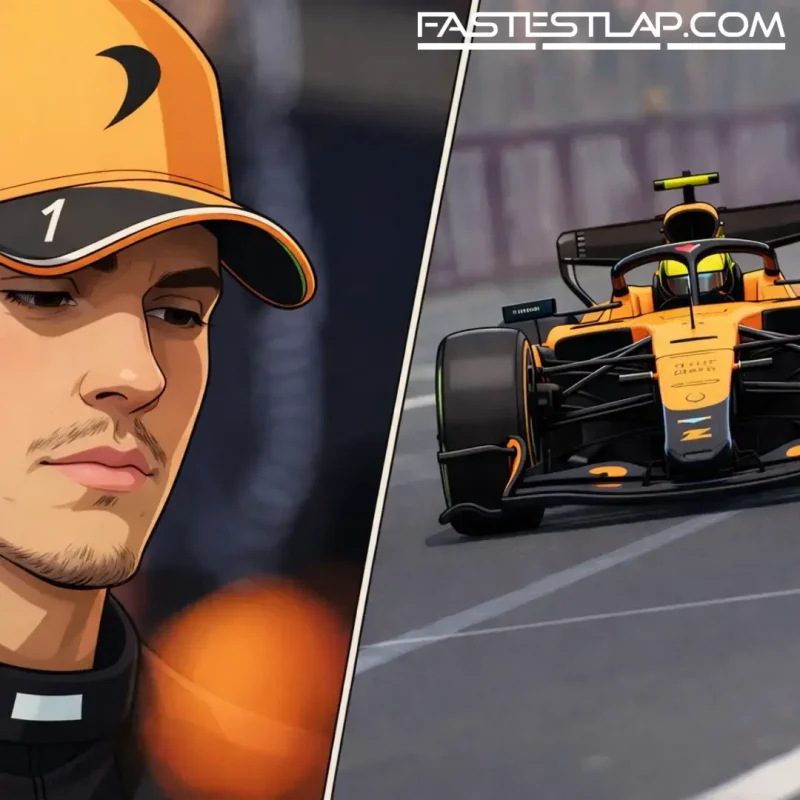
Lando Norris didn’t look like a man relieved to have banked points on a messy opening weekend. Fifth in Melbourne is the sort of result you file away as “damage limitation” in March, but the reigning world champion climbed out of his McLaren wearing the expression of someone already tired of the conversation 2026 is forcing everyone to have.
The headline, from Norris’ side, is simple: the new cars feel worse on Sunday than they do on Saturday.
He’d started sixth and converted it into fifth after Oscar Piastri’s pre-race crash left McLaren effectively playing the Australian Grand Prix with one hand tied behind its back. Up front, the Mercedes and Ferraris were in their own fight, leaving Norris marooned in that uncomfortable no-man’s land where you can see the leaders but never really threaten them.
What made his afternoon feel like something more than an anonymous top-five was the late pressure from Max Verstappen. Verstappen had been forced to recover from a troubled start, and by the closing stages he’d arrived on Norris’ gearbox with enough pace to make it feel inevitable. Instead, the pair fell into what McLaren described as “energy chess” — the new rhythm of 2026, where the battle isn’t only about tyre life and DRS, but about who can spend, harvest and defend at precisely the right moments.
Norris won that particular game, holding Verstappen off. Yet the broader picture was grim: he finished 51 seconds behind George Russell at the flag. That gap, as much as anything, framed his post-race tone. This wasn’t a champion shrugging off an off-day. It sounded like someone looking at the new baseline of the sport and not liking what he sees.
“It’s not as fun as last year,” Norris said, bluntly, before landing the line that will follow him around the paddock for a while: in race trim, the 2026 cars are “even worse” than they are in qualifying.
There’s been a noticeable shift in his body language since the early running. In Bahrain testing he’d been able to poke fun at the quirks of the new machinery. Melbourne hardened that into something closer to an indictment. Norris went as far as calling these cars the worst F1 has produced — mirroring Verstappen’s view that the 50/50 split between internal combustion and electric power simply doesn’t deliver the sort of racing drivers actually want to take part in.
The uncomfortable bit, for anyone hoping the spectacle would sell itself, is Norris’ insistence that what looks like overtaking is often just the by-product of battery offsets — cars arriving with wildly different deployment states, creating speed differentials that don’t necessarily reflect underlying performance.
“Way too much. It’s chaos,” he said. And he didn’t sound like he meant it as a compliment.
His worry isn’t aesthetic; it’s safety. Norris painted a picture of drivers effectively bracing for the moment the numbers don’t line up and someone gets collected at a huge closing speed. In his view, the current dynamic can produce 30, 40, even 50kph differences depending on what the power unit is doing, and he openly talked through the consequences of a hit at that kind of delta.
That’s not the sort of language drivers reach for casually, and it’s rarely the tone you hear from someone who has just defended against Verstappen under pressure to start a season. Norris sounded more like a driver who believes the sport has wandered into a competitive format where too much is being dictated by systems logic rather than instinct, feel and readable racing.
He’s also not offering solutions — and, to be fair, he’s right to be wary of being pulled into the role of rule-maker in the media pen.
“There’s nothing we can change about it, so there’s no point talking about it anymore,” he said, before adding the caveat that drivers will still say what they need to say.
What Norris did accept, without dressing it up, is that McLaren’s own job isn’t good enough right now. Even with the late defensive highlight, he was clear the team simply isn’t in the fight with the cars that mattered at the front. The opening lap, he noted, wasn’t as strong as those around them — another small detail, but telling in a formula that’s supposed to reward precision and preparation more than ever.
In other words: yes, he thinks the rule set has created something fundamentally awkward. But he’s not hiding behind it. McLaren, in his eyes, has missed the mark relative to Mercedes and Ferrari, and Melbourne underlined just how much ground there is to make up.
It’s only round one, and everyone in F1 knows early-season form can be deceptive under a fresh set of regulations. But when the world champion comes out of the first race talking about artificiality, chaos and looming accidents — and does it after a clean, professional drive to fifth — you don’t dismiss it as post-race grumpiness.
This is the opening note of 2026. And Norris is already telling you he doesn’t like the tune.