Lewis Hamilton’s first year in red ended with something he’s never worn well: silence on the podium front. A season of combative Sundays and scratchy Saturdays wrapped with P8 in Abu Dhabi, and with it the statistical sting — no grand prix podiums across his debut Ferrari campaign.
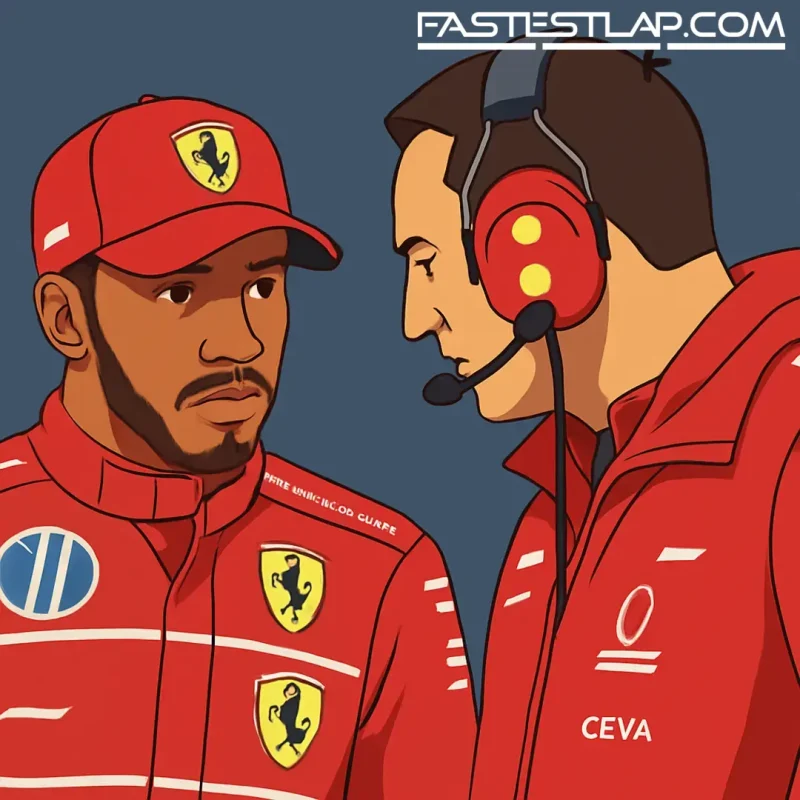
This wasn’t just about a tricky car. According to Karun Chandhok, the other soundtrack that went missing mattered just as much: the symphony Hamilton used to conduct with Peter Bonnington. Leaving Mercedes meant leaving Bono, the most familiar voice of his F1 life. At Ferrari, Hamilton’s had to build a brand-new rhythm with Riccardo Adami, and Chandhok reckons the beat never settled.
“Mercedes are the gold standard at how they talk to their drivers,” Chandhok argued on The Fast and the Curious podcast. Years of trust made that Lewis–Bono radio feel telepathic — concise prompts, no fluff, the right data at the right moment. Ferrari, he suggested, is a different ecosystem. New engineer, new language, new culture, new shorthand. And when the margins are razor-thin, misfires in communication show up on the stopwatch.
It’s not as if Hamilton walked into Maranello expecting plug-and-play. He switched teams after 12 seasons and six titles with Mercedes, knowing Bono couldn’t follow due to a no-poach agreement. No more “It’s Hammer Time.” No more instinctive half-sentences that carried the weight of a decade. At Ferrari he’s been learning everything — car traits, processes, the code of the garage — while also trying to decode the SF-25’s braking feel, energy management and balance. The result, more often than not, was recovery drives that didn’t quite recover enough.
Chandhok drew a sharp contrast with Charles Leclerc’s side of the garage. Leclerc is seven years deep at Ferrari, with a settled cadence alongside race engineer Bryan Bozzi. That stability showed — he outscored Hamilton convincingly across the year — while Hamilton, per the former F1 driver, was still finding the edges of what he needed from Adami and the pit wall.
If this all sounds a bit soft-skill for a sport obsessed with tenths, it’s not. Communication is performance. Look around the grid: Max Verstappen and Gianpiero Lambiase spar like brothers and then go faster for it. George Russell and Marcus Dudley at Mercedes have honed a crisp, data-first rhythm that mirrors the team’s culture. Every pairing has a dialect, built over time.
Chandhok’s prescription for Hamilton was pragmatic. Know your personality; define what you want; fast-track the learning. Study how the best engineer-driver duos feed each other information. Be explicit with the pit wall about timing, tone and detail. In other words: write the radio playbook you need, then rehearse it until it’s second nature.
None of that absolves Ferrari of its own homework. The SF-25 was good enough, often, to threaten the podium on raw days, but not consistent enough to make it a habit. The team ended the campaign without a win, and Hamilton’s lone-bright-spot weekends tended to peak in traffic rather than on the rostrum. That speaks to underlying issues that go beyond radio craft — bite under braking, confidence on turn-in, and how the power unit’s deployment dovetails with Hamilton’s driving style. Those are solvable, but not overnight.
The encouraging bit? Relationships can catch up faster than cars, and winter is where you close the gaps you can control. Hamilton’s had 24 race weekends with Adami. That’s a foundation, not a finish line. There were flashes late in the year of cleaner exchanges and better pre-empting of scenarios — the kind of progress that doesn’t make highlight reels but shifts results by two or three positions when the field is covered by a blanket.
Ferrari’s job now is to sharpen the package and keep the dialogue simple. Hamilton’s is to squeeze the learning curve, be ruthless about the information he wants in the cockpit, and keep leaning into what he does better than almost anyone: pattern recognition at 300 km/h. He finished the season sixth in the standings, well behind Leclerc, and that will sting. It should. He didn’t come to Maranello to make up numbers.
What he did bring, though, is a decade-plus of living at the edge of excellence with a pit wall that matched him heartbeat for heartbeat. Build that again — in Italian, in Adami’s cadence, in Ferrari’s way — and the rest tends to follow. The car needs to move forward; the radio needs to move faster. If both happen, the next time we talk about silence, it might be the blessed kind that falls just before a national anthem.