George Russell didn’t just lose out to Kimi Antonelli in Silverstone qualifying — he spent most of Saturday feeling like he’d turned up to a drag race with the wrong rear wing bolted on.
Russell will line up fourth for Sunday’s British Grand Prix, a decent recovery on paper given his early wobble in Q1. But it also came with a clear edge of frustration, because the other Mercedes wasn’t merely ahead — it looked freer, faster and, crucially at this circuit, cleaner through the air.
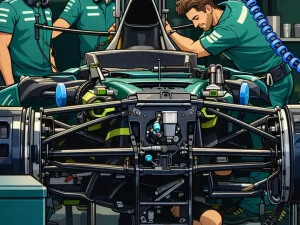
An uncharacteristic moment at Luffield nearly turned Russell’s afternoon into something far messier. An inside-front lock-up at the long right-hander pitched him into the gravel in Q1. He gathered it up, rejoined, and ultimately did enough to get his session back on track. There was, he said, no damage to the W17. The problem was something more nagging: straight-line speed that simply wasn’t there.
“All weekend we’ve been losing lots of time in the straights,” Russell explained afterwards. And he wasn’t talking in vague driver-speak. He pointed to the numbers Mercedes will have been staring at all day in the garage: speed-trap deficits that add up to lap time you can’t claw back with bravery in the high-speed stuff.
“Yesterday in Q3, it was almost three tenths I lost in the straights,” he said. “Again today in qualifying, you look at the speed traps, it’s 3k down middle sector, 6k down in the last sector compared to my teammate and compared to the McLaren cars.”
That’s the part that stings. If Russell is down to Antonelli by a click or two, you can talk about tow effects, micro-errors, differing prep. But when the same car — same team, same day, same conditions — is consistently quicker on the straights in the other half of the garage, it stops looking like “one of those things” and starts looking like something tangible Mercedes can, in theory, fix. Or at least explain.
Mercedes thought it might have. Russell revealed the team arrived at Saturday morning believing it had found the culprit, with suspicions around the brakes. “We thought we found the problem this morning and we thought the brakes were locking on,” he said, before adding that they weren’t convinced that was the issue. The effect, though, has been obvious from the cockpit: going into qualifying already feeling compromised.
“The deployment looks okay,” Russell insisted, ruling out the kind of energy-release quirks that can bite over a lap. “I’m just offset on speed in the straight – it just looks like I’m running a draggier car is the look.”
In other words, Antonelli’s Mercedes is cutting through the air and Russell’s is paying a tax, and Silverstone is the sort of place where that tax becomes public. You can carry a small deficit at a twistier venue and hide it in traffic. Here, with long full-throttle stretches and clear speed-trap reads, there’s nowhere to tuck it away.
The bigger context is hard to ignore, too. Antonelli didn’t just nick pole — he’s backing up momentum from the Sprint win, while Russell is having to frame his weekend around damage limitation and salvage. Russell even admitted that without the straight-line deficit he’d have been closer to the sharp end. “I wouldn’t have been on pole for sure,” he said, “when I definitely would have been higher up yesterday, and I think in the fight for pole yesterday and today.”
That’s an important distinction. Russell isn’t claiming the pole was his, but he is making the point that the margin to the front is being inflated by a problem that shouldn’t be inherent to his performance.
For Mercedes, it’s the sort of headache that can turn political quickly if it lingers — not because anyone’s accusing anyone of anything, but because modern F1 teams run on trust and symmetry. When one driver feels he’s carrying extra drag and the other is taking trophies and pole positions, engineers don’t just need the fix; they need the explanation to land cleanly, internally and externally.
As for Sunday, Russell’s job is straightforward and messy at the same time. Fourth is a strong launchpad at Silverstone, but if your car is down the straights, overtaking becomes more expensive and defending becomes a gamble. He’s talking podium, and with the pace Mercedes has shown across the weekend, it’s not unrealistic — but he’ll need the race to offer him something qualifying couldn’t: options.
“The team are working super hard to understand why that is,” Russell said. If they can’t, he may find himself spending the British Grand Prix watching the other Mercedes disappear into the distance — again — and that’s a story Mercedes can’t afford to let run for long.
Russell goes into the race 43 points behind Antonelli in the championship. On current form, that number feels less like a gap and more like a warning light. Sunday at Silverstone won’t decide a season on its own, but if Mercedes can’t get to the bottom of why one W17 is consistently faster in a straight line than the other, Russell’s summer could start to look like a long chase with the wrong tools.