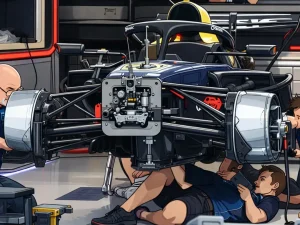
Miami is shaping up to be one of those “nothing’s changed on paper, everything’s changed in the garage” weekends.
Behind the scenes, the FIA and FOM have been in the room with the power unit manufacturers and teams, trying to sand down the rough edges of this season’s energy-management behaviour. Two of three technical meetings have already taken place, with a final sit-down scheduled for 20 April where a vote is expected to land on a tweak aimed at restoring something closer to a natural driving rhythm — without ripping up the broader concept.
Nobody is talking about rewriting the fundamentals, and there’s little appetite for anything as dramatic as altering the split between internal combustion power and the electrical side. The sense in the paddock is still that the current package can produce good racing. The problem is what it’s been asking drivers to do to extract it.
The leading idea being discussed is deceptively simple: vary the maximum harvestable energy figure from circuit to circuit.
Right now, teams can harvest up to 8.5MJ back into the 4MJ battery over a lap, then redeploy it as a 350kW kick alongside the ICE. In the pursuit of hitting that harvesting number, the driving has, at times, looked more like an energy accountant’s spreadsheet than an attack lap — pronounced lift-and-coast, odd downshifts on straights, and a general reluctance in corner approach, all in service of making sure the car has enough electrical deployment for the important bits.
Drivers haven’t been shy about how unnatural it feels. One exploration already happened at Suzuka, where the maximum harvest figure was trimmed to 8.0MJ. The expectation now is that the cap could be reduced more aggressively depending on circuit characteristics — potentially into the 5.0–6.0MJ range — as a way of cutting off the need for the most extreme techniques without gutting lap time.
The sting in the tail is procedural: there’s no testing to lean on. So if the rule tweak is approved, Miami is where everyone learns what it really means.
And Miami is a sprint weekend. One practice session, then you’re into parc fermé territory and competitive running. There isn’t the usual luxury of spending Friday building a setup baseline, then circling back for the finer points. If energy-management software behaviour changes, teams are going to have to validate it in real time — in the one hour they’re also meant to sort tyres, balance, ride, and everything else that normally gets tidied up across multiple sessions.
Haas head of car engineering Hoagy Nidd put it plainly: it won’t turn the weekend upside down, but it will nudge the entire agenda.
“Obviously, with the changes to the energy management, that’s something that is more managed by our power unit partners, and they will come up with a strategy based upon that,” Nidd explained, adding that power unit manufacturers will need to introduce software changes. He noted that some submission deadlines for updated code ahead of the event have been pushed back slightly, giving manufacturers more time to write, deploy and get at least some level of validation before arriving trackside.
From there, it becomes a team problem — and a driver problem.
“In terms of extra work we need to do, we need to dedicate a bit more time to understanding what the changes mean, and then how that will affect our vehicle performance,” Nidd said. The consequence, as he sees it, is that Friday’s lone practice becomes less about the usual opening-session routine and more about proving that the new energy tools behave as expected.
Normally, you’d expect those early runs to be devoted to the essentials: dialling the car in, making some quick mechanical and aero steps, getting the drivers comfortable, doing the first tyre reads. That still has to happen — but now it shares space with running through energy modes, deployment behaviour, overtaking boost characteristics, and even launch performance. Those are all things you’d rather have validated before it counts, and Miami’s format means you’re forced to do it in a compressed window.
The irony is that reducing harvest doesn’t magically “fix” the driving feel by itself; it changes where the team can most efficiently hit its targets. Nidd’s view is that a lower recharge limit can help move energy collection back into the places where it feels normal — braking zones and grip-limited corner sequences — rather than asking drivers to manufacture recovery in awkward parts of the lap.
If teams can achieve their energy numbers in conventional phases, the worst excesses start to disappear. No need to chase “the final mega joule” by lifting early. No need for heavy “clipping” tricks. No need for drivers to nurse the throttle on corner exit just to stop the car deploying in the wrong place and starving the next straight.
That said, Nidd also acknowledged the broader reality: these are workarounds around hardware constraints, not some elegant end-state. It’s a compromise designed to smooth out the product with what the grid currently has.
There’s another layer here that matters, especially at Miami: who controls the levers.
Haas, running Ferrari customer power, sits on the receiving end of whatever software and strategy architecture its supplier brings. Nidd — who has experience on the works side, having spent 11 years at Mercedes and time with Ferrari’s power unit operation — didn’t sugar-coat the dynamic. Customer teams can feed back, but they aren’t the priority when the big decisions are made and the first iterations are developed. The factory team naturally comes first.
That’s not presented as complaint so much as the baseline reality of modern F1. Haas can work closely with Ferrari, and Nidd described the relationship as one of the better partnerships he’s seen, but he also admitted that with the added complexity of energy management this year, customers can find themselves living with what they’re given early on — simply because they don’t have full visibility on how the software will behave until it arrives.
All of which makes Miami’s single practice session feel less like a warm-up and more like a live systems check.
If the meeting on 20 April produces the expected vote and the FIA pushes through a circuit-specific harvest reduction, the stopwatch story in Miami might not be the only one worth watching. How quickly teams can understand the new energy behaviour — and how cleanly drivers can revert to instinct rather than choreography — could decide who looks comfortable by Saturday, and who spends the weekend chasing a moving target with no time left to catch it.