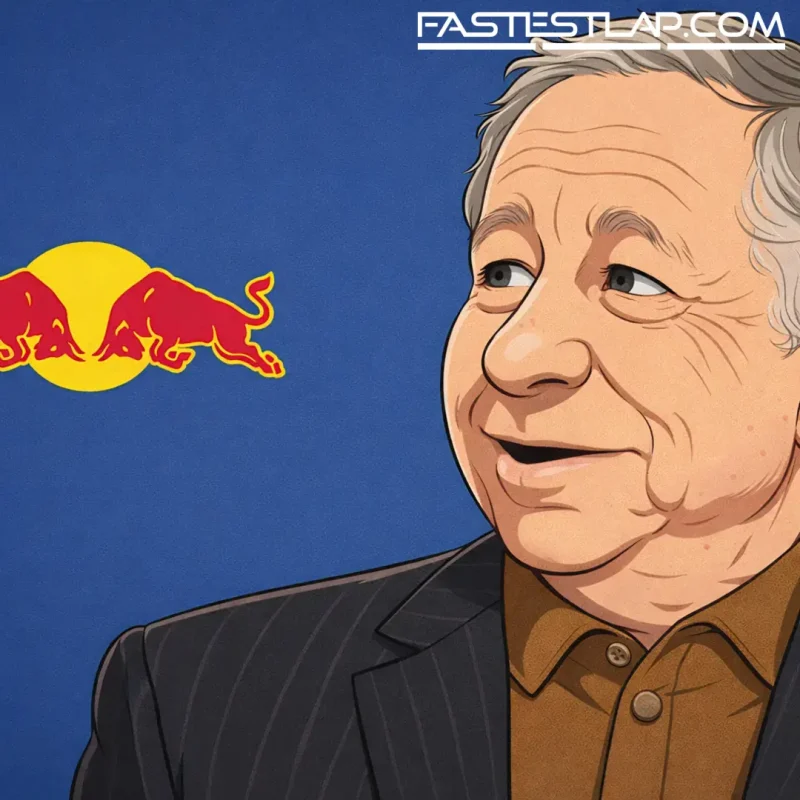
Jean Todt has never been shy about closing a chapter cleanly, but one detail from his post-Ferrari exit adds a delicious “what if?” to modern F1 history: Dietrich Mateschitz tried — twice — to lure him into running Red Bull’s racing operation.
Speaking on the *High Performance* podcast, Todt said the late Red Bull co-founder visited him at his home in Paris on two occasions, pitching a role that would have put Todt above the day-to-day structure already in place at Milton Keynes. Christian Horner was team principal, Helmut Marko the key adviser, yet Mateschitz wanted Todt to steer the broader motorsport project.
Todt wasn’t tempted.
“I decided in 2008 that it was time to give something back,” he said. “My interest was to give something back… he came to have lunch at home in Paris with me twice. To run the team and to run the motorsport activities of Red Bull. And I said no because for me, this chapter was over.”
That “chapter” was, of course, Ferrari — and not just any Ferrari stint. Todt arrived in Formula 1 in 1994 as general manager, recruited by Luca di Montezemolo to drag a sleeping giant into a new era. A year later he convinced Michael Schumacher to make the leap from Benetton, then brought in two more cornerstone hires from that orbit: Rory Byrne and Ross Brawn. It was a set of decisions that re-shaped the competitive order and turned Maranello into the sport’s benchmark.
The results were clinical: five consecutive drivers’ titles from 2000 to 2004, and six constructors’ crowns in that period — dominance that only looks less alien because Mercedes later went on its own run from 2014 to 2020. By the time Todt stepped away in March 2008 — having progressed from CEO to special adviser — he’d essentially completed the archetypal team-building mission: assemble the right people, empower them, let them win, then leave before the story curdles.
That context matters, because it explains why Mateschitz’s pitch didn’t land. For Todt, the Red Bull offer wasn’t the exciting start of something new; it was another turn of the same wheel, and he’d decided he’d done enough turning.
“I was running an iconic brand with success,” Todt said. “So in a way, I could not do better, and I wanted to do other things.”
Instead, he moved towards governance and public service — running for FIA president and winning, then serving three terms at the head of the sport’s governing body. After that, he was appointed by UN Secretary-General Ban Ki-moon as the United Nations Special Envoy for Road Safety, and has remained involved in charitable work.
Todt’s explanation for that pivot is less about career planning and more about values — a conscious decision to step away from the insular logic of F1, where the bubble can convince smart people that lap time is the whole world.
“It’s still the part of my life where I want to give something back,” he said. “In some worlds, when there is competitiveness, money, people forget that. That’s why it is important to travel to see poverty, to see people who don’t have access to medical care… and to try to give a little hand.”
He’s not dressing it up as a grand mission, either. Todt was careful to frame it as incremental impact rather than salvation narratives. But the line that lands is the one that would probably make plenty of paddock lifers pause: making someone smile can be “a win” — just a different kind.
As for Red Bull, Todt’s anecdote also underlines something long understood about Mateschitz’s approach: he wasn’t afraid to go straight to the top, even if it meant awkward overlaps in authority. Imagining Todt parachuted into that structure while Horner and Marko remained in situ is fascinating purely as a study in power dynamics. Todt’s Ferrari success was built on clarity of leadership and an almost ruthless commitment to getting the right individuals into the right seats. Red Bull, even when it’s winning, has often been a more openly political ecosystem.
But Todt didn’t bite — and the reason wasn’t that he doubted Red Bull’s potential. It was simpler than that. He’d already done the job he wanted to be remembered for, and he didn’t need another pit wall to prove it.