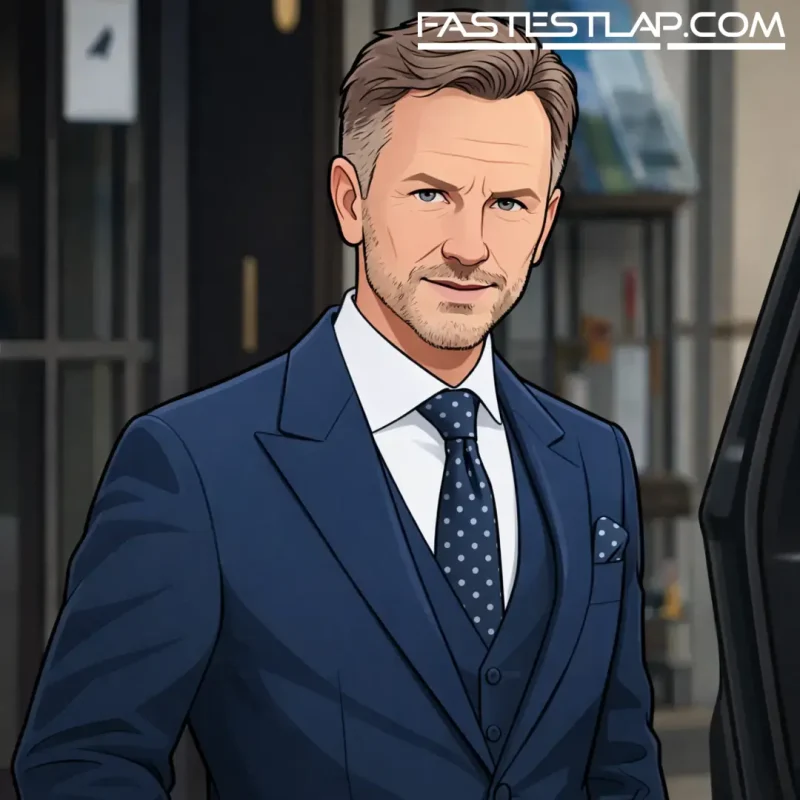
Christian Horner has a habit of turning up where the sport’s decision-makers are congregating, and on Saturday he did it again — this time in Jerez, in the MotoGP paddock, shoulder-to-shoulder with Formula 1 CEO Stefano Domenicali.
It was the sort of low-key cameo that instantly invites interpretation, because Horner isn’t just any recently unemployed team boss killing time between consultancy calls. He remains one of the most connected figures in the modern F1 ecosystem after Red Bull’s decision to sack him in the aftermath of last year’s British Grand Prix, ending a reign that stretched more than two decades at the helm of the Milton Keynes operation.
Horner subsequently agreed a settlement with Red Bull in September 2025 worth $100million, and ever since, the paddock has treated his “next move” as less of a question and more of a timetable. Jerez didn’t answer that directly — but it did offer a pointed reminder of where his relationships still run deep.
The most eye-catching element of the visit was where Horner spent time: the Honda factory team garage, where he was seen catching up with Koji Watanabe, president of Honda Racing Corporation. That’s a significant reunion given the scale of the Red Bull-Honda project between 2019 and 2025, a partnership that delivered four straight world titles for Max Verstappen before Honda pivoted into a new technical relationship with Aston Martin ahead of the 2026 season.
And that’s where the subtext gets interesting. Horner has been persistently linked with Aston Martin in recent months, with the suggestion he’s in contention for a senior role and remains in regular contact with executive chairman Lawrence Stroll. The talk in those circles has been of a CEO-type position — not simply a figurehead — potentially tied to equity. If you’re trying to read tea leaves, there aren’t many more direct ones than a former Red Bull principal, an F1 powerbroker in Domenicali, and Honda’s top racing executive all in the same paddock on the same day.
Horner, though, played it straight when speaking on the MotoGP television feed. Asked about the prospect of buying into a MotoGP team — a question that makes more sense than it would’ve a year ago, given MotoGP now sits under the same Liberty Media umbrella as F1 — he leaned into enthusiasm rather than intent.
“I have always been a big fan of MotoGP,” Horner said. “While I’ve got a little bit of time, I thought it was a good opportunity to come down and have a look at the championship.
“Obviously, [MotoGP] is under new ownership now, in common with Formula 1, and it’s great to see the bikes and how they have evolved.”
He added that his last MotoGP visit was Estoril in 2005 — an eyebrow-raiser in itself, given how much his life has been consumed by F1 since — and described the current moment as “a really interesting time” for the championship as it transitions under Liberty’s ownership.
“It’s great racing. It’s a great show. The riders are incredible and the bikes are incredible,” Horner continued. “It’s only when you get to see it live that you appreciate how insane these machines are.
“I think as a sport, it has so much to offer, so hopefully the Liberty guys, with the experience they have in Formula 1, will be able to lean into that. I know Stefano is very passionate. I’m here with him today, so there’s going to be some synergies there.”
“Synergies” is the kind of word that can mean everything and nothing — but in the current climate, it also points to something else: influence. Horner’s value to any operation has never been limited to what happens on a pitwall. He understands governance, commercial strategy, the politics of rule-making, and, crucially, how to make a project feel inevitable long before it wins anything. If Liberty is serious about borrowing F1’s playbook to reshape MotoGP’s presentation and business model, then spending a Saturday with one of F1’s most consequential operators is hardly a waste of time.
There’s also a broader context here: cross-pollination between the two championships is no longer hypothetical. Former Haas team principal Guenther Steiner made the jump from F1 to MotoGP last year, fronting a consortium that bought the Tech3 team. Alpine driver Pierre Gasly was named among the investors in that deal, making him the first active F1 driver to invest in a MotoGP outfit. The notion that senior F1 figures might take stakes, advisory roles or leadership positions in MotoGP isn’t some far-fetched fantasy anymore — it’s a live pathway.
Horner’s name has been attached to serious business on the F1 side, too. Alpine confirmed in January that a group of investors including Horner is among those interested in purchasing Otro Capital’s 24 per cent stake in the team. That alone suggests he’s not simply shopping for a new job title; he’s positioning himself where ownership, governance and long-term leverage intersect.
So was Jerez a scouting mission, a social visit, or a carefully staged reminder that Horner still has access to the sport’s most important rooms? The answer is probably “a bit of all three”.
What’s clear is that he’s not in hiding, and he’s not waiting quietly for the phone to ring. He’s being seen — in the right places, with the right people — at a moment when both F1 and MotoGP are being reshaped by the same commercial force. In 2026, that overlap matters. And Horner knows it.