Red Bull’s done a neat job this week of reminding the paddock that, even in an era of tightly defined regulations, the quickest way to change the conversation is still to bolt something clever to the back of the car and roll it out where everyone’s cameras are pointed.
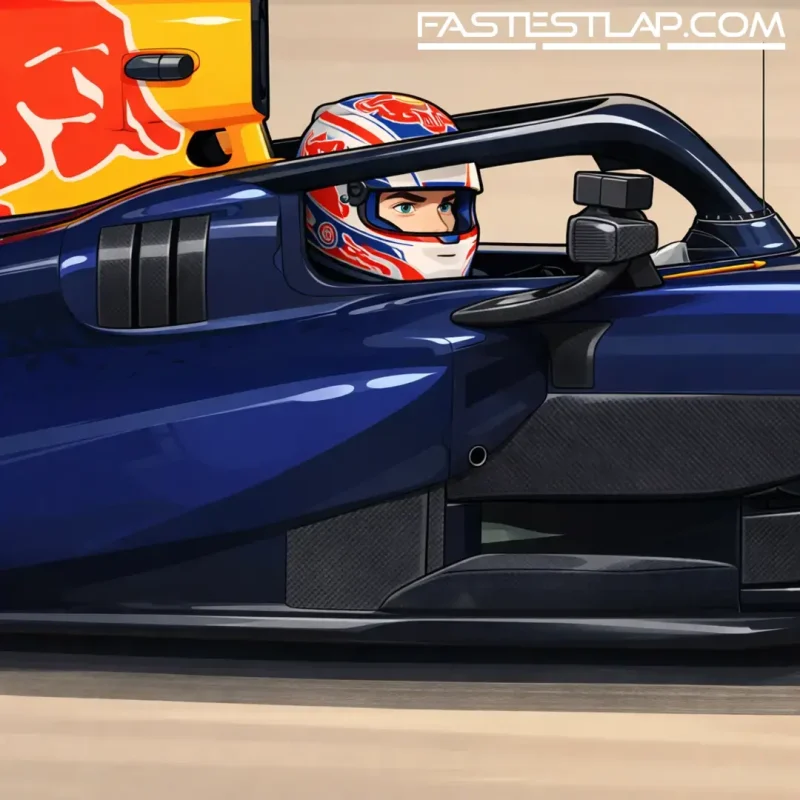
Images from a Silverstone filming day appear to show Max Verstappen running a rotating rear-wing concept on the RB22 — the sort of visual that instantly triggers the familiar paddock reflex: half the pitlane squints at grainy photos, the other half reaches for the rulebook. The device looks broadly aligned with the “macarena” rear wing Ferrari unveiled in Bahrain pre-season testing, a piece of engineering theatre Ferrari has yet to commit to in a grand prix setting.
What’s important isn’t just whether Red Bull is copying Ferrari, or vice versa — this isn’t schoolyard plagiarism, it’s high-speed iteration. It’s the subtext: Red Bull is clearly willing to explore moving aero concepts aggressively in 2026, and it’s doing so in public, on a day designed for controlled running but inevitably loaded with signals. Even if the rotating element never sees a Sunday, the exercise can still be valuable: correlation, understanding sensitivities, and learning how far you can lean into a concept before it starts biting you in instability, drag, or legality.
It also sounds like the rear wing isn’t the only item on the menu. The run is said to be part of a broader upgrade package with changes to the front wing and sidepods. That matters because no rear wing concept lives in isolation — if you’re trying to unlock a new operating window at the back of the car, you often have to rebalance the entire aerodynamic map to make it usable across a lap, not just on the straight where the photos look most dramatic.
While Red Bull’s engineers were doing their talking with carbon fibre, the off-track rumour mill carried on doing what it does best: stretching small threads into big narratives.
Martin Brundle, speaking as a Sky F1 pundit, has played down the idea that Christian Horner’s next move is a straightforward hop into Aston Martin. The logic is simple enough. Horner has been linked with Aston since his departure from Red Bull last year, but Brundle’s read is that Horner is more likely to sit tight and wait for the right circumstances rather than jump at the first high-profile vacancy.
There’s another layer here, too: in modern F1, “joining” a team can mean any number of things. Alpine has already confirmed Horner is among those interested in purchasing Otro Capital’s 24 per cent stake in the team, which adds a different dimension to how he might re-enter the sport’s power structures. Ownership interest isn’t the same as turning up on Monday with a team principal’s badge — and the distinction matters when you’re trying to understand which rumours are about influence and which are about job titles.
And then there’s Helmut Marko, never one to leave a storyline alone when there’s an extra angle to add. The former Red Bull adviser has claimed his disappointment over Verstappen missing out on the 2025 title was “the reason” behind his exit. Verstappen lost the championship to McLaren’s Lando Norris by just two points after last year’s Abu Dhabi Grand Prix — a margin so tight it invites the kind of internal post-mortems that can either sharpen an organisation or fracture it.
Marko’s framing is revealing because it turns a personnel change into an emotional verdict on performance. Red Bull has long prided itself on being ruthless and forward-looking, but the Verstappen/Marko era was also built on a particular kind of alignment: total clarity of purpose, and a shared belief that the programme’s job was to manufacture winners. When a season ends with “two points” as the headline number, it’s easy to see how disappointment becomes a catalyst — and how that disappointment can be weaponised, even unintentionally, in explaining why key figures move on.
Away from the politics and prototypes, Red Bull also ticked the box of pure showmanship. Yuki Tsunoda climbed back into an F1 cockpit for a demonstration run in Istanbul on Friday, a timely bit of fan service after confirmation that the Turkish Grand Prix will return to the calendar on a five-year deal from 2027. For Tsunoda, now serving as Red Bull’s reserve after losing his race seat to Isack Hadjar at the end of 2025, it’s a reminder of how quickly the sport’s conveyor belt moves: one year you’re racing, the next you’re the face of an event — still in the picture, but looking in from a different angle.
Finally, McLaren’s Zak Brown swatted away one of the week’s more persistent whispers, calling rumours of team principal Andrea Stella returning to Ferrari “total nonsense”. Brown went a step further, suggesting the speculation came from “a team or two stirring it.”
That’s classic paddock tradecraft: destabilise a rival by tugging at a key name, see if it creates noise, and hope the distraction costs them time. Brown’s choice of words suggests McLaren isn’t merely dismissing the rumour; it’s pointing a finger at motive. Stella’s trajectory — following Fernando Alonso from Ferrari to McLaren in 2015 and rising to team principal in late 2022 — makes him an easy candidate for any hypothetical Maranello reshuffle. But McLaren’s message is blunt: he’s not for sale, and they’re not going to play along.
Put it all together and you get a very 2026 kind of day in Formula 1: a flash of hardware that could reshape performance if it’s real and legal, a swirl of leadership chess that never fully leaves the background, and the steady churn of careers being nudged by timing as much as talent. The cars may be new, but the sport’s habits haven’t changed a bit.