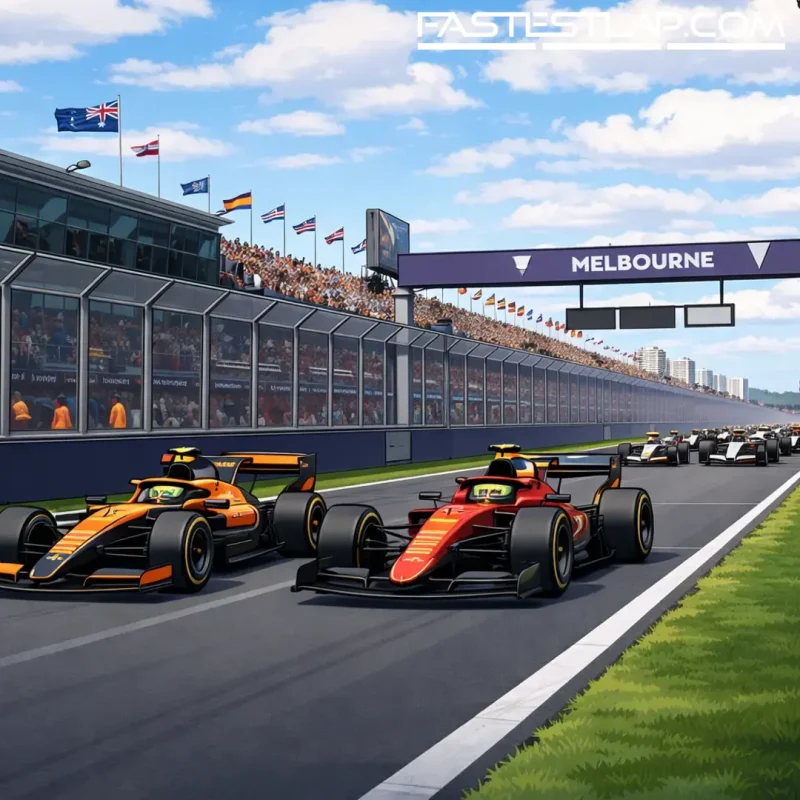
Melbourne’s stint as Formula 1’s curtain-raiser looks set to be just that — a stint.
As the early shape of the 2027 calendar comes into focus, the Australian Grand Prix is not expected to open the season, with Bahrain pencilled in to reclaim Round 1. After two straight years of Albert Park hosting the first race, the championship appears ready to swing back to the Gulf for a March 14 start, with the timing of Ramadan once again dictating the rhythm of the first flyaways.
That’s been the quiet reality behind the recent “Australia as opener” narrative. F1 didn’t suddenly fall back in love with a 5am European start time; it simply needed a cleaner fit around the sporting and logistical constraints that come with a calendar this tightly packed. With Ramadan due to finish on March 7 in 2027, Bahrain becomes workable as an opening venue again — and, frankly, it’s the path of least resistance when you’re trying to build a calendar that doesn’t collapse under its own weight.
Bahrain hasn’t been the first race since 2024, and Australia’s return to the top slot in the past two seasons has had as much to do with necessity as romance. Prior to the COVID-era disruption — and the cancellation of the 2020 Australian GP — Melbourne was the default season launch for most of Albert Park’s modern run. From 1995 through to 2019 it was Round 1 in all but two seasons. The difference now is that F1 is no longer building a 16- or 18-race year with generous gaps; it’s trying to thread 24 events through a global freight operation that runs like a military campaign.
Australia’s organisers, importantly, aren’t being left empty-handed. When the most recent hosting contract was agreed, the Australian Grand Prix Corporation locked in five season-opening slots. Two have already been used, leaving three still available between 2027 and 2035 — but not necessarily in a neat, consecutive run. If Bahrain does indeed lead off in 2027, Melbourne’s leverage shifts from being “the opener” to being “one of the first act”, and that’s still significant in commercial terms.
There’s also a contractual floor: Australia must host one of the first three races. That clause is likely to keep Melbourne in a prominent early-season window even if it’s not the first stop out of the blocks. On the current projected cadence, Saudi Arabia would follow Bahrain on March 21, before a weekend off. That would place Australia as the third round on April 4, kicking off what looks like a compact Asia-Pacific sequence — China a week later, then Japan on April 25 — before F1 heads to North America for Miami and Canada.
If all of that sounds familiar, it’s because this is how the calendar has increasingly been constructed: less around tradition, more around minimising disruption. Once you commit to 24 races, there’s very little room left for sentimentality. The sport will sell you the romance of a season opener under Melbourne’s trees or Bahrain’s floodlights, but the people actually building the calendar are staring at freight costs, turnaround times, and the domino effect of one date change.
Attention has sharpened on 2027 planning anyway because Turkey is confirmed to be returning to the championship next season, on a five-year deal that effectively locks down all 24 available slots. That’s the key point: the calendar isn’t just “taking shape”; it’s being forced into shape. With no slack left in the system, adding venues doesn’t mean “more races”, it means a reshuffle — and that reshuffle is where the political and logistical trade-offs start to show.
Two placement questions loom largest: where Turkey lands, and how Portugal is used. Portugal is widely seen as a natural fit to backfill the absence of the Barcelona Grand Prix next year, and Portimão has proven it can function in different windows. When it last appeared in 2021 it slotted into the early European run; a year earlier it was used in October, with that later date bringing the increased prospect of variable weather.
Turkey offers a similar split personality. In its initial spell on the calendar it typically occupied a chunk of the mid-season European leg. More recently, its appearances have come later in the year, when conditions tend to be milder — but with a greater risk of rain playing havoc with a modern grand prix weekend. There’s also a logistical neatness to positioning Turkey as a bridge out of Europe on the way to Azerbaijan and Singapore, which is why a September date is already being floated in early projections.
None of this is official yet, and the timeline suggests it won’t be for a while. F1 didn’t confirm the 2026 calendar until June, and there’s little reason to expect 2027 to be any quicker, especially with multiple moving parts still being negotiated behind the scenes.
Still, the emerging outline is clear enough to read between the lines. If Bahrain opens on March 14, Saudi Arabia follows on March 21, and Australia is held to an “early three” slot, then Melbourne becomes Round 3 by process of elimination — not because anyone’s punishing Albert Park, but because the calendar is now a puzzle where the edges matter more than the picture on the box.
A potential 2027 sequence being discussed in the paddock currently runs:
Bahrain (March 14), Saudi Arabia (March 21), Australia (April 4), China (April 11), Japan (April 25), then Miami (May 9) and Canada (May 23). Monaco would sit on June 6, Portugal on June 13, before the familiar European run through Austria, Britain, Belgium and Hungary, followed by Spain and Italy. Turkey is being eyed for September 19, leading into Azerbaijan (September 26) and Singapore (October 10), then the end-of-season run through the United States, Mexico City, São Paulo, Las Vegas, Qatar and Abu Dhabi.
It’s an itinerary that underlines the point: in 2027, the fight to be “the opener” is less about prestige than positioning. Melbourne may lose the first page of the story next year — but with three more opening-round slots still banked in its contract through 2035, it’s not the last time Albert Park will be in the spotlight.