Buenos Aires doesn’t get many opportunities to remind Formula 1 what it looks like when a country truly claims a driver, so it took full advantage when Franco Colapinto rolled into town with Alpine.
The team says around 600,000 people turned out across the weekend for a street demonstration in the Argentine capital — a number that would make plenty of actual grands prix on the current calendar look a little sheepish. For Colapinto, born and raised in the city, it was a homecoming dressed up as a motorsport festival: noise, smoke, selfies, and the kind of crowd energy you can feel through the barriers.
Alpine brought a proper old-school crowd-pleaser for the occasion: the E20, the 2012 car from the Enstone stable’s Lotus era, repainted in modern Alpine colours. It’s the sort of machine that instantly fixes the most common demo-run problem — that fans are being asked to get excited about a car they can barely hear. Colapinto did two runs on a temporary 2km layout carved through the Palermo district, running along Avenida del Libertador and Avenida Sarmiento, and he didn’t treat it like a polite parade. There were stoppages to greet fans at different points around the loop, and yes, donuts — because if you’ve got a willing V8 and half a city watching, you’d be committing malpractice not to.
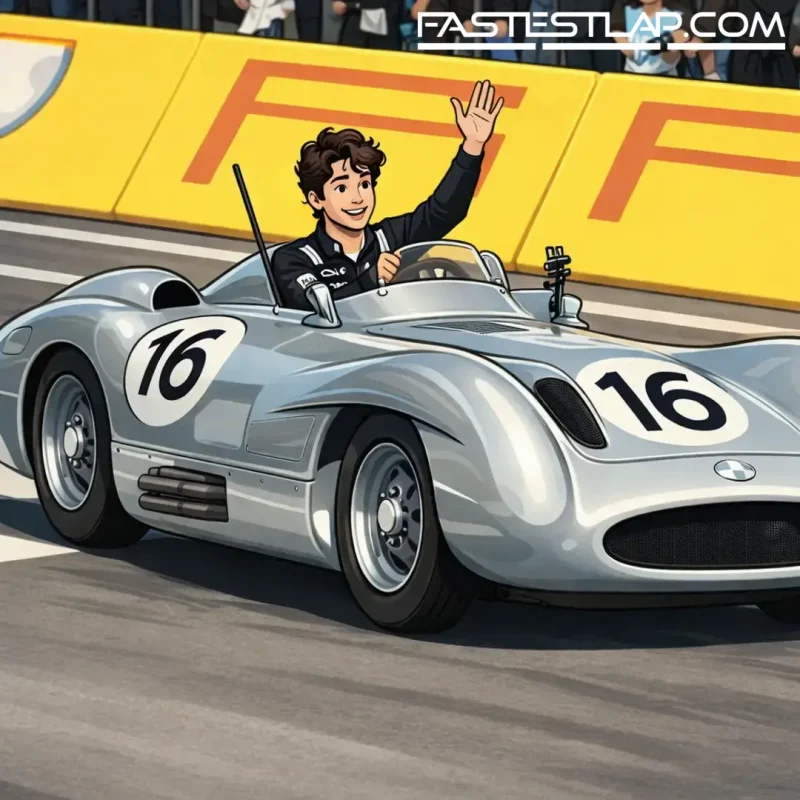
There was also a neat piece of symbolism layered into the show. Alongside the modern(ish) F1 machinery, Colapinto ran a replica of the Mercedes W196 — the car Juan Manuel Fangio used to win two of his five world titles in 1954 and 1955. It was the kind of heritage nod that can feel corny if it’s handled lazily. Here, it landed because Argentina’s relationship with F1 has always had two poles: Fangio’s history and the long wait for someone new to carry the flag. Colapinto is, after all, only the second Argentine to race in F1 this century, following Gastón Mazzacane.
What’s striking is how quickly Colapinto has become more than “an Argentine on the grid”. Since debuting with Williams in 2024, he’s been elevated into something closer to a national sporting property — the kind of figure who drags casual eyeballs toward F1 and makes sponsors return calls. His route since then has been anything but linear: he wasn’t retained by Williams for 2025, then joined Alpine as a reserve, and from there his opportunity arrived abruptly when he replaced Jack Doohan mid-season. In other words, there’s been just enough unpredictability in the story to keep the fanbase protective and invested.
For Alpine, the timing of the spectacle is no accident. F1’s 2026 season is still settling into its early rhythms and narratives, and the team is sitting fifth in the Constructors’ Championship as the paddock heads to Miami this weekend. In that context, putting Colapinto in front of a six-figure crowd isn’t merely a victory lap — it’s a reminder of the commercial and cultural gravity a team can harness when it has a driver with genuine pull. Enstone has never been shy about leaning into a strong personality when it finds one; this felt like the modern version of that instinct, staged at city scale.
It also, inevitably, reopened the familiar Argentine conversation: could F1 come back? The Autódromo Oscar y Juan Gálvez hosted the Argentine Grand Prix 20 times, most recently in 1998, and it remains a name that sparks nostalgia in the older corners of the paddock. The circuit is currently being upgraded to host MotoGP from 2027, which doesn’t automatically translate to F1 ambitions, but it does underline that Argentina’s top-level motorsport infrastructure isn’t being left to gather dust.
None of this guarantees anything beyond a memorable weekend and a few spectacular photos. But F1 is a sport that lives on momentum — in results, in reputation, in the way a driver’s value can suddenly feel self-evident when you see the numbers on the street. Colapinto didn’t just do a demo run in Buenos Aires; he reminded everyone how loud the next chapter can be when a country decides it’s ready to write one.