Miami might be about to provide the first proper stress test of F1’s 2026 energy-and-aero era — not because anyone’s chasing the perfect deployment map, but because the weather could take that choice away entirely.
With thunderstorms now a serious prospect for Sunday and the circuit’s concrete-lined confines offering little margin for a snap, the FIA has moved to block drivers from using the new Boost Mode for overtaking in low-grip conditions. It’s a significant intervention, and it underlines a reality that’s been bubbling since the first discussions around the 2026 power curve: instant electric torque and standing water are a volatile combination.
The updated forecast has pushed the rain risk to 68 per cent, enough for the governing body to act quickly. The mechanism will feel familiar to anyone who’s lived through the DRS-in-the-wet era — a performance tool that’s perfectly acceptable in the dry, then abruptly off-limits when grip falls away and the consequences get ugly.
Boost Mode, as defined in the FIA’s documentation, will be “inhibited” in low-grip conditions and therefore cannot be used for overtaking. The concern is straightforward: the new engine regulations place more emphasis on electrical deployment, and even with recent trims to its peak effect, that hit of torque can provoke oversteer when the tyres are skating. Miami’s walls do the rest.
What makes this interesting is that it arrives only weeks after the FIA and F1’s stakeholders already agreed to tone down the headline numbers. After an April crunch meeting involving the FIA, FOM, team principals and power unit manufacturers, Boost Mode’s impact was reduced to a +150kW ceiling — part of a broader set of energy management changes aimed at smoothing driveability and limiting the sort of aggressive harvesting that risks turning races into lift-and-coast competitions.
That meeting also produced a clarifying line that now reads like a warning label: “maximum ERS deployment will be reduced, limiting torque and improving car control in low-grip conditions.” Miami is the first time we’re seeing that philosophy translated into a hard operational rule on a race weekend.
It doesn’t stop there. Alongside the Boost Mode ban, Straight Line Mode will be adjusted too. In low-grip conditions, only partial activation of the Driver Adjustable Bodywork will be permitted within the relevant low-grip activation zones. In other words, even the aero tools are being dialled back when the track goes greasy — a reminder that 2026 isn’t just about new cars, it’s about new guardrails.
Teams have been given a small concession in another area drivers have been vocal about: tyre preparation. They’ll be allowed to increase the tyre blanket temperature for intermediates, following feedback that initial grip and early-lap behaviour in wet conditions needs help. It’s not a silver bullet — intermediates are still intermediates — but it’s an admission that the current window for switching to green-walled tyres can be uncomfortably edgy, especially on a track that can go from shiny wet to patchy dry and back again in minutes.
The procedural point matters, too. Because the changes are framed around safety, the FIA doesn’t need to run the usual political gauntlet through the F1 Commission or the Power Unit Advisory Committee. That’s not a trivial detail in 2026, when every tweak to energy deployment is a sensitive topic for manufacturers and teams who’ve designed their whole car concept around the new regulations.
The knock-on effect for the race, if it rains, could be more than just a slightly calmer throttle trace. Overtaking was always likely to be different this year with the new power characteristics; remove Boost Mode and partially restrict active aero, and you’re effectively asking drivers to pass the old-fashioned way in the least forgiving conditions possible. That tends to create two outcomes: either we get a tense, strategic chess match where track position is king, or we get a scrappy, mistake-led race where the only “overtake button” is bravery.
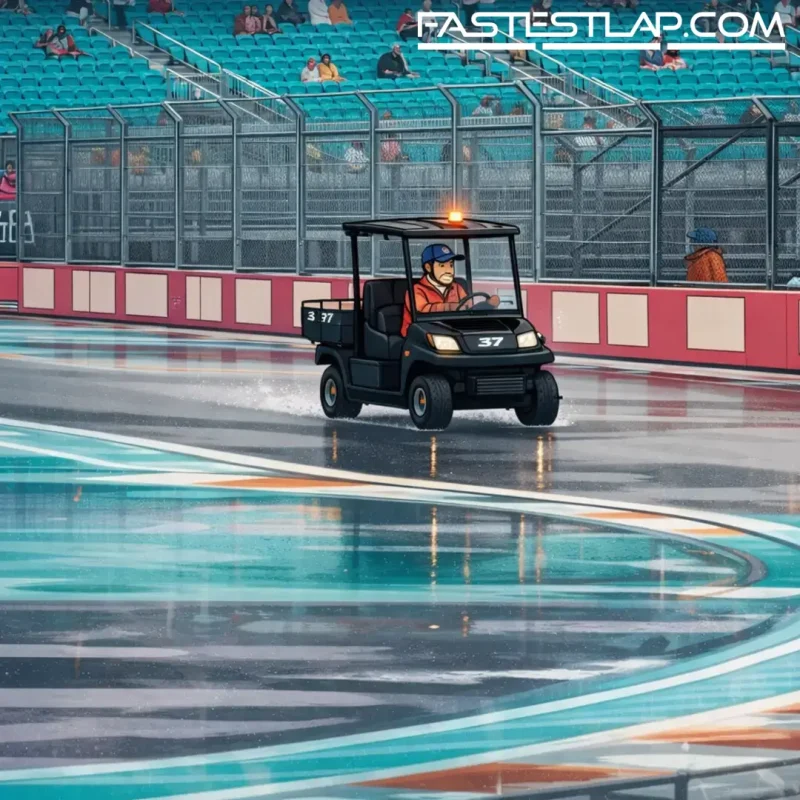
Miami has already shown it can be chaotic when weather rolls in. Last year’s Sprint was delayed and shortened, and the forecasts this weekend suggest a similar risk of disruption — perhaps even a scenario where rain clears before the main event, leaving teams guessing whether they’re preparing for a wet start, a drying track, or a late downpour. If that’s the case, the new restrictions could become a moving target: tools available one moment, then inhibited the next once the FIA declares low-grip conditions.
There’s also a subtle competitive angle here. In a dry race, teams with stronger energy deployment and better traction management can make the new systems sing. In a wet race where Boost Mode is locked out, that advantage is blunted, and the emphasis swings back toward mechanical compliance, driver feel and whoever can keep tyre temperatures in a workable range. The intermediate blanket temperature allowance is an attempt to make that range easier to hit — but it’s still going to reward the cars that are kindest on a cold, damp surface.
Qualifying is touched by the wider energy clampdown too: the maximum permitted recharge has been reduced from 8MJ to 7MJ. That’s part of the same effort to reduce extremes in management and avoid the “superclip” scenarios teams have worried about. Then there’s the new ‘low power start detection’ system, which will trigger an automatic MGU-K deployment to mitigate start-related risks — another sign that the sport is trying to engineer out the sharp edges of the 2026 transition before they bite.
All of which is to say: if Miami is wet, it won’t just be a test of who can drive a modern F1 car in the rain. It’ll be a test of how quickly the sport can adapt its shiny new performance toys into something that still makes sense when the grip disappears and the walls close in.