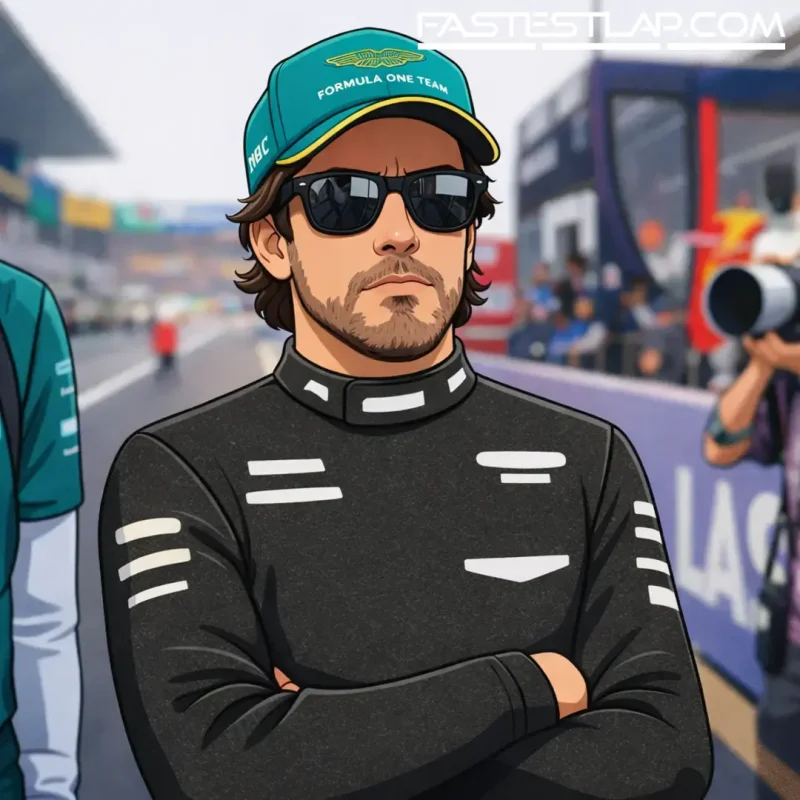
Fernando Alonso has never been one for leaving decisions to the last minute, and he’s not about to start now. With his Aston Martin contract expiring at the end of 2026, the two-time world champion says he’ll draw a line under the question of whether he carries on into 2027 sometime around the summer break.
It’s a typically Alonso way of framing it: no melodrama, no retirement tour, just a practical checkpoint in a season that’s already asked plenty of Aston Martin on and off the track.
“I didn’t start yet to think about the future,” Alonso said in Miami, having already spent time with team owner Lawrence Stroll away from the noise. There was dinner in Monaco last weekend, he revealed, but nothing resembling a formal negotiation. “We are aligned on everything. We are a team, but we are talking more about the present, than the future.
“But I know at one point this year, around summertime, or right after summer, I need to make a decision.”
The timing matters because Aston Martin is in the middle of one of the biggest transitions on the grid. The old Force India/Racing Point outfit has been rebuilt with serious money and serious ambition: new infrastructure at Silverstone, the arrival of Adrian Newey as a shareholder, and—most significantly in the context of the 2026 rules era—the start of life as Honda’s works partner.
That last piece is the sort of badge Alonso has historically gravitated towards. Works status is leverage. Works status is influence. Works status, if it all clicks, is the shortest route to the only thing Alonso still can’t get out of Formula 1: a third title.
But 2026 hasn’t been an instant fairytale. Alonso described the early part of the season as affected by teething issues with the new Honda package, which is hardly shocking given how sweeping these regulations are and how much integration is required when a team and manufacturer begin from scratch together. Still, it puts Alonso in an awkward place psychologically: the project looks like it *should* be pointing upwards, yet the present tense is doing its best to test his patience.
There’s also the simple reality of time. Alonso will turn 45 later this year. He’s already racked up well over 400 grand prix starts since debuting in 2001, and his second act since returning in 2021 has been, in his own words, a “gift” — proof that he could step away, come back, and still feel properly competitive.
That sense of competitiveness is central to how he wants this to end, whenever it ends. Alonso isn’t interested in lingering simply because the paddock enjoys the theatre of having him around.
“Leaving the sport with a bad taste, it’s not always the best thing. But these things you cannot choose,” he said. “But I’m very relaxed. I’m very happy with my career… I also want to leave the sport one day when I feel fast. I don’t want to leave the sport when I’ve been beaten by everyone and I feel slow, and I make mistakes and all these kinds of things.”
It’s a revealing line, because it hints at a driver who’s weighing more than lap time. Alonso’s always been obsessive about standards—his own, and the team’s—and he’s acutely aware that the final chapter tends to colour everything that comes before it. If Aston Martin’s 2026 is a slog, it’s not hard to see why he’d want to ensure there’s a believable upswing baked into any decision to stay.
That’s where 2027 comes in. Alonso sounded convinced that a second year of the Honda works project would be stronger than the first, suggesting the learning curve of 2026 could pay dividends if he’s prepared to see it through.
“If I continue racing, I think it will be a better season that this one with the project in year two,” he said.
And if he doesn’t? Alonso was candid about the fact that he won’t be swapping the cockpit for a quiet life. If Formula 1 is done, another challenge is waiting — and he’s already namechecked the sort of ambitions that would keep his competitive itch scratched and his legacy expanding in new directions.
“If I stop racing, I know that I will race in other series,” he said, pointing again to Dakar as a real possibility. He also dangled an idea only Alonso could make sound both outrageous and completely plausible: stitching together wins across endurance racing, Formula 1, and rally-raid. “That will be probably unprecedented and then that’s something that is very appealing.”
There are hints, too, of the endurance door creaking open. During the April break Alonso drove the Aston Martin Valkyrie, exactly the sort of machine that can plant a seed for Le Mans-style adventures down the line. And while he didn’t spell out a timeline, he made it clear Aston Martin will remain part of the picture even after his F1 days are done.
“When I stop Formula 1, I will keep racing somehow,” he said. “I will still link with the team in a different role in the future, so either way, I’m relaxed. I will be active, in a way, when I stop.”
So what does all of this actually tell us? That Alonso’s decision won’t be driven by sentiment. It’ll be driven by whether he believes Aston Martin’s trajectory is real — and whether he still feels sharp enough to be worth building around when the grid is only getting younger and more ruthless.
A summer deadline gives him a clean window to take stock: how the Honda partnership is bedding in, whether the team’s upward promises are turning into performance, and whether the work-in-progress is starting to look like a proper contender rather than an expensive experiment.
And if Alonso does decide to walk away, he’s already told you the one thing you need to know: it won’t be the end of Fernando Alonso the racing driver — just the end of Fernando Alonso the Formula 1 driver.