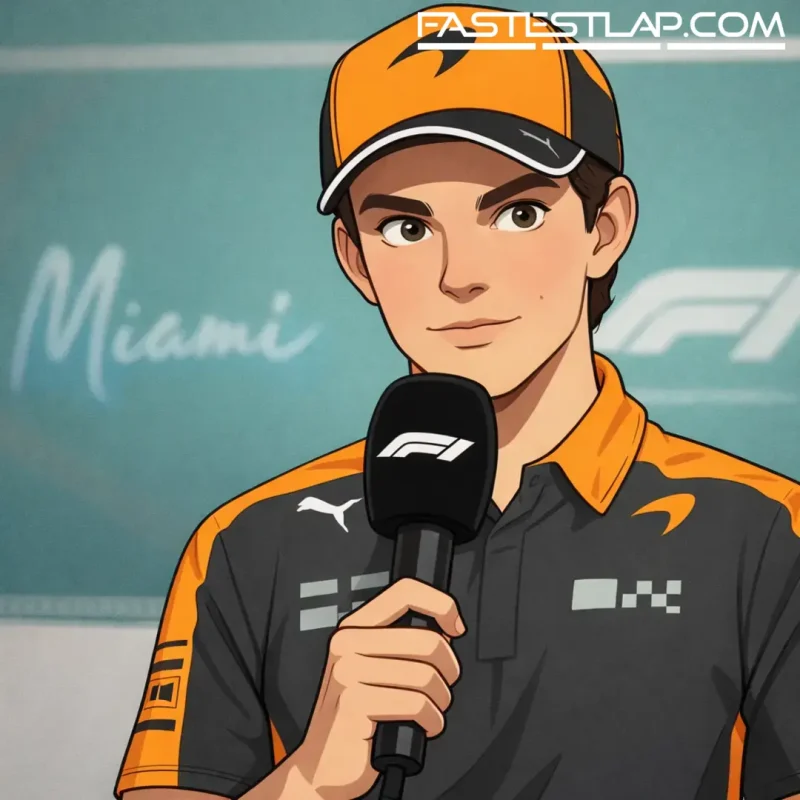
Oscar Piastri didn’t dress it up. Yes, the FIA has moved quickly to trim the sharp edges of Formula 1’s new 2026 package ahead of this weekend’s Miami Grand Prix — but in his view the sport is still trying to solve a hardware problem with software answers.
“The collaboration has been good,” Piastri said after drivers were consulted on the latest revisions, calling the changes a “step in the right direction”. Then came the part that’ll land on the desks of team principals and power unit chiefs: “You’re never going to fix the problems without changing the hardware of the power units.”
That’s the uncomfortable truth sitting beneath the Miami tweaks. The FIA has acted after the first three rounds delivered a messy cocktail of unintended driving techniques, overtaking that can look more like a battery-management exercise than wheel-to-wheel racing, and growing concern in the cockpit about speed differentials that don’t feel natural in combat.
The headline changes for Miami are targeted. Qualifying will see reduced charging limits, intended to curb the counter-intuitive preparation laps and energy-banking routines that have become a talking point in the early races. There’s also an adjustment to Boost Mode power designed to reduce the yawning deltas that can appear when one car is in full deployment and another is effectively defenceless.
In other words, the FIA is trying to narrow the extremes — without pulling at the thread that unravels the whole sweater.
From Piastri’s side, there’s a clear distinction between “better” and “fixed”. He’s already sampled the revised parameters in McLaren’s simulator during the April break and came away with a familiar refrain: some areas feel improved, others very much unchanged.
What he’s most willing to endorse is the safety intent behind the Boost Mode tweak.
“From a safety point of view, I think the changes with the boost button are sensible in the right direction,” he said. “You can’t eliminate the instances of people having 350 kilowatts more than another car at all times, but hopefully [it] reduces the amount of times that happens.”
That line — “350 kilowatts more” — is doing a lot of work. It’s the sort of gap that can turn a normal fight into a closing-speed problem, and those worries sharpened in Japan when Oliver Bearman suffered a 50G crash after taking evasive action to avoid Franco Colapinto. Nobody needs reminding how little time a driver has to react when the cars arrive at corners with mismatched acceleration and deployment.
The FIA’s ability to push changes through quickly is one thing; the politics of going further is another. Drivers, as ever, can advise, complain, and offer perspective — but they don’t have votes in the rooms that matter. Piastri was candid about that pecking order too.
“The discussions are at a far higher level than drivers; you’re talking about team bosses and bosses of the biggest car manufacturers in the world, so it’s certainly above my level,” he said, before pointing to the bigger shift happening around the sport.
The 2026 rules were shaped with the automotive sector in mind, built with concessions intended to make F1 attractive to manufacturers and to keep them committed. At the time, that approach was easier to sell: F1 was still leaning hard on the idea that manufacturer muscle was essential.
But the sport of 2026 is not the sport those rules were conceived for. Teams are now valued in the billions, the commercial platform is stronger, the financial model is more equitable, and the cost cap has reset what “survival” looks like. F1 doesn’t feel as dependent as it once did — and that’s why the frustration is bubbling up faster when the racing product takes a hit.
There’s a growing sense in the paddock that the championship has made itself simultaneously richer and more brittle: richer because it’s thriving, brittle because it’s still vulnerable to being steered by the priorities of road-car marketing cycles and boardroom objectives.
Piastri didn’t go as far as to frame manufacturers as a problem, but he did underline how different the landscape is now compared to when these regulations were minted.
“As a sport, where the automotive industry was when these rules were conceived, versus where it is now are two very different places,” he said. “Everyone understands the limitations of what we have and trying to adapt it to make things better for everybody.”
That’s the key phrase: “adapt it”. Not “replace it”.
Piastri’s view is that tweaks can help — and Miami is proof the FIA can act quickly when the alarm bells ring — but that some issues won’t go away without more fundamental change.
“Some of those things we can tweak, like we have done, some of those things you need to change in the medium term, some of the things need a complete overhaul,” he said. “But I think everyone’s aware of where we are, at least, and we can make changes from there.”
If that reads like a driver trying not to step on political landmines, it probably is. What’s striking is how plainly he’s prepared to say what many in the paddock have been hinting at: the current behaviour isn’t just a calibration mistake. It’s baked into the way the cars are being asked to create performance.
Miami, then, is less a “fix” than the first attempt at damage limitation — a round of edits designed to make the racing less artificial and the closing speeds less alarming, without reopening the foundational question F1 is circling again: whether the 2026 direction, shaped to keep manufacturers happy, is still the right one for the sport F1 has become.
For now, Piastri’s verdict is as blunt as it is accurate: the sport can sand down the worst corners, but if it wants to truly change the feel of this era, it’s going to have to stop pretending the issue is purely in the settings.