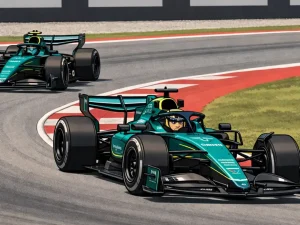
Oscar Piastri had the look of a man who’d just been told to bring a canoe to a Grand Prix weekend, and he didn’t try to hide it. With Miami’s weather threatening to turn Sunday into one of those days where the stopwatch becomes a suggestion, the McLaren driver joked he might need to bolt “some oars” to the car to get through it.
The organisers have at least tried to stay ahead of the worst of it. The race has been pulled three hours earlier than planned, now set for 1pm local time (6pm UK), in an attempt to dodge the heavier thunderstorms forecast later in the afternoon. In the joint statement from the FIA, Formula One Management and the Miami GP, the reasoning was familiar and sensible: minimise disruption, maximise the window to get the full distance done, and keep drivers, fans and staff safe.
That doesn’t mean it’s suddenly straightforward. Even at the earlier start time, the forecast still leaves a 37 per cent chance of rain hanging over proceedings — enough to keep every strategist’s laptop open and every driver’s shoulders tense.
For McLaren, it’s also landed in a slightly awkward place. Piastri will start seventh, having ended qualifying seven tenths off pole-sitter Kimi Antonelli, but he comes into Sunday with at least a small advantage over his own team-mate: he’s one of the few who’s actually driven this generation of cars on a wet track.
“I think probably build some oars,” Piastri quipped to Sky F1 when asked what the plan was if Miami turns properly wet. The smile was there, but the subtext wasn’t hard to spot. Nobody truly knows how these new cars will behave in a full-blooded wet race scenario, because there simply hasn’t been much of it.
“If it’s wet, that’s going to throw a lot of spanners into the works,” he said. “No one has really driven these cars in the rain, and no one really knows what they’re going to do. Hopefully we’re on the right side of that.”
Piastri’s reference point is unusually useful: he’s had wet running in the MCL40 during a Pirelli wet tyre test earlier this year. It’s not race weekend pressure, and it’s not Miami’s slippery surface with walls waiting, but it’s still more than most have had.
Interestingly, he doesn’t think the big unknown is the car’s basic behaviour — the braking points and the feel — so much as what happens when the track is low grip and the power delivery becomes a more delicate business.
“In terms of driving the car, it’s not going to be that different to what we had before,” Piastri explained. “It’s just going to be what happens with the power unit, how you get power, where you get power, it’s in a computer’s hands. It’s just making sure that that does roughly what we expect.
“Obviously, the margin for error when it’s wet is significantly low.”
That line about it being “in a computer’s hands” is the bit that will resonate up and down the pitlane. In the dry, everyone can live with a few quirks in deployment or delivery because the grip is there to lean on. In the wet, those tiny inconsistencies become moments — and moments become damage.
If Piastri sounds cautiously amused about the whole thing, Lando Norris was rather more blunt about where he stands. The world champion admitted he has no wet experience at all in this new-spec machinery, which puts him in the unusual position of relying on instinct and adaptation while others at least have some data in their head.
“No, I have never driven this car in the rain,” Norris said to media in Miami. “Some people have, so we’re at a disadvantage for the time being.”
There was no attempt to dress it up as a heroic challenge. If anything, Norris framed it as the sort of day where you keep your options open and accept that the normal order can vanish quickly — but also that, if it stays dry, he’s not convinced McLaren has the outright speed to simply drive away from the cars ahead.
“It’s with more chaos, but it’s hard to know,” Norris said. “It would be more just everything in the air, and let’s see what happens.
“But I think in a dry the pace is not bad. I just don’t think we have the pace of the cars ahead. Yes, I won this morning, and the pace looked strong, just because I had cleaner air. If I was behind, whoever starts in the front wins the race.”
That’s a telling assessment from a driver who knows what a clean-air advantage looks like. Miami can punish you for being stuck in traffic even in perfect conditions; add damp patches, changing grip and uncertain crossover timing and it becomes less about theoretical pace and more about being the first person to guess correctly.
Asked whether the lack of wet running left him apprehensive, Norris didn’t deny it — but he also pointed out that wet Miami is a different kind of problem even for those with a little test experience banked.
“Of course, it’s also a very different track for the people that have driven in the wet,” he said. “But I think for all of us, it’s a different track, different conditions.
“I don’t know how wet it’s going to be, so it’s going to be a big challenge on race day for everyone to kind of perform, find the limit, and obviously you can’t afford to make any mistakes. So we’re kind of thrown in the deep end, but that’s what we’re here to do.”
So McLaren arrives at Sunday with a split-screen situation: Piastri with at least a little wet familiarity and a starting spot that invites aggression, Norris with the title-holder’s expectation on his shoulders and a race that may demand improvisation more than perfection.
If Miami does get hit, nobody will be reaching for actual oars. But Piastri’s joke lands because the feeling is real: this could be one of those Grands Prix where you’re not just racing rivals — you’re racing the conditions, your own software, and your ability to stay calm when the track stops making sense.