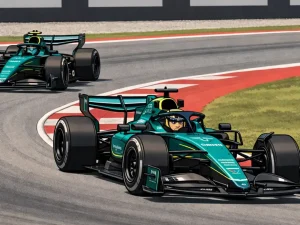
Kimi Antonelli is starting to make Saturday afternoons feel routine — which, for the rest of the pitlane, is becoming a problem.
In a Miami qualifying session that kept threatening to swing in Red Bull’s direction, the Mercedes rookie delivered again, pinning down a third consecutive pole with a 1m27.798s. Max Verstappen was back to looking properly menacing in the RB22 and came at him on the final runs, but even that late surge left the four-time world champion 0.166s short. Charles Leclerc’s Ferrari slotted into third, with Lando Norris salvaging fourth on a day McLaren never quite had its usual clean edge.
The broader picture was almost as striking as the pole itself: four different manufacturers across the top four, and a front-two-rows mix that underlined just how volatile this 2026 season has become when the margins tighten.
Qualifying came straight after Norris’ comfortable Sprint win from Oscar Piastri — useful context, because McLaren arrived at parc fermé looking like it had the weekend’s best race car. The one-lap story, though, was messier.
Q1 set the tone for an afternoon that never settled. Gabriel Bortoleto was already under pressure after being disqualified from the Sprint results for an engine intake air pressure breach, and Audi had his R26 up on the stands as the session began. At the sharp end, Verstappen hit the ground hard with a 1m29.099s and, for a moment, it looked like Red Bull had flipped the switch back to “daunting”. Only Antonelli and Norris initially stayed within a tenth, and most of the frontrunners leaned on used softs early.
Antonelli then made the first proper statement of the session by bolting on new softs and punching in a lap that moved him four-and-a-half tenths clear. The bottom end turned ugly: Bortoleto, the two Cadillacs of Sergio Perez and Valtteri Bottas, both Aston Martins (Lance Stroll and Fernando Alonso), and Arvid Lindblad all fell out. Piastri — uncomfortably — scraped through in 16th having only used softs, a hint that McLaren’s day might not be straightforward.
It got worse for Bortoleto on the way back, the Audi suffering a rear brake fire as he tried to limp to the pits. It was the kind of moment that snaps you out of lap-time watching and reminds you how quickly a weekend can tip into damage limitation.
Q2 should have been more controlled. It wasn’t.
Verstappen went to new tyres and immediately sounded unconvinced: “These tyres are terrible. They have no grip.” Lewis Hamilton, meanwhile, briefly looked like the man to beat, laying down a 1m28.477s at a key point in his weekend — he’d complained after the Sprint of a recurring software issue costing him around three tenths, so the tone in qualifying mattered.
Antonelli matched Hamilton to the thousandth, which told you plenty about where Mercedes’ baseline is right now — stable, confident, and seemingly less sensitive to Miami’s little traps. Norris, by contrast, had a big moment that wrecked a lap, then only managed ninth when he did get a representative one in. On the radio he questioned an absence of deployment out of Turn 16; McLaren initially blamed wind, but team boss Zak Brown later confirmed a boost issue.
Antonelli improved again late in the segment to edge Hamilton, only for Verstappen to land the lap that re-framed the session: 1m28.116s, suddenly the Red Bull looked “happy” in a way it hadn’t earlier. Q2 ended with Williams taking a hit (Alex Albon and Carlos Sainz out), Haas losing both Oliver Bearman and Esteban Ocon, plus Liam Lawson and Nico Hulkenberg also eliminated.
So into Q3, and it really was open. Mercedes had been quick, Ferrari had the tools to interrupt, Verstappen had momentum, and McLaren — issues or not — had already shown in the Sprint that it could put together serious pace when things aligned.
Piastri posted the first meaningful reference at 1m28.6, but it was quickly exposed as a soft benchmark. Provisional poles changed hands in the usual Miami blur of sector times and track evolution, then Antonelli dropped the lap that effectively made everyone else chase shadows: 1m27.798s, more than three tenths clear of Leclerc at that point.
Even inside Mercedes, the temperature rose. Antonelli described it as “close” as he and George Russell headed out for their final attempts, Russell squeezing around the outside and ahead in the garage choreography — a small moment, but one that hints at a team now managing two drivers who both expect to be in the pole conversation.
Ferrari didn’t find the late step it needed. Norris couldn’t conjure a clean, fully powered lap when it mattered. And Verstappen, for all the menace of his Q2 time and the sense that Red Bull had finally got on top of its tyre behaviour, just ran out of road. He improved, came on strong at the end of the lap, and still fell short by 0.166s.
Behind the headline fight, the midfield mixed it nicely: Franco Colapinto put Alpine eighth, just ahead of Isack Hadjar’s Red Bull in ninth, with Pierre Gasly tenth in the other Alpine.
The grid, then, is set for a Miami Grand Prix that feels delicately poised. Verstappen is close enough to turn pole into a footnote if Red Bull’s long-run pace matches its qualifying resurgence. Ferrari has two cars in the top six and won’t consider that “good damage limitation” if the race offers more. McLaren’s Sprint strength suggests Sunday could suit it — assuming that boost issue is tamed.
But at the front sits Antonelli again, and it’s becoming harder to call it a run of nice Saturdays. Three poles in a row, in a season that’s not giving anyone freebies, is the kind of streak that changes how rivals plan their weekends. In Miami, Mercedes’ newest star didn’t just keep the momentum going — he held off Verstappen when the pressure finally arrived.