Max Verstappen managed to turn one of those heart-in-mouth Miami moments into a punchline – and, in his own way, a warning shot.
Red Bull arrived at the Miami Autodrome looking for signs its updated RB22 could finally put a dent in the early-season gap to the front. Verstappen delivered the first part on Saturday, dragging the car onto the front row with his best qualifying of 2026 so far, just 0.166s shy of Lando Norris’ pole. After being nowhere closer than eight tenths across the previous three rounds, that was a proper step.
Then the race started and the whole thing got very Red Bull, very Verstappen, very quickly.
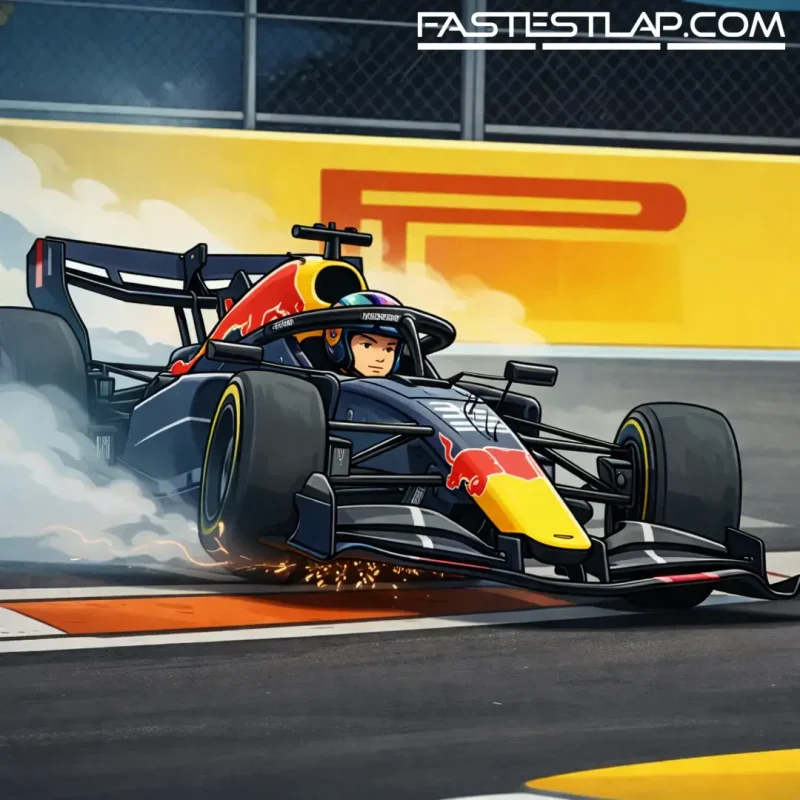
On the opening lap, battling Charles Leclerc, Verstappen lost the rear at Turn 2 and spun – not a lazy half-loop into the run-off, but a full, neat 360 that somehow avoided terminal damage and let him keep rolling. It looked dramatic from the outside, but the detail that matters is what it did to his afternoon: the front-row advantage evaporated before the tyres had even come up to temperature.
“I lost the rear in Turn 2 and then of course I tried to minimise the time loss by doing a 360,” Verstappen said afterwards. “Yeah, I thought I was going to crash but then I floored it, so I managed to do a good 360.
“If F1 doesn’t work out I can always go rally.”
It was classic Verstappen in the pen: disarm the incident with humour, file it under ‘one of those things’, move on. But you could hear the subtext. Miami was supposed to be the kind of weekend where Red Bull finally converts improved one-lap pace into a clean, controlled race and a straight fight at the front. Instead, it became another reminder that when you’re trying to claw back performance, you often end up living on the edge of it.
Verstappen was adamant the little bit of early contact with Leclerc didn’t trigger the spin.
“Just one of those things,” he said. “I don’t think so. I mean, we just pushed, of course, into the corner, but, yeah, just lost something. The rear just started to slide. And once it goes, you know, with heavy fuel it’s hard to catch.”
That last line is doing a lot of work. With a heavy car and cold tyres, there isn’t a driver on the grid who can reliably “save” that moment if the rear fully lets go. Verstappen did the next best thing: he committed to keeping it rotating, got back on the throttle at the right time and avoided the kind of snap-back that ends in a broken front wing and a ruined floor.
Whether that’s skill or good fortune became a debate in its own right on the F1TV post-race show, with Jolyon Palmer praising Verstappen’s knack for getting away with it and Juan Pablo Montoya countering that it was simply luck.
Palmer’s argument was essentially that repetition tells you something. “When you do it as often as Max, you have to say it’s talent,” he said, pointing to the difficulty of timing your inputs when the world is spinning around you.
Montoya wasn’t buying it. “You say that’s talent? I thought it was pure luck,” he replied, before adding that the car slows down in the spin anyway.
The truth, as ever in F1, probably sits somewhere between. Yes, physics takes speed out of the car when it rotates. But there’s still a difference between “I spun and I’m not in the wall” and “I spun, didn’t hit anything, didn’t collect anyone, didn’t stall it, and I’m still basically in the race.” Verstappen’s ability to make that outcome happen more often than most is part instinct, part muscle memory, part that ruthless refusal to accept the worst-case scenario.
He rejoined ninth, then tumbled to 16th after an early pit stop on lap seven. From there, the day became a recovery drive shaped by tyre behaviour and time loss rather than outright opportunity. Verstappen said the medium stint was respectable, but the hard tyre proved a grind – and he hinted Red Bull may have stretched that phase too far.
“After that, I think the pace was not too bad on the medium, but as soon as I swapped to the hard compound, it was just a lot more difficult,” he explained. “I think now after the race it’s easy to say of course but I think that stint was just a bit too long.”
Even with the compromised strategy and the messy first lap, he still hauled it back to fifth on the road – the sort of result that tells you the underlying pace was there, even if the execution wasn’t. A post-race penalty for crossing the white line at pit exit only added another layer of avoidable damage to the final classification, the kind that doesn’t make headlines like a spin but makes championship maths uglier all the same.
And that, more than the optics of a 360, is the lingering point from Miami. Red Bull has clearly found something on Saturday speed. But Sundays are still demanding the same precision they had when the team was operating from a position of control – and right now Red Bull isn’t. When you’re fighting forward rather than managing from the front, tiny mistakes don’t just cost a couple of seconds; they detonate the entire shape of your race.
Verstappen can laugh about rallying, and the spin will live forever in highlight reels, but Miami read like a weekend where the line between “we’re back” and “we’ve made it harder than it needed to be” remained uncomfortably thin.