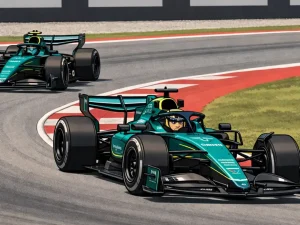
Aston Martin finally got both cars to the flag in Miami and, in 2026, that counts as a small victory in itself. But Fernando Alonso wasn’t in the mood to dress it up as anything more than that: the team’s rare clean Sunday was built on reliability rather than any genuine step forward in form, and the next problem on the list is already clear.
For Canada, Alonso wants the gearbox sorted — urgently.
Miami was the first time this season Aston has managed to bring both cars home in a grand prix, a basic milestone that underlines just how scrappy the opening stretch has been. Alonso qualified 17th, matching his best Saturday of the year, then converted it into a season-best 15th. Yet even that came with a familiar caveat: the result said more about survival than speed.
What did lift Alonso’s mood, at least a touch, was that one of Aston’s earliest headaches eased off. The vibrations from the Honda power unit that plagued the first three races were reduced in Miami, which at least removes one distraction.
That’s when the gearbox took centre stage.
“No issues,” Alonso said when asked to sum up the first of the season’s three races in the United States, before quickly clarifying where the real discomfort had been. “Honestly, it was more the gearbox the whole weekend than the engine.
“It was very weird on the downshifts and the upshifts, so not very well in control.”
For Montreal, that matters. Canada’s stop-start layout leans heavily on stability under braking and confidence in the downshift phase — the kind of circuit where any odd behaviour in the transmission can turn a lap into a compromise. Alonso didn’t overcomplicate it: “That’s the fix number one for Canada. I think with all these heavy braking in Canada, we need to improve the gearbox behaviour at the moment.”
There’s a bluntness to the way Alonso is talking about Aston right now. Not angry, not theatrical — more like someone who’s done enough seasons in the sport to recognise when the only sensible play is damage limitation and internal discipline. He’s been around too long to confuse “we finished” with “we’re back”.
“I think we will make a step on that drivability point of view,” he said. “Performance, not. So, we need to stick together with the team.”
And this is where Aston’s season starts to feel like a psychological management exercise as much as a technical one. Alonso all but warned that the next run of races could become a weekly rerun: the same questions, the same answers, the same grim acceptance that there isn’t a quick fix coming.
“Now it’s going to be very tough races. It’s going to feel repetitive,” he said. “Obviously, we need to face the media every Thursday, Friday, Saturday and Sunday.
“You do your job, and we drive fast, but seems repetitive, the message. We have no upgrades until after summer.
“So we don’t need to come to Canada and [be asked] what to expect in Canada, the same. What to expect in Austria, the same.”
Alonso’s point isn’t that the team has stopped working — it’s that the kind of gains Aston can realistically bring in the short term won’t change the shape of their weekends. In a budget-cap era, spending hard for small lap-time returns can become an exercise in self-harm, especially if your baseline is miles off the midfield fight.
He framed it in terms that will resonate with anyone who’s watched teams burn money chasing marginal improvements that don’t move the needle.
“I’m at peace, because I understand the situation,” Alonso said. “The team is claiming that if we bring one or two tenths every race, it doesn’t change our position. We are P20 or P19, and the next car is one second in front. So even if we bring two tenths every race, it doesn’t change our position.
“And it’s a huge stress in the system, in the budget cap and things like that. So [if] we don’t have one second and a half or two second improvement, it’s better not to press the button into production, because we waste money.”
That’s the stark reality Aston Martin is living with right now: the gap ahead is big enough that “normal” development doesn’t buy you much except a lighter budget and a noisier factory. Alonso is essentially arguing for restraint — fix what’s broken, tidy up the drivability, and save the real spend for when it can be part of a bigger, coherent step.
The wider numbers are brutal. Aston is one of only two teams yet to score a point in 2026, alongside Cadillac. That’s not a sentence anyone expected to be writing about Aston Martin a couple of seasons ago, and it explains the tone: not panic, but a sort of controlled irritation, the kind that creeps in when you’re doing everything you can inside the car and it still isn’t enough to get you into the conversation.
Canada, then, isn’t being sold as a turning point. It’s a test of basics — whether Aston can give its drivers a car that behaves properly under the heaviest braking of the lap, and whether it can keep stringing together clean weekends while it waits for the promised post-summer reset.
For now, Alonso’s message is unglamorous but unmistakable: sort the gearbox, keep the head down, and don’t pretend two tenths is a revolution.