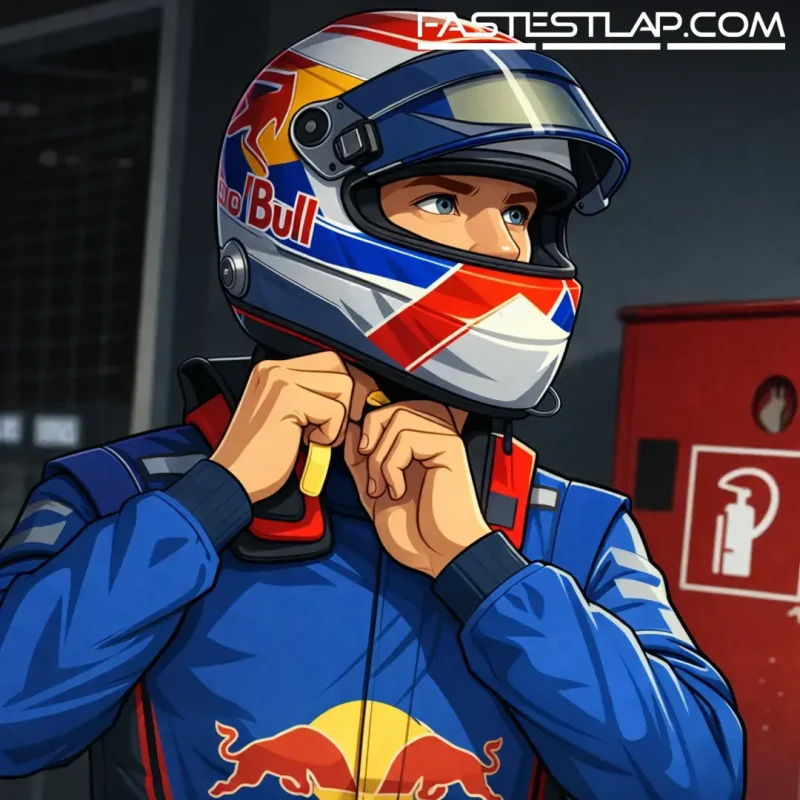
Max Verstappen turning up at the Nürburgring 24 Hours in a Mercedes-AMG GT3 is exactly the sort of detail that makes modern motorsport partnerships feel both hugely powerful — and oddly flimsy.
On one side you’ve got Red Bull’s F1 programme heading into 2026 with Ford branding in the picture. On the other, Verstappen is about to take on the Nordschleife in a Red Bull-liveried Mercedes run through a deal between the German manufacturer and Verstappen Racing that was put in place late last year, pointedly separate from anything he does on the grand prix trail. In the middle sits Ford, watching one of the biggest stars in the sport drive someone else’s car in one of endurance racing’s biggest shop windows.
Ford Performance boss Mark Rushbrook has now put a polite-but-clear version of the company’s stance on the record: it’d rather Verstappen was doing this in a Ford.
“We prefer our Ford drivers to stay in Ford,” Rushbrook said, while acknowledging why Verstappen ended up where he did. The tone matters. This wasn’t an angry corporate ultimatum, more a recognition of how these relationships actually work when a driver has his own ambitions, his own organisation, and frankly his own leverage.
Verstappen will share the Mercedes-AMG GT3 this weekend with Jules Gounon, Lucas Auer and Daniel Juncadella — a properly serious line-up for a race that doesn’t reward half-measures. And it’s not as though the Mercedes choice is some casual whim. Verstappen’s endurance programme has been building, methodically, and the Nürburgring 24 Hours is a different kind of examination: traffic management, night running, weather roulette, and a circuit that punishes anyone who turns up without a plan.
Ford, for its part, evidently wanted to be part of that moment. Rushbrook confirmed the company made a “significant push” to get Verstappen into a Mustang GT3 EVO for this year’s race, alongside the wider tie-up involving Verstappen Racing in GT World Challenge Europe. It didn’t happen — and for anyone expecting a neat alignment of all the logos, that’s the point. F1’s partner ecosystem is enormous, but it isn’t a set of handcuffs.
Rushbrook’s comments also underline a second, bigger play. Ford isn’t just thinking about a Nürburgring photo-op; it’s looking down the road to a potential Verstappen-shaped headline at Le Mans.
Ford is due to enter the World Endurance Championship’s Hypercar class in 2027, a move that will pitch it directly against an increasingly stacked top tier that already includes McLaren, Ferrari, Aston Martin and Cadillac. That is a marketing and sporting stage built for a crossover star — and there are few crossover stars bigger than Verstappen, particularly one who so obviously enjoys racing for racing’s sake.
“We would love to see that,” Rushbrook said when asked about Verstappen at Le Mans. The caveats came quickly: schedules, timing, the right programme, the right moment. But he didn’t hide the fact that conversations have been going on for “three-plus years”, which is telling in itself. You don’t keep a line warm for that long unless you can imagine a scenario where it becomes real.
What Rushbrook did do was draw a line under the one outcome Ford doesn’t want: Verstappen being thrown into its debut Hypercar season as a kind of instant saviour. A 2027 Le Mans effort for Verstappen was ruled out on the basis it would be “taking on too much” in Ford’s first year in the WEC. That’s an unusually cautious admission in an era where manufacturers love to talk about “ambition” and “targets” without acknowledging the learning curve. Ford knows the sharp end of endurance racing doesn’t bend to star power alone.
Still, the Nürburgring situation leaves Ford in an awkward, slightly exposed position. Verstappen is, in Rushbrook’s own words, someone Ford loves “what he does for us in Formula 1” — and yet the most visible extracurricular racing he’s done at this level is in a Mercedes. That is the unavoidable optics problem when a driver’s personal programme develops on a different axis to a manufacturer’s messaging plan.
Rushbrook tried to frame it as a net positive — and in pure driver-development terms, he’s right. “We love that he’s a racer, whether it’s sim racing or that, it only makes him better,” he said. It’s a very modern view of talent: the idea that a driver who stretches himself in other disciplines brings sharpened instincts back to the day job. For Ford, that’s a convenient argument because it allows the company to be publicly supportive even when the badge on the nose isn’t theirs.
But there’s also a harder truth underneath it. Verstappen doesn’t really need anyone’s permission to build a parallel career. If he wants to do Nürburgring in a Mercedes because that’s where the right package, people and preparation sit today, he will. The best Ford can do is keep the relationship healthy, keep the door open — and make sure that when its Hypercar project is ready to sell a dream, it’s offering something compelling enough that the conversation finally turns into a contract.
This weekend, though, the immediate story is simpler: Verstappen’s about to find out what the Nürburgring 24 Hours feels like when it’s real, not simulated — and he’s chosen a proven tool for the job. Ford might “prefer” otherwise. It can’t pretend it doesn’t sting. But in a way, it’s also a warning shot: the moment Ford has the right car at the right time, it fully intends to go back in for him.