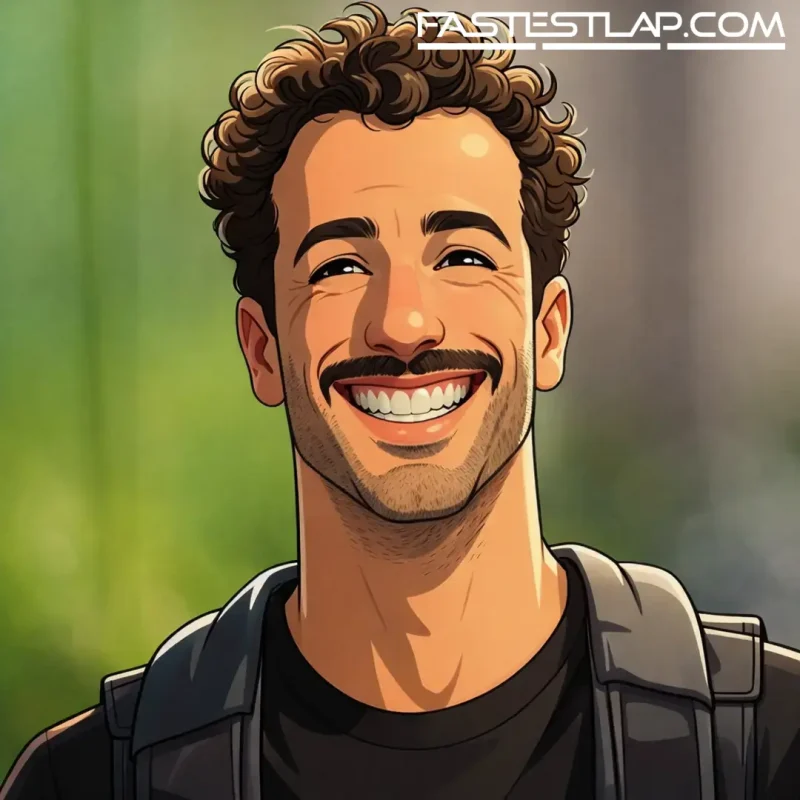
Daniel Ricciardo still talks about racing like someone who’s spent his whole adult life measuring weeks in lap counts — but, for once, he’s doing it from the outside looking in.
Now firmly detached from the F1 grind after stepping away following the 2024 Singapore Grand Prix, Ricciardo has admitted he’s “really enjoying” not competing. That’s not the sort of line you expect from an eight-time grand prix winner who built a career on showmanship and staying power, but it neatly captures where his head’s at in 2026: lighter, less performative, and, crucially, no longer chasing a version of himself that belonged to a different era.
Ricciardo’s exit was announced as a surprise, even if the direction of travel had been clear. After his Red Bull highs and that lone win with McLaren, the back half of his career turned into a long negotiation with form, confidence, and circumstance. McLaren cut him loose at the end of 2022, and while he stayed in the Red Bull family as a reserve, his mid-2023 return to a race seat with AlphaTauri didn’t deliver the clean reset he needed. A broken hand early in that comeback, sustained at the Dutch Grand Prix, handed Liam Lawson an opening — and the wider story of Ricciardo’s final year became less about a grand revival and more about whether he could still force the door back open at the sharp end.
He didn’t. Singapore 2024 gave him a neat closing image — fastest lap, a guard of honour, the paddock doing what it does when it senses an ending — and then the confirmation followed days later.
What’s interesting now is how Ricciardo describes the emotional mechanics of all that. Speaking on the *Speed Street* podcast, he didn’t dress it up as unfinished business or a tragedy of timing. It sounded more like relief mixed with a bit of recalibration.
“At the end of my career, I was like, ‘Why do I love it?’ And I just wanted to remove myself for a bit,” he said. “But I think going to other races kind of rebuilt a healthy relationship with it.”
That’s a telling phrasing: not “fell back in love”, not “itching to return” — just healthy. The subtext is obvious to anyone who’s watched F1 chew through drivers once the margins tighten. When you’re in the paddock, everything is a referendum. Every lap is weighed against a team-mate, a contract clause, a rumour. Even the “fun” drivers eventually end up carrying the same tension in their shoulders.
Ricciardo also confirmed last September that he was retiring from motorsport, then took up an ambassadorial role with Ford — Red Bull’s new technical partner. It’s the kind of job that keeps him connected to the world without requiring him to live by the stopwatch.
And yet he’s not slamming the door on racing entirely. The key is that he’s reframed what a comeback would even mean. If he does it, he says, it won’t be to prove a point — and it won’t be about titles.
“Never say never,” Ricciardo insisted. “I’m really enjoying not competing where I currently sit, and just enjoying the small things in life, and not having to kind of be on a stage and all that.
“Do I know what I’ll feel in three years, five years? No. If I was to do something maybe one day, it would definitely be more from a fun aspect than, like, ‘I’m chasing some championship’ aspect.”
It’s a very Ricciardo way to land a serious truth: ambition is addictive, but it can also sandblast the joy out of the thing that got you into racing in the first place. He talked openly about the balancing act — needing goals to get you out of bed and into the gym, while recognising that the same hunger can “rob some of the joy”. The version of Ricciardo speaking now sounds like someone who’s no longer willing to barter his mental bandwidth for the right to say he’s “still got it”.
If there’s any hint of a spark returning, it’s not coming from F1. It’s coming from the idea of turning up to something like the Indy 500 with no obligations other than curiosity — and maybe a little childlike awe.
Ricciardo is heading to Indianapolis this year as a spectator, his first Indy 500, and he’s fascinated by what his old life looks like when it’s not his. He spoke about the intensity of the F1 schedule — how it becomes “normal” only because you’re trapped inside it — and how strange it feels once you step out.
“I was in the F1 sphere bubble for so long and I got used to how intense the schedule was – the paddock, all of it – and that became normal,” he said. “But now that I’m outside of it I’m like: ‘Oh, that was as far from normal!’”
He’s curious about the human side of it too: how an Indy weekend is structured, how drivers split “personal time” versus “on time”, and whether the mood is laidback or permanently switched on. In other words, he’s studying the culture — not scouting for a seat.
Then there’s the part that almost sounds like the original Ricciardo peeking through: the cars, the speed, the fear factor.
He talked about the “sheer size of the infield”, the sound, and the spectacle of watching cars arrive into Turn 1 flat-out. The sensory pull is still there — the reason so many drivers never really detach even when they swear they’re done. The difference is that Ricciardo can indulge that fascination without it demanding anything back.
“I’ll be glad that I don’t have a suit or a helmet on!” he joked.
That line lands because it’s true. Whatever racing Ricciardo does — if he does any at all — it won’t be a grind back up the mountain. It’ll be a choice made from comfort, not desperation. In a sport that rarely allows a clean emotional exit, that might be the most surprising part of his post-F1 chapter: he sounds like someone who got out at exactly the right time for himself, even if the paddock didn’t see it coming.