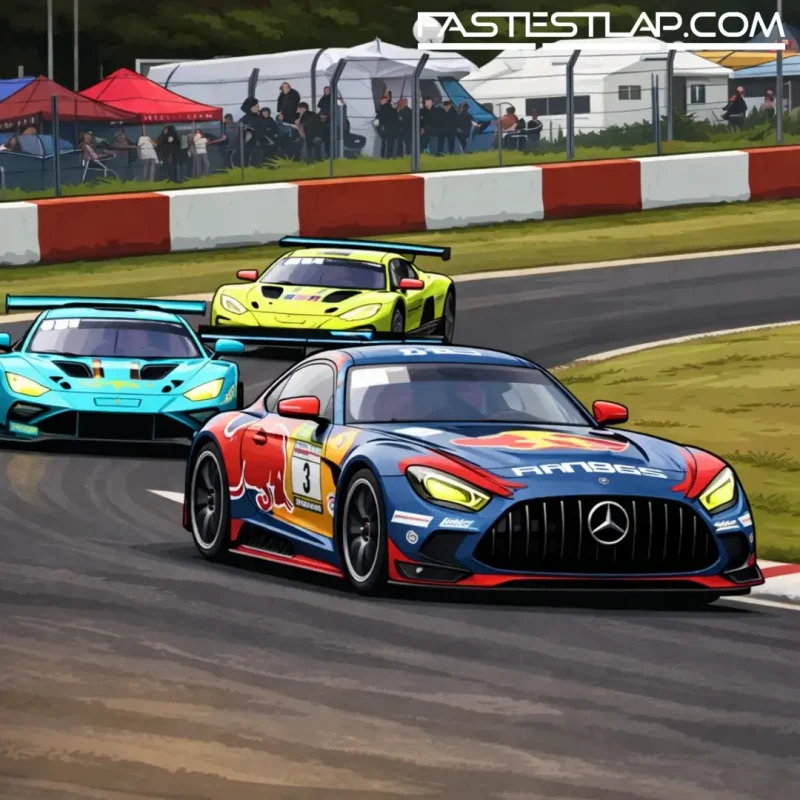
Max Verstappen turned up at the Nürburgring 24 Hours last week and, for a few minutes on the Nordschleife, made a grid full of GT3 lifers look like they’d been playing the percentages a little too safely.
His debut in the event was always going to draw the cameras — a four-time Formula 1 world champion stepping into the deep end of endurance racing is a ready-made storyline — but what actually landed in the paddock afterwards wasn’t the novelty of seeing Verstappen in a GT3 car. It was the way he treated risk as something to be engineered, not avoided.
Sharing the Verstappen Racing #3 Mercedes-AMG GT3 with Daniel Juncadella, Jules Gounon and Lucas Auer, Verstappen got his first proper taste of the race in a double stint. The highlights came in quick succession: a pass on the #47 Mercedes-AMG with two wheels on the grass; a committed lunge up the inside of the #911 Porsche at Turn 1; then the sort of sequence that makes even hardened Nürburgring regulars sit up — a double overtake on the #67 Ford Mustang and the #34 Aston Martin down Döttinger Höhe.
On paper it reads like a highlight reel. In context, it was more pointed than that.
As the leaders approached traffic, the expected play was to breathe off the throttle early and live to fight another lap — standard Nordschleife etiquette when you’re about to be compromised by slower-class cars through the final section. Verstappen didn’t. He stayed planted, read the moment, and went.
David Pittard, who races in both the Nürburgring Endurance Series and IMSA, put it bluntly during the broadcast: Verstappen had “almost reinvented the game”.
It’s an arresting line, but the reasoning was clear. Pittard described the decisive moment into Tiergarten when the Aston Martin ahead rolled out of the throttle earlier than normal, anticipating the mess that can unfold when you catch slower traffic at exactly the wrong place. “Max’s instinct was: ‘Right, if you’re lifting off, I’m going for it,’” Pittard said.
That’s the crux of it. Plenty of drivers can do brave things in fast cars. What separated this wasn’t bravado — it was speed of calculation. The GT3 “veteran” approach in that scenario is often conservative for good reason: the Nordschleife is the biggest risk-versus-reward track in mainstream motorsport, and it has a habit of humiliating anyone who believes they can bully it into submission.
Verstappen’s move worked because it wasn’t a gamble for the sake of it. He’d clocked the Aston Martin’s lift as a cue, not a warning. By the time most drivers would still be negotiating with themselves about whether the door was open, he’d already committed to the line that made the door irrelevant.
Pittard believes it will have knock-on effects. Asked if it would change how other GT3 drivers race, he replied: “Yeah.” His explanation was telling — Verstappen’s entire career has been built in sprint racing, in single-seaters where decisive, high-conviction moves are currency. Sometimes that mentality bites back, as F1 watchers know well enough. But at the Nürburgring, in that specific moment, it paid off spectacularly.
There’s also a subtle pressure this puts on the established order. Endurance racing — especially at the Nordschleife — has always prized restraint and craft. The culture leans towards survival as a performance trait. When someone arrives with Verstappen’s reputation and demonstrates that a “sprint” solution can work in a place designed to punish impatience, it forces an uncomfortable question: were some of the usual choices actually about safety margins… or about habit?
Of course, endurance races have a way of reminding you that highlight reels don’t win trophies.
For all the pace and the theatre, Verstappen and his team-mates didn’t get the result their stint at the front promised. While leading, the #3 Mercedes-AMG suffered a driveshaft failure. The Winward Racing-operated car made it back to the garage, was repaired, and eventually reached the chequered flag — but only in 38th, the kind of classification that looks almost comedic next to “leading the Nürburgring 24 Hours” on the same weekend.
That contrast is precisely why this outing will linger. Verstappen didn’t “try GT3” as a celebrity guest and disappear. He looked immediately at home, he made moves that had seasoned drivers reassessing their own instincts, and he left with the most endurance-racing of lessons: you can do everything right for a stint and still lose everything to a mechanical part you’ll never see.
If this was a one-off, it’d still be talked about for a while. But it didn’t feel like a box ticked. It felt like the first chapter of something Verstappen’s taking seriously — and that’s what will have the GT paddock watching his next step at least as closely as the F1 world always has.