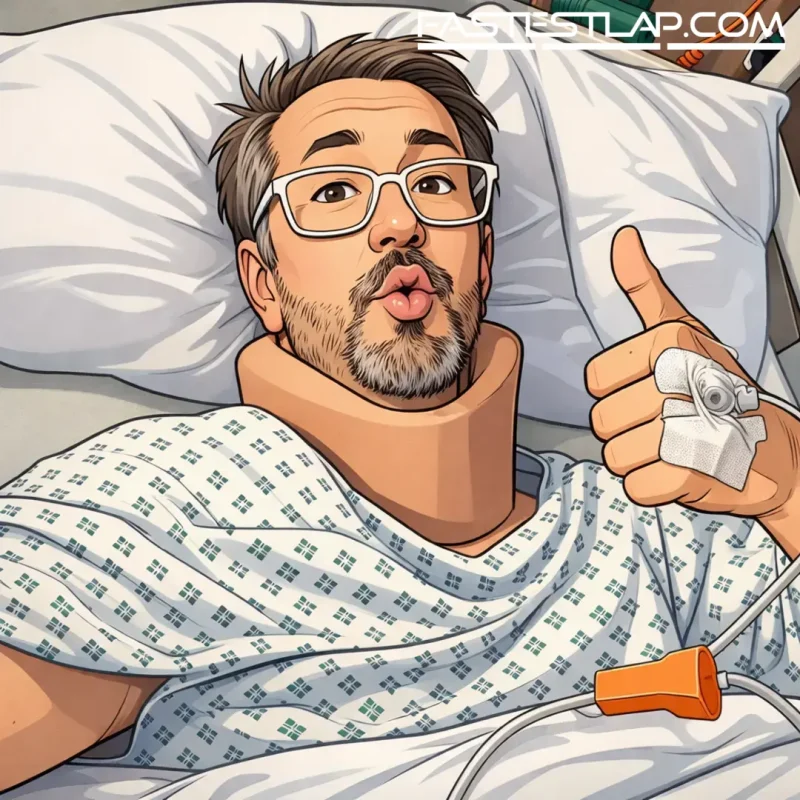
Heinz-Harald Frentzen has marked his 59th birthday in rather more dramatic fashion than most: by posting from a hospital bed in Mönchengladbach after undergoing back surgery.
The former Formula 1 race-winner shared a selfie on Monday, lying flat with a neck brace and offering a thumbs-up — the sort of dry, understated update you’d expect from a driver who spent a decade making hard work look easy. “Happy Birthday to me!” Frentzen wrote. “Woke up after back surgery to hundreds of birthday wishes – thanks so much! Got myself a brand new disc as a birthday present this year. Feeling very blessed. Greetings from Mönchengladbach.”
For those who followed Frentzen through the late 1990s, it was a reminder of just how long the sport’s bruises can linger, even for drivers who’ve been out of the cockpit for more than two decades. Frentzen made 156 grand prix starts between 1994 and 2003 for Sauber, Williams, Jordan, Prost and Arrows, picking up three victories along the way. His standout campaign came in 1997, when he ended the year second in the championship behind Williams team-mate Jacques Villeneuve — a season that, in a different timeline, might’ve been his route to a title.
Retirement hasn’t dulled his interest in F1, though. Frentzen remains a regular voice on social media, and he’s been characteristically blunt when the modern sport’s debates get heated — particularly around motivation, driver mindset and the direction of the rules.
When Max Verstappen voiced concerns in March about the 2026 regulations and hinted he could one day walk away if he wasn’t enjoying it, Frentzen didn’t try to talk him down. He effectively told him to do it.
“If you lose your motivation in F1, it’s better to quit, or at least take a break,” Frentzen wrote at the time. “That’s what I did. The sport is too dangerous if you lose your focus.”
It’s an old-school perspective, but it lands because it comes from someone who lived the consequences of a distracted moment at 300km/h. Frentzen’s point wasn’t about celebrity exits or bargaining power; it was about the narrow margin between a normal lap and a career-ending one — something F1 still can’t engineer away entirely, whatever the era.
He’s also weighed in on the technical direction beyond 2026, after news emerged that F1 will revise the current 50:50 split between internal combustion and electrical power for 2027. Frentzen made it clear he’s not against more electrical deployment in principle, but he doesn’t buy the idea of drivers deliberately backing off on the straights to harvest energy.
“I’m not against additional electrical power in general,” he wrote. “But deliberately slowing down on straights just to charge the battery by sacrificing combustion engine acceleration makes no sense – neither ecologically nor in terms of efficiency.”
Instead, Frentzen argued the battery should be recharged through more conventional means — “during normal braking or manually while in a slipstream” — suggesting it would allow cars to start lighter with less fuel and use energy more efficiently across a race.
It’s a pointed critique, and it reflects a wider tension the sport keeps bumping into: the push for a particular kind of sustainability narrative versus the basic promise of grand prix racing — that the fastest car should be the one accelerating hardest, not the one best at strategically coasting.
For now, though, Frentzen’s latest update is a personal one rather than a paddock argument. He’s out of sight on grand prix weekends, but clearly still tuned in — and still speaking with the sort of clarity that made him a compelling figure when he was threading a Jordan through the midfield and occasionally reminding everyone he belonged at the front.
The thumbs-up suggests the immediate post-op mood is positive. The rest, as ever in motorsport, is about recovery — and doing it properly.