Mick Schumacher arrived at Indianapolis talking up the privilege of a new challenge. Now he’s staring at the hard bit of it: making 500 miles from the back third of the grid count for something.
Schumacher will start 27th for his first Indianapolis 500 this weekend after a bruising qualifying left him 28th on pace in the 33-car field, before post-session penalties reshuffled the order. Caio Collet, who had originally been 10th, was disqualified when his car failed post-qualifying inspection, while Jack Harvey — initially 29th — was also excluded from the final classification. The net effect: Schumacher gains a slot, but not the speed he was chasing.
For a driver still learning the particular violence of IndyCar on ovals, the comments Schumacher made afterwards landed with an honesty you don’t always get in the middle of a big-weekend spin cycle. “Quali! It was a great experience yesterday, we’ve got some work to do our side and 500 miles to make something happen!” he wrote on social media. That’s the right attitude, but it also reads like an admission that the baseline isn’t where it needs to be.
Schumacher, now 27 and running with Rahal Letterman Lanigan Racing after switching to IndyCar for 2026, is still searching for his first points in the series. His best result through six starts is 17th, and the learning curve hasn’t been helped by the fractured wrist he suffered in an opening-lap accident at St Petersburg back in March. Even in a category where everyone expects rookies to take a few knocks, that kind of early disruption matters — especially when you’re trying to build trust in the car’s behaviour at high speed.
At Indy, where confidence is currency, Schumacher’s read on the qualifying run was telling. He said the car felt “good” — then immediately questioned whether that was actually the problem.
“We wish we would have been a little faster,” Schumacher said in a statement released by the team. “I’m not quite sure where the speed went from this morning. I think this morning looked pretty good, so we’ve got to understand that.
“The car felt good (in qualifying), but maybe it’s not the best thing that the car feels good. Maybe you want it to be a bit edgy but overall, we’ve just got to get after it, understand it and hopefully have a good car for the race.”
It’s an interesting window into the adjustment. In Indy 500 qualifying, comfort can be a trap: a car that’s too planted can also be too slow, and chasing that last handful of mph tends to mean flirting with instability. Schumacher is essentially saying they erred on the safe side — and at Indianapolis, “safe” can quickly become “stuck in traffic”.
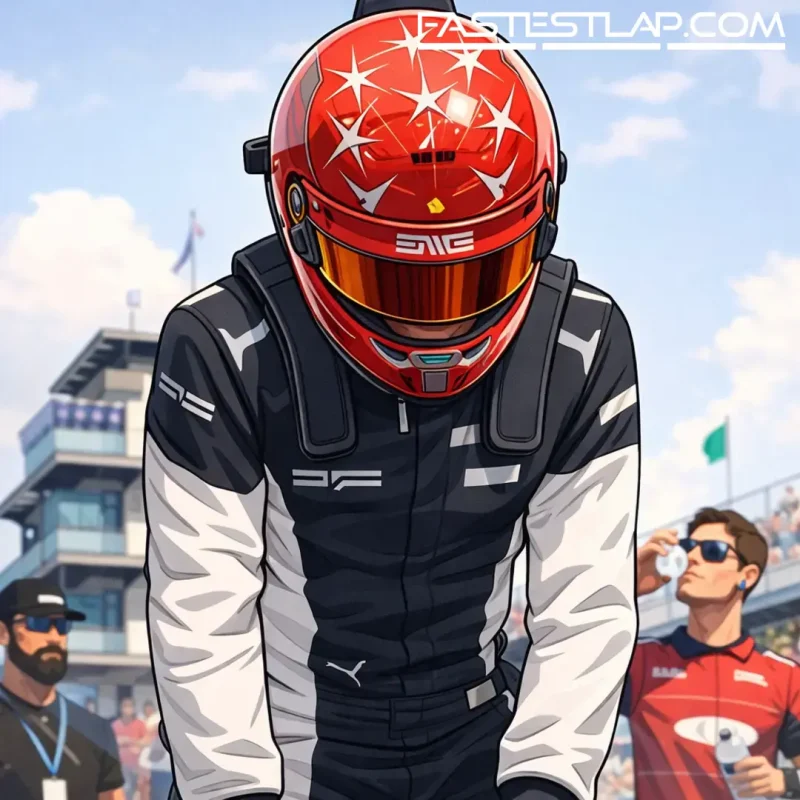
There’s another layer to his week as well. Schumacher has gone with a special red helmet design for the Indy 500, a clear tribute to his father Michael. It’s a personal touch in an arena that’s relentlessly unsentimental. The Brickyard doesn’t care about surnames, and it certainly doesn’t yield anything for nostalgia — but it does underline that this isn’t just a guest appearance. Schumacher is trying to build a second top-level career in a very different kind of racing, under the weight of a name that still turns every head in the paddock.
Starting 27th doesn’t doom a driver at Indy, but it does dictate the shape of their race. It forces you to be opportunistic without being reckless; you need the patience to let the race come to you, but you also can’t sit there waiting for miracles. For a rookie, it’s a particularly awkward assignment: the instinct is to prove you belong by making moves, yet the smartest thing you can do early is survive, learn the patterns, and keep the car in one piece for when the race opens up.
Schumacher, at least, sounded grounded in what he’s walked into. “I was just saying to everybody here how privileged I am to be able to work with such a great crew and such a great team,” he added. “Everybody on the 47 car, and everyone on the whole Rahal Letterman Lanigan team did an amazing job so far… It’s been a great experience so far and I’m just very excited to go into the race now.”
He won’t be alone in drawing F1 eyes across to Indiana. Alex Palou — once McLaren’s reserve on the F1 side — will start from pole position. Alexander Rossi, who raced in F1 with Manor and won the Indy 500 as a rookie in 2016, qualified second but suffered a heavy accident in practice on Monday that has left his participation uncertain. Takuma Sato, twice an Indy 500 winner, lines up 12th; Marcus Ericsson, the 2022 winner, starts 17th; and Romain Grosjean will begin 24th, three places ahead of Schumacher.
There’s a neat piece of Sunday scheduling theatre too: the Indy 500 will run just hours before Formula 1 goes racing in Montreal for the Canadian Grand Prix. For Schumacher, it means his biggest IndyCar moment so far lands on a day when the F1 world is already tuned in — and where any statement drive, even from 27th, will travel fast.
But first he has to do the unglamorous bit: settle into the rhythm, manage the risk, and turn that “work to do” into a race that looks like progress rather than damage limitation. At Indianapolis, reputations are built as much on judgement as they are on speed. Schumacher’s got 500 miles to show he’s learning both.