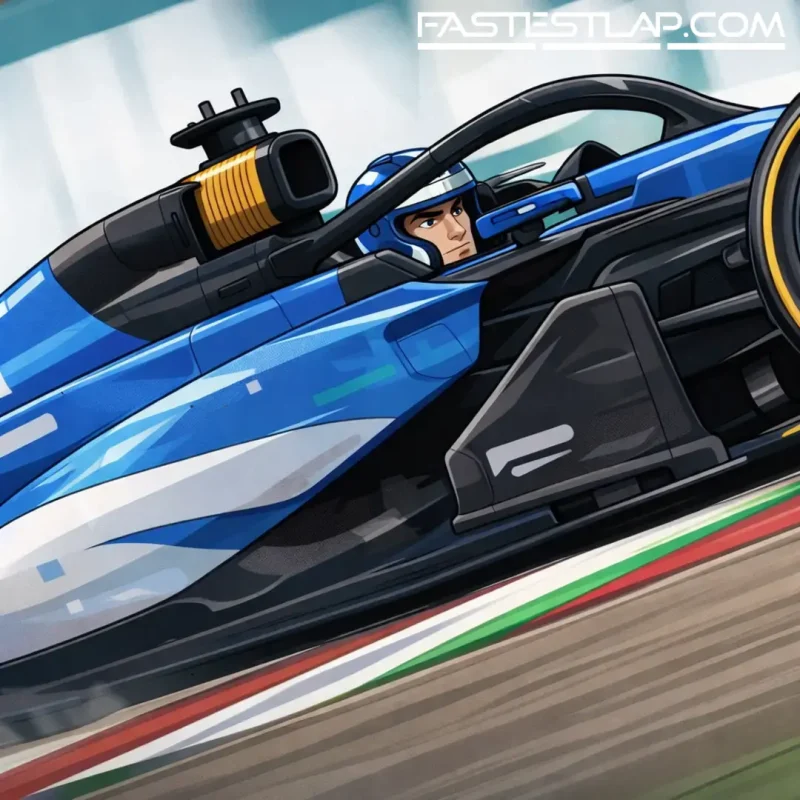
Williams will head into the Canadian Grand Prix with a different voice in its ear: Victor Martins has been drafted in as the team’s trackside reserve this weekend with Luke Browning tied up on Super Formula duty at Suzuka.
It’s a neat illustration of how modern junior and reserve programmes really work in 2026 — talented drivers spread across parallel championships, teams juggling availability at short notice, and the “reserve” label meaning far more than just turning up with a helmet in case of disaster. Browning’s calendar clash has opened the door for Martins to step into the operational rhythm of a grand prix weekend, even if the hope, as always, is that he never has to turn a lap in anger.
Martins’ path to this moment has been steadily built. A former Alpine junior, he’s currently racing for the French manufacturer in the World Endurance Championship and started his 2026 campaign with back-to-back 11th-place finishes at Imola and Spa. Williams brought him into its academy at the start of 2025, gave him a first proper taste of F1 machinery with an FP1 outing at last year’s Spanish Grand Prix, then elevated him into a test and development role ahead of this season.
That job title matters. Around Grove, Martins has been embedded in the simulator programme and the feedback loop that underpins Williams’ attempt to dig itself out of a difficult start to the new regulations era. He’s been working directly with Carlos Sainz and Alex Albon on development direction and set-up correlation — the sort of unglamorous, high-frequency work that can quietly decide whether a midfield car finds consistency or just cycles through “nearly” upgrades that never quite land.
So when Williams needs a reserve at short notice, Martins isn’t simply the next name on a list; he’s someone already plugged into the team’s week-to-week decisions and, crucially, its current pain points.
Those pain points have been no secret. Sainz, speaking after Miami — where Williams finally had something to smile about with ninth and 10th — offered a blunt snapshot of where the FW48 really sits. The upgrade that helped deliver that double points finish was, he revealed, originally intended to be on the car for the season-opener in Australia back in March. It arrived late, and it arrived into a project still wrestling with an overweight chassis.
That’s the kind of phrase that should make any technical group wince, because “overweight” isn’t just a number on a scale. It bleeds into everything: where you can put ballast, how aggressive you can be with set-up, how much freedom you have to chase tyre life without paying for it in lap time. When a driver tells you the car is still heavy, they’re also telling you the engineering group is fighting with one hand tied behind its back.
“We finally put the upgrade on the car that was supposed to come to race one, because of all the delays we had at the beginning of the season,” Sainz said. “Now we’ve finally put on the car what was supposed to be the race one package.
“Now it’s on the car, it’s performing at least at the level of the midfield cars. We know we still have a lot of overweight [issues] to set up the car. When you look at that, then it’s positive.”
There was relief in his tone, but not indulgence. Sainz has been around enough teams to know that one weekend of competence doesn’t erase months of under-delivery — and that the new ruleset rewards the teams who stabilise their fundamentals early, not the ones who spend half a season unpicking rushed decisions.
“I think the team has done a great effort over the last few weeks to bring this and it shows that when you do things right, things start to come away a bit better,” he said, before adding the part Williams will feel most sharply: “Not where we want to be.”
The bigger warning came next. Sainz doesn’t expect the “proper turnaround” to be immediate, suggesting Williams may need to wait until the final third of the season before the recovery looks convincing.
“Still, I expect everyone at home to know this is still not where we want to be… we need to keep pushing because it’s still not where we expected to be at the end of last year when we were hoping for 2026,” he said.
“It’s going to take some months to finish the turnaround. I think we’re going to need to get to the last third of the season to see a proper turnaround… the weight of the car came a bit off but we still know there’s a bit to go. We have a few bits and pieces coming for the next couple of races.”
That context is what makes Martins’ presence in Montreal more than a footnote. Williams is in the phase of the season where it needs clean, consistent decision-making — and that’s exactly where a well-integrated reserve can add value even without driving. Extra set of eyes in debriefs, more capacity to stress-test simulator tools against what the drivers are feeling on a bumpy, traction-sensitive circuit like Montreal, and someone who understands where the latest package is supposed to be heading.
For Martins personally, it’s also a quiet opportunity. Trackside weekends matter when you’re trying to convince a team you’re more than a good sim hand: how you communicate, how quickly you absorb information, whether you can contribute without forcing it. Browning will be back when Super Formula allows; this is still his slot. But these are the weekends that linger in a team’s memory when unexpected driver-market moments arrive.
Williams will hope it’s a calm one. Yet with the FW48 finally resembling the car it was meant to be in March — and still carrying the baggage of what it isn’t yet — having Martins on standby feels like sensible insurance in more ways than one.