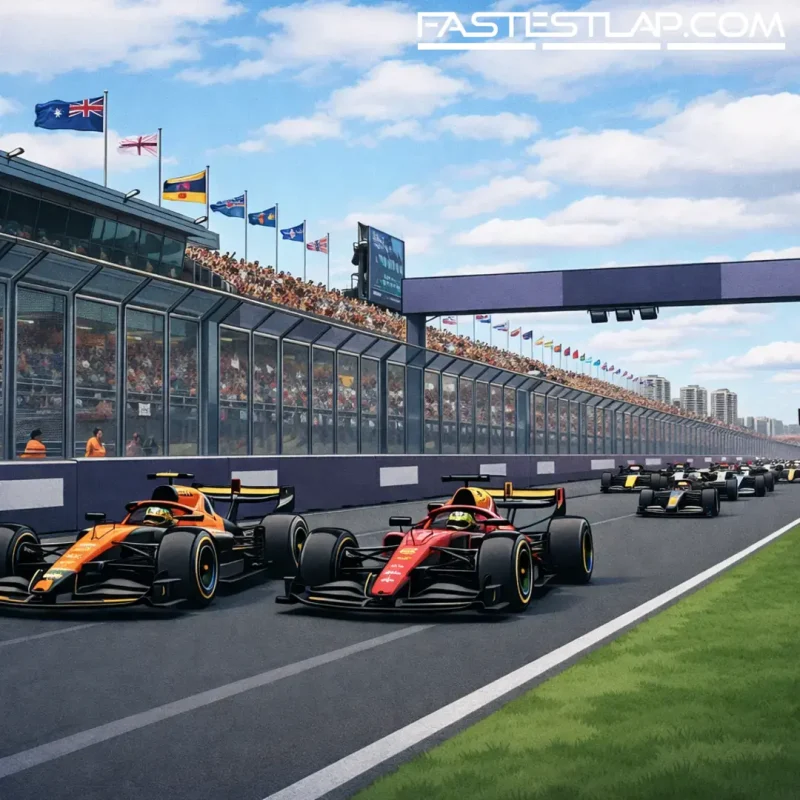
Fred Vasseur’s joke landed because everyone in the paddock knows it’s basically true. Take away the FIA’s extra pre-start help in the opening rounds and, yes, you probably would’ve had cars still parked on their grid boxes in China.
But the Ferrari team boss wasn’t laughing for long. Because the same interventions that have stopped 2026’s new power-unit era from turning race starts into a lottery have also blunted one of Ferrari’s few clear, repeatable edges over the first chunk of the season.
With the MGU-H removed from the regulations, teams lost a familiar tool for masking turbo lag at low revs. Launching these cars cleanly has become a far more delicate operation — not just in terms of driver technique, but in how quickly the power unit can get itself into the right state as the clutch goes. That’s why the FIA first introduced a pre-start warning sequence with flashing blue lights, essentially giving drivers a clearer “get ready” moment to start putting the car into its launch configuration.
Even with that, Ferrari was still consistently sharp off the line. It was the one thing you could almost bank on: a red car having a proper look at the pole-sitter on the run to Turn 1.
Then Miami happened, and the FIA went further again. After continued struggles across the grid — and a near-miss involving Liam Lawson and Franco Colapinto — the governing body introduced a ‘low power start detection’ system. The idea is straightforward: if a car is detected to be low on acceleration shortly after the clutch is released, the system triggers automatic MGU-K deployment to help it get moving.
In isolation, it’s an easy sell. Nobody wants a 2026-era grand prix start where half the field bogs down and someone arrives with nowhere to go. But Ferrari’s frustration is equally easy to understand: if you’d invested in building a power unit package that nails the launch phase, and the FIA then adds an assist to bring everyone else closer to your level, you’d feel like you’d been taxed for doing your homework.
Vasseur didn’t try to dress it up.
“You can put on the table the safety grounds, and it’s the right of the FIA and I have just to accept,” he said. “But at the end, I think it’s also a bit unfair on us.”
His point — and it’s one that will resonate with plenty of engineers up and down the pitlane — is that this wasn’t some bolt-from-the-blue discovery. Vasseur says Ferrari had raised the issue with the FIA a year ago and that it had been discussed in both the Sporting Advisory Committee and the Power Unit Advisory Committee. The message from the FIA then, he insists, was essentially: build to the regulations; don’t expect the regulations to bend around your particular car.
That’s the line teams usually want to hear, right up until they’re the ones watching the rulebook effectively gain an asterisk mid-season.
“So then to have half of the grid, 40 per cent of the grid complaining, that it’s mega dangerous and so on,” Vasseur added, before delivering the sharper barb. “Politically, [it] was well played but not very fair.”
It’s a telling choice of words. In Vasseur’s telling, this wasn’t simply the FIA spotting a safety gap and closing it — it was rivals successfully framing a performance weakness as a safety problem, and forcing the regulator’s hand. Whether you agree with him or not, the underlying reality is familiar in F1: if you can’t fix it quickly on track, you try to fix it in a meeting room.
Vasseur accepts the FIA’s authority to act on safety, but he also floated a more purist alternative: if teams genuinely believed their cars couldn’t launch safely, then they should’ve been made to start from the pit lane rather than being handed a system-level assist.
“For us, it’s also a choice that we made,” he said. “We developed an engine with a criteria and somehow they changed the rule at the last minute.”
That line matters because it speaks to how teams have approached the first season of the new power-unit rules. There are only so many areas where you can “choose” to excel early on, and the start phase is a big one. Vasseur was blunt about the trade-off Ferrari’s engineers have been managing.
“The start is by far the biggest,” he said. “The trade-off is do we want to make one tenth of a second [in lap time] or do we want to lose five positions at the start. If you ask the engineers they say, okay, let’s have a good start.”
In other words: if you’re going to leave lap-time on the table anywhere, you’d rather it not be in the first 200 metres, when track position can decide your entire Sunday.
All of this lands in a season where Ferrari has rarely looked slow — it has led laps in every grand prix so far — but still hasn’t converted that into a win. Mercedes, meanwhile, has been setting the pace with a power unit that’s been labelled controversial in the paddock, with talk of a loophole around compression ratios. That particular door, according to the information in circulation, won’t be shut until 1 June.
In the standings, the shape of the story is stark: Mercedes leads the Constructors’ Championship by 70 points over Ferrari, while Kimi Antonelli and George Russell sit first and second in the Drivers’ Championship.
So Ferrari doesn’t have the luxury of shrugging and moving on. When the margins at the front are tight, “losing” something as specific as launch advantage isn’t a footnote — it’s a direct hit to a team trying to turn promising pace into proper results.
And it’s also an early reminder of what 2026 is going to be like: the technical reset was supposed to standardise the targets, but the politics will still decide how — and how quickly — everyone’s allowed to reach them.