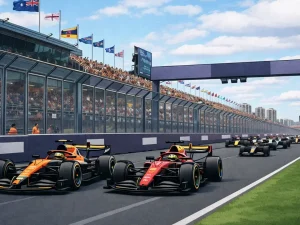
Mercedes will roll into Montréal with a familiar problem dressed up as a pleasant surprise: it’s got two drivers capable of winning, and right now the younger one has the leverage.
Kimi Antonelli arrives at the Canadian Grand Prix on the kind of run that rewires a team’s internal dynamics almost overnight. Three straight wins have put him 20 points clear at the top of the standings and, perhaps more importantly, have shifted the tone of the conversation around Brackley. Instead of asking when he’ll arrive, the paddock is now asking how Mercedes manages him.
George Russell, though, has no intention of playing supporting actor in a season that was supposed to underline his credentials as the senior figure in this pairing. Miami went against him — and both Russell and Toto Wolff have been quick to frame that result as an outlier rather than a warning. Russell has described Miami as a bogey track, while Wolff pointed to Russell’s discomfort with the circuit’s smooth surface and talked up Montréal as a very different proposition.
Russell also told the BBC’s Chequered Flag podcast he’s “looking forward to getting back into some more normal tracks,” which isn’t so much an excuse as it is a statement of intent. On paper, the next stop should suit him: he won the 2025 Canadian Grand Prix, one of two victories he managed last year alongside Singapore. If Russell is going to steady the story around his season, this is the venue to do it.
That’s precisely why Juan Pablo Montoya thinks Antonelli needs to treat Montréal like a chance to land a psychological blow, not simply another weekend to bank points.
Montoya, speaking on the same Chequered Flag podcast, said he’d heard the Miami narrative being built in real time — that it was a weak circuit for Russell, and that Canada is where he “comes back.” If you’re Antonelli, Montoya’s view is simple: don’t allow that reset.
“If I’m Kimi, I’m going out for blood,” Montoya said, repeating the line for emphasis. He framed it in the language of teammates and pressure points, recalling how he’d target Ralf Schumacher at the races that mattered most to him — Germany, in that case — because beating a teammate on “their” track is worth more than the stopwatch alone.
It’s a brutally honest reading of how intra-team hierarchy is often decided in F1. Russell has history in Montréal and a recent win there; Antonelli has momentum and the championship lead. If the rookie beats him again at a circuit where Russell is expected to be strong, the “Miami was just Miami” argument doesn’t just fade — it collapses.
Adding another layer is Mercedes’ planned first upgrade package for the W17, due to appear in Canada. In a year that’s already being described in the paddock as a development knife fight, timing matters. The first meaningful updates of the season tend to harden perceptions inside factories as much as they change the lap time. McLaren, fresh from a clear step forward last time out, is also expected to bring more new parts to Montréal, which only sharpens the sense that this is a pivot weekend for the competitive order.
The obvious question, when a young driver starts winning quickly, is whether the team quietly begins to swing the development spotlight in his direction. Montoya doesn’t buy that, arguing Mercedes is “very neutral” compared to rivals — that it simply brings what makes the car faster and lets the drivers deal with it.
That sounds idealistic, but there’s also a practical truth in it. Mercedes can’t afford to play favourites with McLaren applying pressure, and with the season still at a stage where one messy Sprint weekend can flip the table. Besides, in Wolff’s world, neutrality is often the stated policy even when the internal temperature rises.
Montoya’s more interesting point is what happens if Russell does find that bounce-back everyone is predicting. In his view, the most dangerous scenario for Antonelli isn’t Russell struggling; it’s Russell matching him.
If Russell can consistently meet Antonelli’s level, Montoya expects the response to be an escalation from the Italian — reaching further, trying to create separation again — and that’s where mistakes can creep in. It’s a classic cycle in a two-car fight: when outright speed isn’t enough to assert dominance, drivers start searching for it in the margins, and the margins are where penalties and errors live.
Damon Hill, on the same podcast, offered the flip-side of that psychology. If Antonelli goes on to win the title, the story writes itself: Mercedes’ big bet pays off early. But if Russell turns the tables and takes the championship, it inevitably reframes the narrative around Antonelli and the investment Wolff has made in him. It wouldn’t erase Antonelli’s progress — three consecutive wins in year two is a serious statement — but it would change the emphasis from inevitability to potential.
That, ultimately, is the tension hovering over Montréal. Antonelli is on a heater; Russell is heading to a circuit where he’s previously delivered; Mercedes is bringing its first upgrades; and the weekend will again use the Sprint format, which compresses preparation and increases the chance of something going sideways.
Montoya is also plainly waiting for the moment the streak ends — not out of scepticism, but because it’s the real test of any young frontrunner. In his words, young drivers can be “like a firework.” The question isn’t whether Antonelli is fast enough. It’s what he looks like when he isn’t.
Canada, with its walls, its chicanes, and its habit of punishing overconfidence, is a decent place to find out.