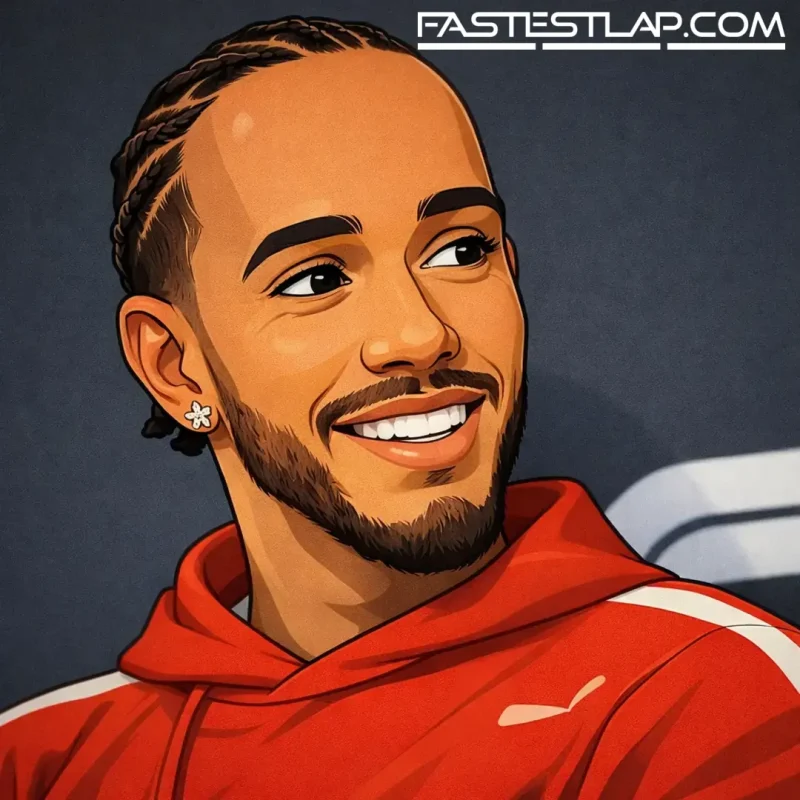
Lewis Hamilton didn’t go to Ferrari to wind his career down quietly, and he’s clearly had enough of the paddock’s favourite pastime: timing a champion’s exit before he’s even hinted at it himself.
In Montreal, Hamilton pushed back hard at the retirement chatter that’s followed him into 2026, insisting he’s “going nowhere” and telling those trying to usher him out to “get used to it”. The message wasn’t just theatre for a press conference; it was a reminder that, inside Maranello, his future isn’t being written by outside noise.
The more interesting detail, though, is what’s bubbling up around the structure of his Ferrari deal. Sky F1’s Martin Brundle says his understanding is that Hamilton has a unilateral option to extend his contract not only through 2027 — which has been the widely assumed lever in the agreement — but into 2028 as well, and crucially on terms that are in Hamilton’s favour.
If that’s accurate, it changes the usual power dynamic. Ferrari contracts are rarely framed as a driver holding all the cards, particularly when the other side of the garage features Charles Leclerc, still in his prime and, as Brundle put it, “on great form”. Yet that’s the point: Ferrari can’t simply wait for a natural end date and start planning the next era without Hamilton’s buy-in. Hamilton, meanwhile, isn’t merely choosing whether he still fancies it — he’s potentially choosing the moment Ferrari gets a vacancy.
Brundle also pointed to something that’s been visible for weeks: Hamilton looks like a man who’s enjoying his job again. He’s “more comfortable”, “happier”, with “a spring in Lewis’ step” that hasn’t been there for “a year or two”. Whether you want to pin that on the 2026 cars or the fresh oxygen of a new environment, the consequence is the same. A Hamilton who feels he can operate on instinct rather than wrestle the machinery is a Hamilton who doesn’t sound like he’s counting down the days.
And it’s not just about joyrides. Hamilton’s Ferrari move was always framed as a legacy play — but legacy isn’t a museum piece, it’s a result. There’s a difference between finishing your career at Ferrari and finishing it having actually bent the team’s direction, dragged it forward, won something meaningful in red. If he believes that’s still possible, then the incentive to keep the door open into 2028 becomes obvious.
Brundle’s read is that Hamilton’s comments in Canada were aimed directly at those who’ve been trying to nudge him toward the exit. “Because there have been a few people saying he should retire,” Brundle said, “that’s what he’s responding to.” Hamilton has never been shy about turning criticism into fuel; the difference now is that the criticism often comes wrapped in a kind of faux-concern — the idea that stepping away would be dignified, tidy, even noble.
Hamilton doesn’t do tidy.
There’s also a broader point Brundle made that tends to get missed when the retirement conversation becomes a cliché. Formula 1 isn’t something Hamilton squeezes in around the rest of his life; it’s the central pillar. Everything else — fashion, his foundation, the wider profile — is integrated around the job rather than replacing it. From that angle, walking away “unless he has to” doesn’t make much sense. Not when he still believes he can be competitive, and not when he still clearly enjoys the rhythm of it.
Of course, any contract option is only half the story. The other half is performance — not just Hamilton’s, but Ferrari’s. A unilateral extension clause is a powerful tool, but it isn’t an autopilot button. If Ferrari can’t give him a car capable of doing what he came there to do, the romanticism will fade quickly, option or no option. Yet Hamilton’s stance in Canada suggests he still sees a route to making it work, and that he’s not prepared to leave the narrative to other people.
It also creates an awkward knock-on effect further down the line. Oliver Bearman is widely viewed as a future Ferrari driver and continues to impress as he settles into his second full season at Haas. Jamie Chadwick summed up the tension neatly: great for Hamilton fans — potentially less so for Bearman’s. If Hamilton has the ability to hold his seat through 2028, then the timeline for Ferrari’s next reshuffle becomes less predictable, and the pressure shifts onto those waiting for the door to open.
Chadwick’s point was that Hamilton staying is “great for the sport” because he’s “clearly still thriving”, and because leaving Ferrari without achieving what he set out to achieve would feel like “a missed opportunity”. That’s the key line. Hamilton didn’t swap silver for red for the scenery; he did it for the chance to finish the story in the most Ferrari way possible — by winning.
So when Hamilton says he’s not going anywhere, it doesn’t land as stubbornness. It lands as leverage. And if Brundle’s information about a 2028 option is right, it’s leverage written into the paperwork too.