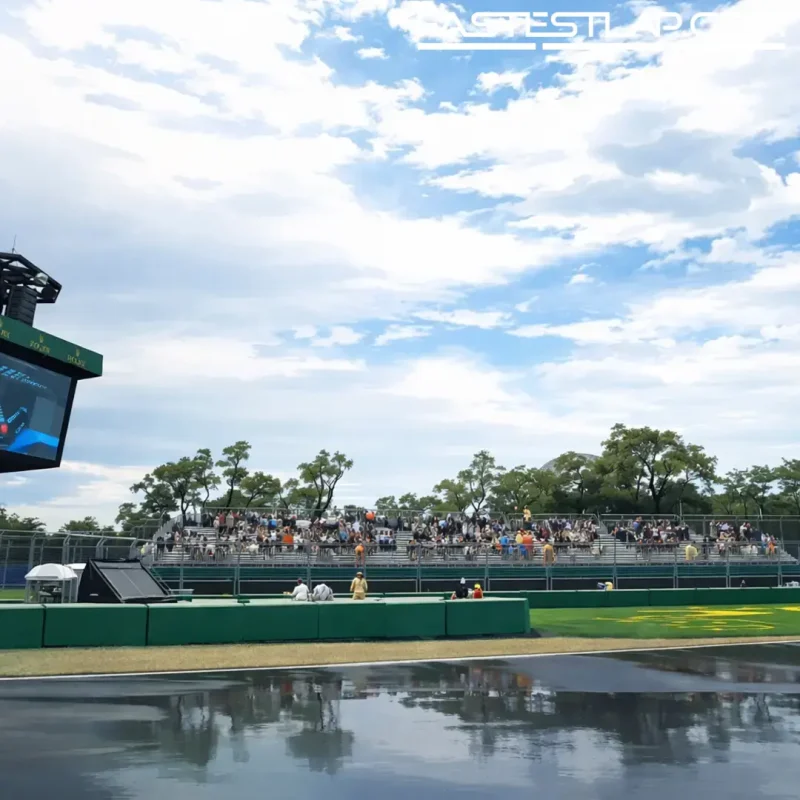
There’s a particular kind of unease that settles over the Montreal paddock when the radar turns ugly. Not the theatrical, nostalgia-tinged “wet race incoming” buzz — more the quiet realisation that, under 2026’s new rules package, nobody actually knows where the cliff edge is.
That’s the tone drivers have struck ahead of a Canadian Grand Prix that’s shaping up to be cold, wet and riddled with the sort of variables teams hate: standing water, long straights that bleed temperature out of the tyres, and a power unit/energy deployment picture that several drivers describe as borderline unpredictable when grip is low. For a field that’s barely had meaningful wet running in this regulation era, it’s an uncomfortable first proper exam.
George Russell, set to start from pole, summed up the mood neatly: there isn’t much the drivers can do to prepare because the relevant mileage simply doesn’t exist. He’s not exactly dreading it — Russell’s always been one to welcome opportunity in changeable conditions — but even he framed Sunday as an exercise in discovery rather than execution.
Mercedes team-mate Kimi Antonelli went straight to the issue engineers have been muttering about since tyre blanket temperatures were reduced. Cold track, cold air, rain: it’s the perfect recipe for a tyre that never properly wakes up. Montreal is already notorious for punishing anyone who can’t generate energy through the carcass; add inters or full wets and the opening laps become less about bravery and more about who finds a workable temperature window first.
Lando Norris didn’t try to dress it up. He says nobody really knows how hard these cars will be to drive in the wet because, effectively, nobody’s done it in anger. Even in the dry, getting heat into the softest compounds has been tricky; take another chunk out of ambient temperature and then ask inters and wets to do the job with minimal help from the blankets, and you’re into the unknown.
Oscar Piastri’s view was blunter still — and more revealing. He’s not only worried about grip and visibility, but about how the current power units behave when inputs are inconsistent. And in rain, by definition, everything is inconsistent: throttle traces, steering angles, braking pressure, corner-to-corner approach. Piastri expects “issues” up and down the grid, and he doesn’t sound like he means a few harmless snaps of oversteer. He also hinted at a truth teams don’t love admitting: after the prep work done as far back as Miami, the conclusion was essentially that the sport’s best engineers still don’t fully know what Sunday will look like once the cars hit deep water on cold tyres.
Max Verstappen’s comments landed in a similar place, even if he came at it from a more familiar angle: if the tyres don’t switch on, they don’t switch on — and Montreal’s long full-throttle sections are tailor-made to undo whatever temperature you’ve just built in the braking zones. His aside about preferring a Virtual Safety Car over a full Safety Car if there’s an incident was telling. In this generation, crawling around behind the Safety Car can be the fastest way to make the tyres *worse*, not better, and then the restart becomes a lottery of who guesses the grip level correctly.
Lewis Hamilton, meanwhile, turned the conversation back to the underlying compromise that’s been bubbling away since blanket rules changed. In his view, the wet tyres simply aren’t delivering — a product of being designed to operate with reduced blanket temperatures and still coming up short. Hamilton said he’d pushed for higher blanket temperatures and for blankets to be added to the extreme wet tyre, which has happened, but he insists it still doesn’t solve the core problem: they’re “a lot worse” than what the drivers had in the past. It’s a sharp critique, and not one made lightly, because it effectively questions whether the current wet package is fit for the kind of conditions Montreal can throw at the field.
Carlos Sainz added a key detail from the driver grapevine: complaints from those who did wet testing — including Pierre Gasly at Magny-Cours — about inters and wets struggling to reach their operating range and a heightened aquaplaning risk. Sainz also asked for patience from media and fans if race control takes a conservative approach. The point isn’t hard to grasp: this is the first time these cars, with their particular speed differentials and energy characteristics, will tackle a genuinely cold wet race on tyres that drivers don’t trust yet.
Further back, the language got even more colourful. Sergio Perez called it a potential “total mess”, pointing to energy deployment “kicking in” down the straights — exactly the kind of moment that can catch out a driver already tip-toeing through spray and shallow rivers. Fernando Alonso, never one to overcomplicate his messaging, described the deployment as “a little bit random”, flagged the harshness of the gearboxes, and predicted that simply finishing could be an achievement if conditions deteriorate. He did, however, sound confident the FIA will manage visibility cautiously — another hint that the start procedure and Safety Car usage may end up being as decisive as outright pace.
The younger end of the grid is largely in the same boat, just with less scar tissue. Gabriel Bortoleto admitted he has “no clue” what to expect. Arvid Lindblad expects prior wet experience — even if limited — to help, but stressed the need to react in real time because so much will be out of the drivers’ control. Oliver Bearman, by contrast, sounded almost eager: rain can scramble the order, and for those not fighting at the very front, that’s often where the points appear.
Gasly offered perhaps the most honest warning: it could turn into “an elimination game”. On a circuit where the walls are close and the braking zones are heavy, it doesn’t take much — a cold front-left, a standing-water patch on the racing line, a snap of deployment at the wrong time — for someone’s weekend to end with a puncture and a broken front wing.
Montreal in the wet has always been about judgement. This time, it may be about something even rarer in modern F1: improvisation. Not just for the drivers feeling for grip, but for teams trying to read tyre behaviour live, and for race control balancing safety with a sport that knows a messy spectacle is only entertaining if it stays on the right side of controllable.