Mercedes hadn’t even made it to Sunday in Montreal before the inevitable arrived: two silver cars, one piece of asphalt, and a reminder that “we’re allowed to race” is always the easy part.
The Canadian Sprint delivered the first proper flashpoint of what’s shaping up to be a genuine intra-team scrap between George Russell and Kimi Antonelli. With Mercedes’ recent update package helping it edge clear of the chasing pack, the team suddenly looks less like a regular podium contender and more like a championship operation with two drivers in the same conversation. That changes the temperature quickly.
It only took six laps.
Antonelli, leading the drivers’ standings coming into the day, launched a move around the outside of Russell into Turn 1 and got properly alongside. Russell responded like a man who’s read the small print: he held his line, closed the gap, and Antonelli ended up taking the escape road to avoid contact. No damage, no retirement, but the message was loud enough.
Antonelli came back again at Turn 7, this time diving up the inside. Russell again resisted — aggressively — and the Mercedes rookie was forced onto the grass in a shower of cuttings and sand. Two incidents, same pattern: Antonelli asking the question, Russell answering with bodywork proximity rather than diplomacy.
Both cars survived, which in modern F1 tends to be treated as proof that everything was fine. Russell went on to win the Sprint, with Antonelli third, trimming the Italian’s championship lead by two points. But the bigger consequence was the one Mercedes always wants to postpone: defining the rules when both drivers are racing for something that actually matters.
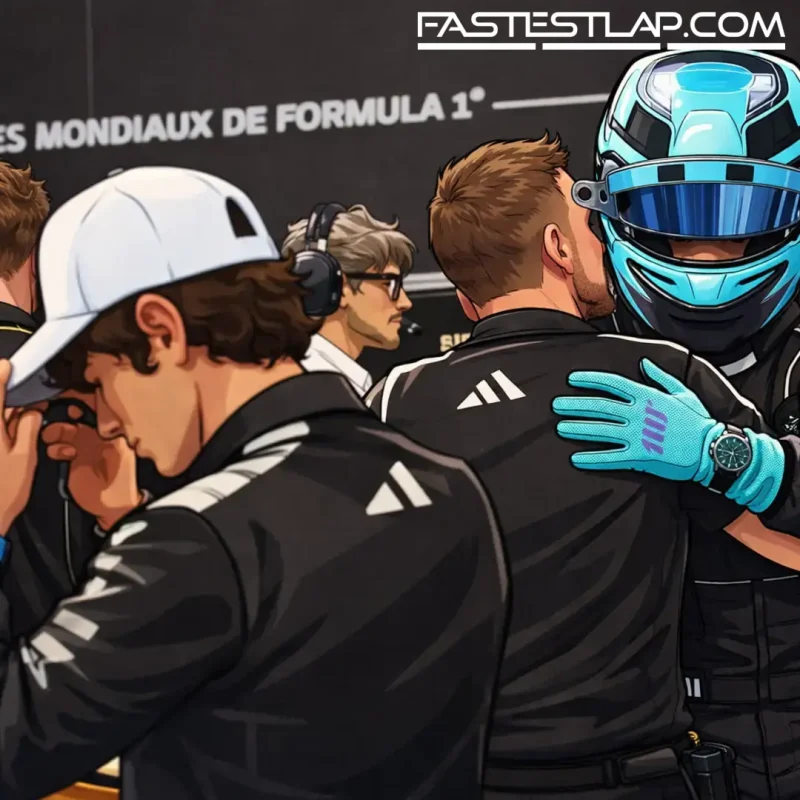
Toto Wolff, who’s lived through the Hamilton-Rosberg years and still carries the scars, didn’t sound remotely surprised. If anything, he sounded relieved to be having the conversation early — in a Sprint, with the Grand Prix still ahead, and with two cars intact.
“That was good, like sports should be – an inter-team battle or outside, and for us, it’s good learning,” Wolff said afterwards. Then he went straight to the familiar dilemma: do you treat your team-mate like any other rival, or do you build in an extra margin because the fallout lands on your own garage floor?
Wolff’s framing was telling. He described sitting the drivers down to establish what kind of racing Mercedes expects: hard racing with no space given, a more cautious “leave-a-car’s-width” approach, or the artificial version where overtakes are effectively reserved for straight-line braking zones. In other words, the classic spectrum between purity and self-preservation — and every team knows where it usually ends up when the points get tight.
Mercedes, for now, is leaning on trust. Wolff’s line was that the drivers know how to push, and that nobody should be expecting the other to politely leave the door open when a win and a title are on the line. That’s a green light, but with a footnote: if you crash, you’ll be having a very expensive conversation.
The other subplot was Antonelli’s radio, which grew sharper as the Sprint went on. He labelled Russell’s defending “very naughty”, asked for a penalty, and later told engineer Pete Bonnington: “That was not fair, he pushed me off!”
Wolff’s response was immediate and unmistakably old-school team boss. He came on the radio and told the 19-year-old to focus on driving rather than “moaning”, making it clear he didn’t want the internal dispute played out in public over the airwaves.
Afterwards, Wolff expanded on the reasoning with a line that revealed his real concern. He doesn’t mind a driver venting once — “We’re the bin for your emotion” — but he does mind the repetition, because it turns the whole weekend into a narrative about rivalry and control. In his words, it wastes time and fuels the questions he’d rather avoid. He even joked he’s “100 per cent sure” he’ll look like a fool a few times this year. That’s the sort of gallows humour that usually comes from someone who can already see where the season might be heading.
Antonelli, for his part, struck a more measured tone once the helmets were off. He said the discussion with Wolff went well and that Mercedes isn’t clamping down with hard restrictions. The key difference, he admitted, is that it needs to be “smarter”.
“We are still free to race – but race in a smarter way,” Antonelli said. “Today was probably a bit too much on the limit from both of us but the most important thing is we clarified and moved forward.”
The timing is what gives this story bite. Russell will start the Canadian Grand Prix from pole position with Antonelli alongside him on the front row. After Saturday’s elbows-out preview, Sunday now comes with an obvious question: what does “smarter” look like when Turn 1 arrives, both cars are in clean air, and neither driver feels obliged to yield?
Wolff can talk about trust and maturity — and both Russell and Antonelli have enough talent to make that credible — but Montreal has already shown the underlying truth. If Mercedes really has built itself a car that can carry an internal title fight in 2026, then the team isn’t just managing pace and upgrades anymore. It’s managing two drivers who both think the corner belongs to them.