
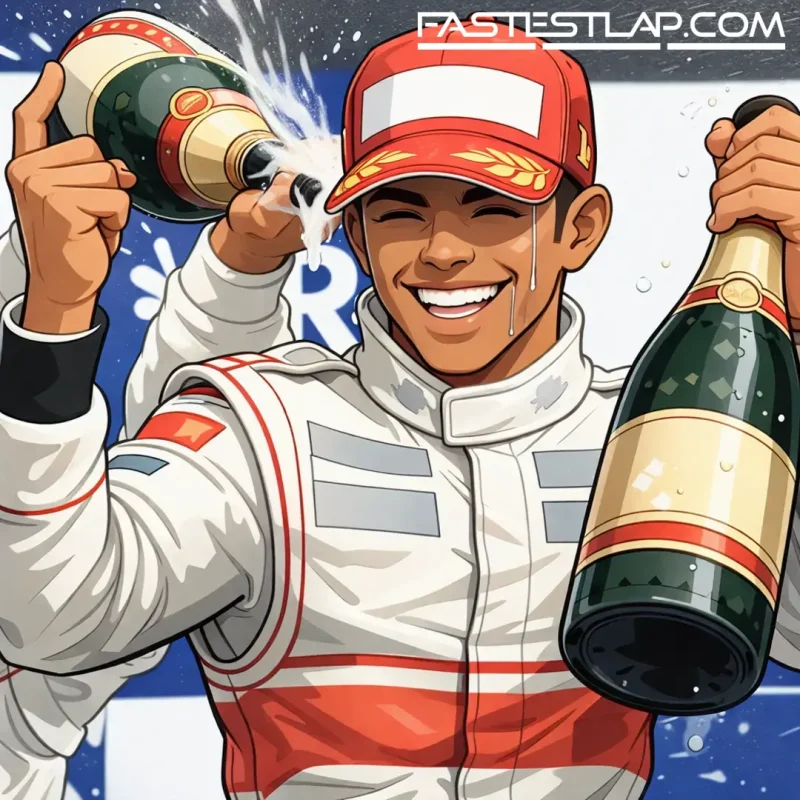
Lewis Hamilton still bristles at the idea he was supposed to play apprentice in 2007.
Ahead of the 2026 Canadian Grand Prix — a race he’s won seven times across his career — Hamilton has been reflecting on the first of those Montreal victories, the one that opened his Formula 1 win account in just his sixth start. It’s remembered as the day the rookie beat the reigning double world champion Fernando Alonso fair and square. What tends to get lost is the internal fight Hamilton says he had to win before he could win the race.
Back then, he was McLaren’s new sensation alongside the sport’s established benchmark, Alonso fresh off back-to-back titles with Renault. The dynamic that season quickly became combustible, not because Hamilton lacked respect for Alonso’s pace — he’s the first to call his former team-mate “so talented and so fast” — but because Hamilton refused to accept an unspoken pecking order.
And in Hamilton’s telling, the pecking order wasn’t just political. It was baked into the strategy.
“I remember the first five races, naturally, in the fuel area, they would always give Fernando the lighter fuel load, separating the cars by two laps,” Hamilton said, recalling the early phase of that season.
In that era, fuel loads shaped everything: qualifying performance, stint length, race flexibility. A lighter car could unlock a crucial couple of tenths on Saturday and put a driver in control of Sunday’s rhythm — especially in a team with two quick cars and no appetite for unnecessary risk. Hamilton’s point wasn’t subtle: if you’re carrying more fuel, you’re being asked to do more to arrive at the same outcome.
“It always felt to me that I had to do the work twice as hard, if not more,” he said. “I always had to be at least a tenth quicker than him or more… to be able to be ahead of him.”
That is a very Hamilton way of framing it — not complaining about the disadvantage so much as turning it into a measurable target — but it also exposes something about top teams when they’re managing a champion and a rookie. “Naturally” is doing a lot of work in that sentence. There’s nothing unusual about a team giving its established star the more aggressive strategy early in a season. What’s more unusual is a rookie pushing back, and having the team actually listen.
Hamilton did exactly that.
“I had pushed so hard to get equal fuel,” he said. “‘Just give me the chance and I’ll show you what I can do.’”
McLaren relented in Canada. Hamilton says the cars were finally put on equal terms, and the results were immediate: pole position, then victory — his first — at a circuit that tends to punish any driver who’s even slightly out of sync. Montreal can flatter the brave, but it doesn’t give much away.
McLaren kept that parity in place for the following round at Indianapolis as well, and Hamilton came out of that double-header with back-to-back wins — a pivotal stretch in a rookie season that ended with him contending for the championship to the wire.
Looking back now, with 105 wins and a record-equalling seven world titles to his name, Hamilton framed Canada 2007 less as a breakthrough drive and more as a moment of internal validation: he’d fought for what he believed was fair, got the opportunity, and proved he deserved it.
“I think it was a real special moment for me because I fought for something I truly believed in and when they gave us the opportunity, I affirmed that belief,” he said. “And then the rest was history.”
It’s also a neat window into how that McLaren partnership deteriorated so quickly. When two elite drivers are separated not by lap time but by the perception of status — who gets the first call, who gets the ‘better’ strategy, who is being protected from who — every decision becomes loaded. Equal fuel wasn’t just an engineering adjustment; it was a statement about how McLaren saw its new asset. You can argue that once Hamilton forced that door open, it was never going to close again.
Alonso left McLaren at the end of that single season, returning to Renault and later racing for Ferrari, then McLaren again, then the Enstone operation in its later guise, before continuing his career with Aston Martin — where he remains on the grid as F1’s most experienced driver.
Hamilton, meanwhile, stayed at McLaren long enough to win the 2008 title, then made the move to Mercedes in 2013 that defined an era as he collected six more championships during the team’s record-breaking run. He joined Ferrari ahead of the 2025 season, bringing his career full circle back into scarlet and adding a fresh chapter to a CV that already reads like the modern sport’s record book.
But it’s telling that when Hamilton thinks about Canada, he doesn’t start with the champagne or the trophy. He starts with the argument he had to win in the garage — and the insistence, even as a rookie, that he wasn’t there to be anybody’s number two.









