Ford knew what it was signing up for when it hitched itself to Red Bull Powertrains: Formula 1 doesn’t stand still, and the politics around power units move even faster than the cars.
That’s why Mark Rushbrook’s stance on the growing V8 noise is so revealing. The Ford Racing global director has made it clear a likely shift back towards a V8 formula in the next rules cycle wouldn’t spook the Blue Oval out of grand prix racing — even though Ford’s 2026 return was sold on the promise of a heavily electrified future.
The context matters. Ford is back on an F1 grid for the first time since the Jaguar-Cosworth era ended in 2004, this time as Red Bull Powertrains’ partner on the new 1.6-litre V6 hybrid regulations. The headline change for 2026 was always the electricity: the power split moved towards a near 50/50 balance between combustion and the electrical motor, with the MGU-K’s output rising from 120kW to 350kW.
Ford’s contribution has been focused where you’d expect a modern OEM to see value — electrical and hybrid systems, investment, and know-how in the ancillaries that make these power units work. And in the early months of this regulation cycle, the RBPT-Ford programme has looked like one of the smarter bets in the paddock.
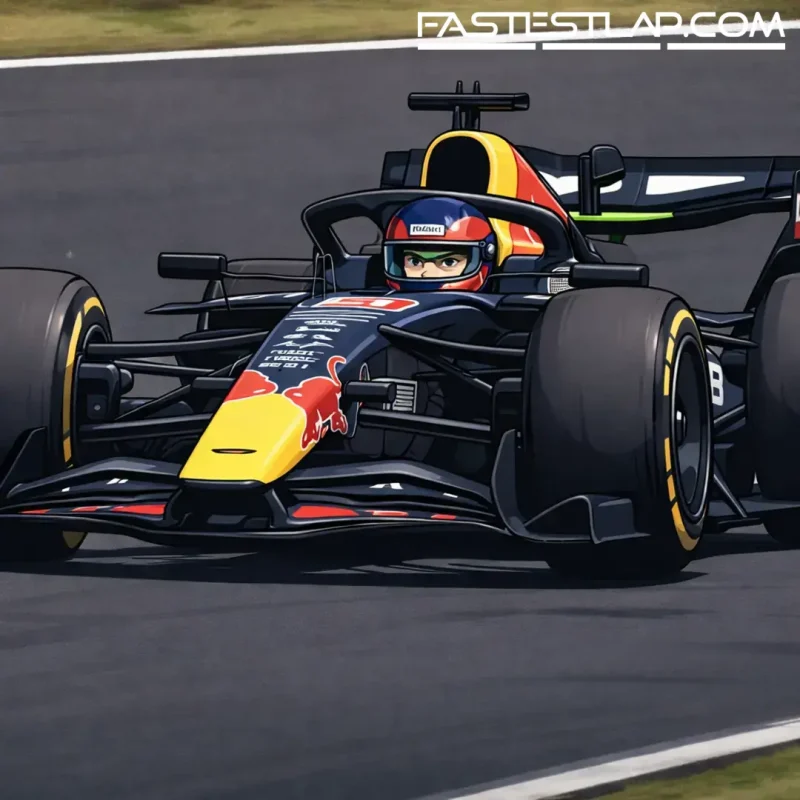
Max Verstappen’s third place in Montreal brought Ford back onto an F1 podium in partnership with Red Bull, and it didn’t feel like a novelty act. The early pecking order has been the subject of the usual paddock squinting — the FIA’s performance indexing for the ADUO system is still not confirmed — but the general read is Mercedes has a small edge, with RBPT-Ford close enough to be uncomfortable company.
Yet while the results have been trending the right way, the sport has already started tugging at the regulations.
Drivers and fans haven’t been shy about their feelings on how the new energy management shapes the racing and, crucially, how it shapes the driving. The FIA has already spoken about changes to improve the show, and there’s an agreement “in principle” to alter the split to 60/40 in 2027, putting more emphasis back on the internal combustion engine.
Then there are the bigger comments from FIA president Mohammed Ben Sulayem, who has been blunt that electrification will be significantly reduced in the next engine formula. The current cycle is officially set to run to 2030 inclusive, with the FIA able to make unilateral decisions for 2031 once the Concorde Agreement expires. But Ben Sulayem has openly targeted 2030 for an earlier shift — specifically back towards a V8 architecture with only a small electrical element.
That sort of rhetoric, coming only months into Ford’s return, could easily read like the rug being pulled. Instead, Rushbrook is effectively shrugging.
Asked during the 2026 Nürburgring 24 Hours whether the tone from the top of the FIA changes how Ford views its place in F1, Rushbrook didn’t blink.
“No, honestly,” he said. For Rushbrook, this is what happens in a sport with multiple stakeholders jostling for influence: opinions get aired, someone eventually makes a call, and the industry adapts. Ford, he insisted, has already communicated what it wants out of the programme — and it has enough breadth in its road-car line-up to find relevance in more than one direction.
That’s the part worth underlining. Ford isn’t coming at this like a manufacturer whose identity is tied to a single technological pathway. Rushbrook pointed to the company’s spread of powertrains — pure combustion, full EVs, and various hybrids — and argued there’s still plenty to learn and plenty to sell regardless of whether F1’s next chapter leans harder into batteries or back towards the noise and simplicity of a naturally aspirated engine.
“I think going to a naturally aspirated V8, to have a small electrical element, is appropriate for the sport,” he said. “We would be happy with that.”
It’s also a subtle reminder that Ford’s F1 project doesn’t live in a vacuum. Rushbrook stressed that Ford’s broader motorsport footprint provides technical and marketing opportunities under different rule sets, so F1 doesn’t have to carry the entire “relevance” brief on its own.
Where this gets interesting is what Rushbrook’s calmness says about the Red Bull Powertrains project itself. Red Bull’s engine programme began as the in-house vision of Christian Horner, backed by the late Dietrich Mateschitz, and it’s now the cornerstone of Red Bull’s evolution into a fully autonomous constructor-manufacturer operation. Ford buying into that wasn’t just about a 2026 rules set; it was a bet on infrastructure, talent, and long-term competitiveness — the sort of things that survive regulation swings.
Rushbrook also acknowledged, without dressing it up, that the new rules have changed the product. “It has definitely changed the racing,” he said, noting the fanbase is split and that the current dynamic has created passing opportunities. In his view, the in-season adjustments made for 2026 are sensible, and further revisions “make sense” as the sport learns in real time.
That sits neatly alongside the mood in the cockpit. The FIA’s tweaks to energy harvesting and deployment have been welcomed by drivers as a step back towards something more natural. But Verstappen has also warned that the more dramatic 2027 changes aren’t optional if F1 wants to keep him fully invested; he’s called the current situation “not mentally doable” if the mooted improvements get watered down by politics.
For Ford, the message is clear: it didn’t return to F1 to be locked into a single ideological vision of the power unit. If the sport lands on V8s with a modest hybrid element by 2030 — whether by consensus or by force of governance — Rushbrook is signalling Ford will still see a place for itself at the table.
In a championship where so many stakeholders talk like they’re issuing ultimatums, that’s a refreshingly pragmatic position. And in the end, pragmatism is usually what wins in Formula 1 — not purity.