Montreal has a habit of revealing what’s been politely hidden in the paddock. This time, it wasn’t the walls doing the exposing so much as Mercedes’ own drivers.
For the first stretch of 2026, the Russell–Antonelli pairing has been sold — and mostly behaved — as a clean, modern partnership: quick, clinical, team-first. Canada didn’t blow that up in one dramatic moment, but it did show the hairline fractures you only notice when two cars are close enough on track that someone has to decide who yields. And on Saturday, nobody did.
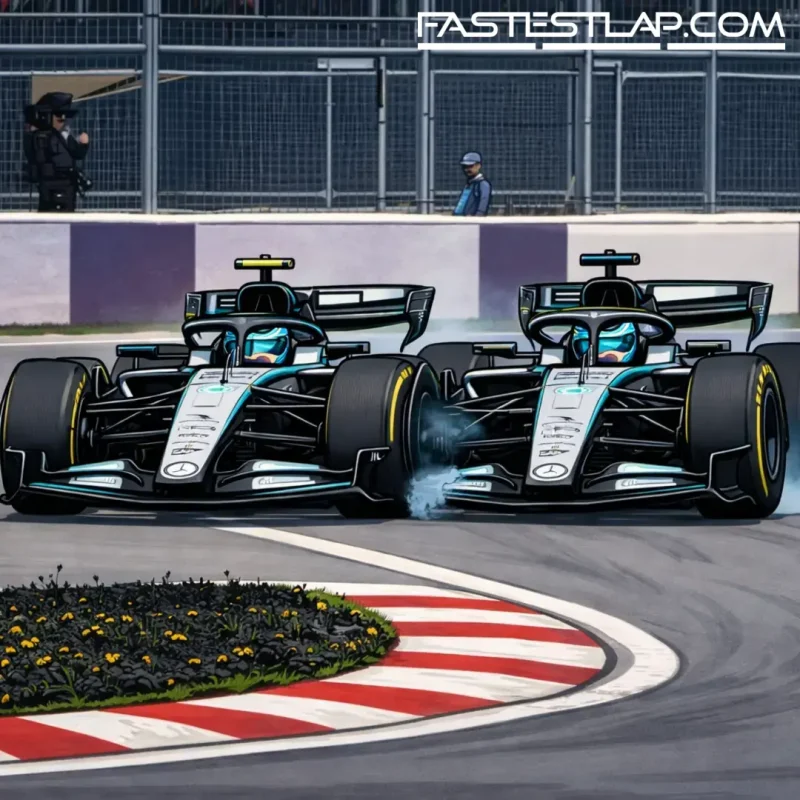
In the Sprint, George Russell shut the door with the sort of certainty that tells you he didn’t feel he owed his team-mate a millimetre. Kimi Antonelli ended up taking to an escape road, later even tasting the grass at Turn 7, and his radio message had less of the “we’ll debrief” polish Mercedes usually insists on. “That was not fair, he pushed me off,” Antonelli snapped, calling the move “very naughty” and even pushing for a penalty — an unusually public escalation when the car on the other side of the argument is painted the same colour.
Toto Wolff didn’t let it breathe. He came straight on the radio, not to arbitrate, but to shut it down: concentrate on the driving, stop moaning, we’ll handle it internally. The subtext was unmistakable. Mercedes can tolerate plenty, but not a driver trying to litigate a team-mate on live television.
The curious thing is, it didn’t end the tension — it just moved it. Jolyon Palmer, speaking after interviewing the Sprint’s top three, put it bluntly: Antonelli’s post-race body language did not match a P3 in a tight title fight. No smile, no easing off, just simmering irritation contained by media training and the knowledge that Wolff had already drawn a line in public.
And then Sunday happened, which is where the weekend stopped being about one defensive move and started looking like a pattern.
The Mercedes pair found each other again in the Grand Prix, wheel-to-wheel, trading the lead and trading errors at the hairpin. This time Antonelli didn’t appear remotely interested in backing out early and living to fight later; he looked like a driver who’d decided Saturday’s lesson was not to complain more effectively, but to position his car so the complaint isn’t necessary.
It’s worth stressing the context: Antonelli is leading this championship by 43 points. That changes the dynamic of every “gentleman’s agreement” inside a team. The younger driver isn’t asking for space because he’s the rookie; he’s arriving with points in hand and a season that’s increasingly bending his way. For Russell, that’s an uncomfortable shift. He’s fast enough to win Sprints — he did in Montreal — but the shape of the year now asks a different question: can he win the fight inside his own garage when the momentum has swung away from him?
Russell’s Grand Prix ended with a battery issue, and frustration spilled out in a way you rarely see from a driver who usually keeps his edges sanded down. He threw his headrest onto the track in front of his stricken W17 — a small act, but one that felt like a pressure valve going. It was the image you couldn’t quite square with the “we’re all pulling together” messaging that defined Mercedes’ early-season calm.
Palmer suggested Canada had the feel of a “flashpoint”, the sort that tends to crop up in every great intra-team rivalry. He’s right, not because the contact was catastrophic — it wasn’t — but because both drivers came out of the weekend looking at the same facts through radically different lenses. Antonelli saw a team-mate squeezing him beyond what he considered acceptable. Russell, by driving the way he did, effectively told the world he thinks he’s entitled to race Antonelli hard and make him take the long way around. Neither stance is outrageous. Together, they’re combustible.
Ralf Schumacher went further, arguing that Antonelli’s composure in the duel was the real story — not just the speed, but the way he repeatedly drew Russell into mistakes. Schumacher’s verdict was pointed: Antonelli looks like a driver who can absorb pressure and learn from it, while Russell “can’t handle pressure well”. That’s a harsh reading, but you can see why the perception is forming. When Antonelli gets agitated, it comes out as anger and immediacy on the radio; when Russell gets squeezed, it seems to leak through in moments of visible, physical irritation.
What Mercedes will be watching now isn’t only lap time. It’s what happens the next time these two arrive at a braking zone with no backmarkers, no strategy offsets, no convenient excuses — just championship arithmetic and the knowledge that the other car is the only one that truly matters.
Wolff’s “we’ll talk internally” line is doing a lot of heavy lifting. Managing a title fight inside the same team is never about one debrief; it’s about setting the boundaries early enough that they’re respected when the stakes get ugly. Canada suggested those boundaries are still being negotiated, in real time, at 300km/h.
For Antonelli, the weekend carried a certain clarity. He’s no longer the prodigy learning alongside the established leader. He’s the championship leader, and he’s driving like it — even when it irritates the other side of the garage. For Russell, Montreal felt like the first weekend where his team-mate wasn’t merely impressive, but actively oppressive: constantly present, constantly threatening, constantly demanding a response.
A season doesn’t turn on one Sprint squeeze or one hairpin wobble, but relationships do. Mercedes came to Canada with a neat story about two quick drivers pushing the team forward. They left with something messier, more human — and, from a sporting point of view, far more interesting.