
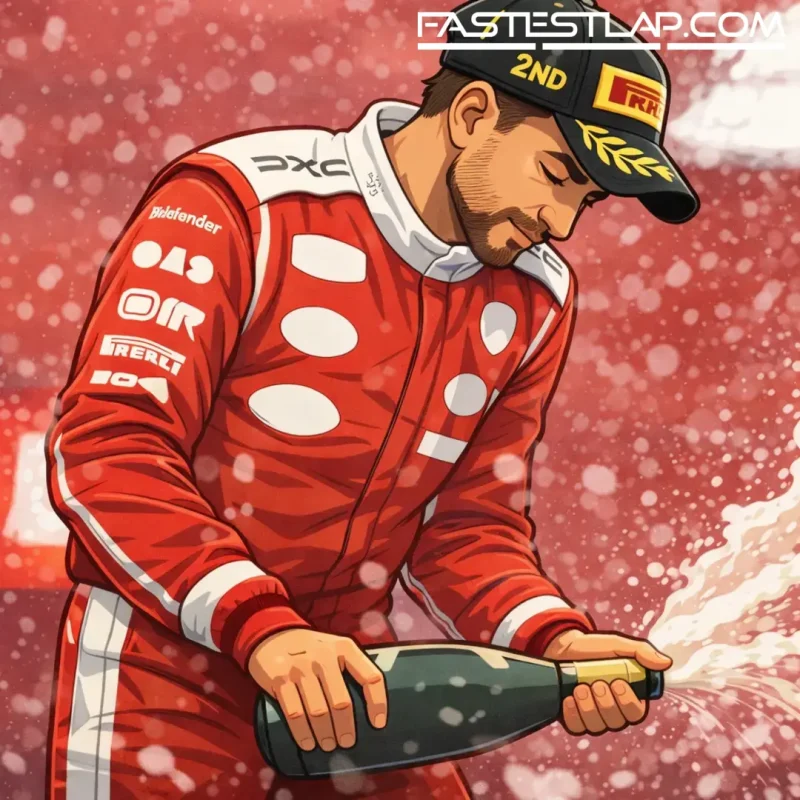
Lewis Hamilton wasn’t interested in playing along with the annual parlour game of trying to pension off a champion before he’s ready. Arriving in Montreal for the Canadian Grand Prix, the Ferrari driver made his position bluntly clear: he’s not “retiring any time soon”, and anyone eager to see the back of him should “get used to it”.
In a paddock that always thinks in terms of the next contract cycle, the line landed with a little extra weight. Not just because Hamilton is still one of the few drivers who can change the temperature of a weekend with a single quote, but because his continued presence inevitably sits in the background of Ferrari’s longer-term planning — and that includes the future of Oliver Bearman.
Bearman has been the name most commonly attached to the “next Ferrari seat” conversation, helped by the fact he’s Ferrari-backed and, crucially, delivering. With Haas in 2026, he’s carried on from a strong rookie year and sits ninth in the Drivers’ Championship with 18 points after the first five rounds — the sort of return that keeps you in the frame even when the top teams are trying to keep their own internal politics tidy.
Yet Hamilton’s stance, and what followed on Sunday, was a reminder of how quickly the supposedly obvious paths can narrow.
Ferrari’s weekend in Canada ended with Hamilton scoring his best grand prix result so far in red: second place, sealed after a bruising, high-quality fight with Max Verstappen. That kind of afternoon doesn’t just add silverware to a cabinet; it buys time, leverage, and goodwill inside a team that is never short on opinion. If there were people in Maranello quietly thinking 2026 might be the year to start easing the conversation towards “what next”, Montreal didn’t help their case.
Bearman, for his part, isn’t pretending he controls any of it. Asked about the wider noise — Hamilton being urged by Ralf Schumacher to retire at the end of the season, or David Coulthard warning Ferrari not to miss the moment to promote Bearman — the 2026 Haas driver has taken the more pragmatic approach: focus on the driving, let the rest land where it lands.
“There’s no dates that I need to be doing X, I don’t really care about that,” Bearman told the Press Association, swatting away the idea that Hamilton’s renewed defiance closes off his route. “I want to continue to become the best version of myself, give this team the best chance to fight and continue to enjoy it.”
That’s a mature answer, and not just because it sounds like someone who’s been briefed. Bearman’s situation is a classic modern F1 squeeze: he’s good enough to deserve a bigger stage sooner rather than later, but the seats he actually wants are occupied by drivers who can still justify being there. Ferrari, in particular, is a team that rarely moves unless it feels forced to — by performance, politics, or the market.
Bearman didn’t hide where he wants this to go. Racing for Ferrari remains “my ultimate target”, he said, but he’s repeatedly stressed he has “no timeline” attached to that ambition. The subtext is obvious: with the sport’s silly season already looming over 2027, the smart play is to keep racking up evidence that you’re ready, and make yourself impossible to ignore when the contracts start expiring.
And those contracts matter. Bearman pointed to the end of 2026 as a hinge point, noting that “a lot of people are having their contracts ending” and that many in the paddock have been waiting to see how the competitive order shakes out in 2026 before deciding what 2027 should look like.
That’s the part that often gets lost when the conversation becomes a simple “who replaces whom?” narrative. Ferrari’s choices won’t be made in a vacuum. It’s not only about Hamilton’s longevity; it’s about where the car is, what Charles Leclerc believes Ferrari can give him, and what the wider market looks like when the dominos start to wobble.
Leclerc, after all, sits third in the championship and is three points ahead of Hamilton, with his best 2026 results so far being third places in Melbourne and Japan. Late last year, his manager Nicolas Todt underlined how important it is for Leclerc to have a winning Ferrari in 2026 — and hinted at a “very hot” 2027 driver market. Those are not throwaway comments in a sport where messages are often delivered via “background” and carefully chosen timing.
For Bearman, the reality is that Ferrari’s decision-makers can admire his trajectory and still decide the short-term risk isn’t worth it if Hamilton is delivering points and podiums — particularly after a result like Montreal that felt as much like a statement as a finish.
But there’s another way to read Hamilton’s weekend. By loudly rejecting retirement talk and then backing it up on track, he’s effectively tightened the standards for anyone trying to argue the next generation should be waved through. If you’re Bearman, that’s frustrating in the moment, but it also clarifies the task: keep outperforming expectations until the conversation becomes about what Ferrari gains by promoting you, not what it loses by waiting.
Bearman insists he’s prepared for whatever comes. “Crucially,” as he put it, he feels “ready whenever anything happens.”
In 2026, that might be the only sensible posture. Hamilton has just reminded everyone that legends don’t move aside on schedule — and Ferrari, as ever, will make its call when it suits Ferrari, not when the outside world decides the storyline is neatest.









