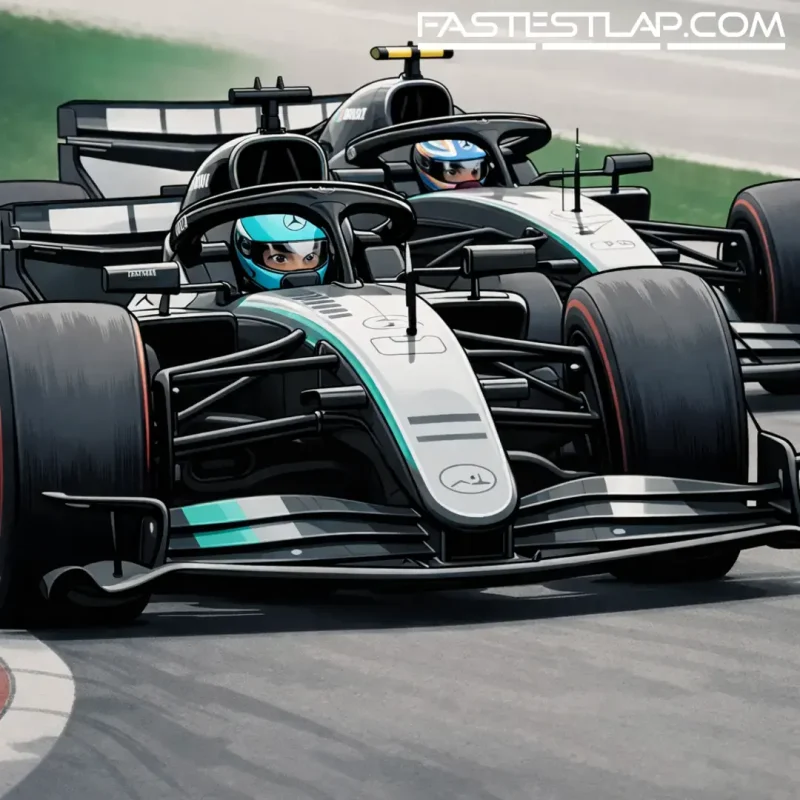
George Russell didn’t just lose a Canadian Grand Prix win in Montreal — he watched a season-defining points swing evaporate in silence as his Mercedes rolled to a stop from the lead.
A battery failure while controlling the race handed Kimi Antonelli the kind of break championships are built on. Instead of Russell dragging back chunks of the deficit, Antonelli left Canada with a 43-point cushion and Mercedes left with the awkward luxury problem of being dominant while one side of the garage keeps taking punches.
Toto Wolff’s read on it was blunt: if there’s anyone in that paddock you’d back to absorb a moment like this and come back swinging, it’s Russell.
“Things have been going against him in the last few races,” Wolff said after the race. “Today certainly would have been big points to collect. He was in the lead, but, if there’s one guy that I would choose in this paddock in terms of resilience and determination, that would be George.”
The context matters. Mercedes has started 2026 with a clean sweep — five races, five wins — and the W17 has looked like the best all-round package on the grid. But the internal scoreboard has tilted hard. Russell took the opener in Australia, Antonelli struck back immediately with his first F1 win in China, and since then the 19-year-old has rattled off Japan, Miami and now Montreal.
Some of that is pure execution from Antonelli, who’s been ruthlessly effective when the opportunities arrive. Some of it is that the margins have repeatedly cut Russell the wrong way.
Japan is the one that still stings because it’s the kind of race that ends up in end-of-season “what ifs”: a well-timed Safety Car turned a likely Russell win into an Antonelli-friendly scenario. Canada, though, was less about timing and more about fate — a straight mechanical failure while leading after a race-long scrap with his team-mate.
When Russell returned to the paddock he looked like a driver who’d just had the wind knocked out of him, talking about how “the gods don’t want him in this battle.” That’s not the language of someone making excuses; it’s the sound of someone doing everything asked and still watching the numbers get uglier.
And those numbers do matter. A 43-point gap this early doesn’t mathematically end anything — there’s still the bulk of the calendar to go, Wolff reckons 17 races remain — but it changes behaviour. It gives Antonelli space. If there are weekends where Russell has the sharper edge, Antonelli doesn’t need to force the issue; he can bank points, limit damage, and strike when the car and circumstance lean his way. In a year where Mercedes’ advantage has reduced the opportunities for rivals to steal big scores, that cushion becomes even more valuable.
Wolff, though, was clearly more interested in the psychological aftershocks than the arithmetic. He’s been around long enough to know the real danger isn’t the DNF itself — it’s the residue. The fraction of doubt that creeps in when a driver starts feeling like the sport is happening to him rather than through him.
“He’s had to overcome adversity previously, whether it’s from karting onwards to junior formulas, and he’s not gonna give up that fight,” Wolff said. His point was simple: nobody reaches Formula 1, let alone wins in it, without being hardened by setbacks. Russell’s route — years of proving himself, then enduring a stint in a struggling Williams before landing fully in the Mercedes picture — is basically a long apprenticeship in patience.
Wolff also stressed the part that will matter most to Russell when he replays Canada in his head: there wasn’t an error to pick apart. No missed apex, no poor tyre call, no clumsy wheel-to-wheel moment with Antonelli. Just a failure.
“There’s nothing he could have done more than what he did today,” Wolff said, suggesting that’s the mental foothold Russell can use to move on quickly. Wolff even noted they’d be travelling back together, giving them time to debrief properly away from the immediate noise.
Russell, for his part, tried to flip the story into something usable — a rare act of emotional triage from a driver who knows the championship narrative is running away from him.
“When I look at the Safety Car timing in Japan, breaking down in China Q3 fighting for pole, breaking down from the lead here today, but the pressure is off,” he said. “I’ll go out, enjoy every single race, try and win every single race, and I’ve got nothing to lose.”
There’s a lot packed into that. “Pressure is off” is what a driver says when the title fight starts to feel like it’s slipping beyond his control. But it can also be a release valve. If Russell genuinely gets to the point where he’s racing without the mental drag of the points table — just hunting wins and putting Antonelli under stress every time they’re on track together — then the dynamic inside Mercedes could sharpen quickly.
Because that’s the other truth about a season like this: dominance doesn’t remove tension, it concentrates it. When the car is good enough that the title is effectively a two-horse race within one team, every DNF and every Safety Car becomes amplified. Antonelli’s 43-point lead is big, but it isn’t immunity — not with this much season left and not with Russell clearly still carrying the pace to take wins when things finally go his way.
For now, Montreal will be filed as a Mercedes win and a Russell loss. The championship table won’t care how it happened. But the next few races will reveal something more interesting than raw points: whether Russell can turn that “nothing to lose” line into a genuine edge, and whether Antonelli can keep being the one who benefits when the sport deals its random hand.